What 'Fully Funded' Really Covers
The phrase 'fully funded' sounds like every rupee is taken care of, and for the biggest international scholarships it comes close. A true fully funded award typically covers your full tuition fees, a monthly living stipend for accommodation, food and local transport, and a return economy ticket from Pakistan. Many also include a settling-in allowance when you arrive, health insurance, and sometimes a thesis or research grant.
But 'fully funded' almost never means zero cost to you. Before the award starts, you pay for your English test, degree attestation, translations, courier charges, and the visa fee yourself — costs that can run into hundreds of thousands of rupees, so plan your finances as early as your essays.
The Flagship Scholarships Compared
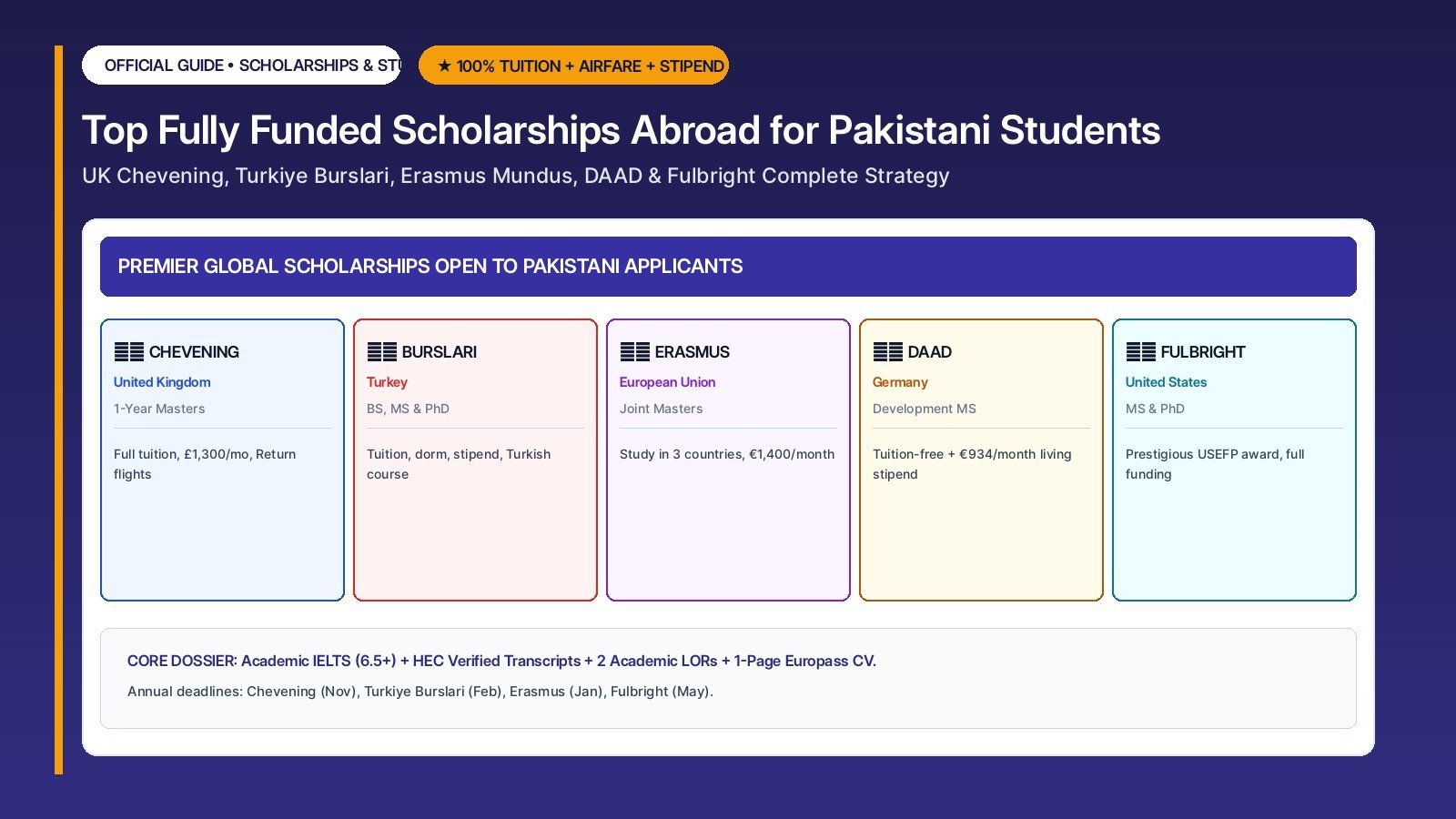
Six programs dominate the fully funded landscape for Pakistani students. Chevening rewards leadership and work experience, Turkiye Burslari welcomes undergraduates as well as postgraduates, Erasmus Mundus offers joint master's degrees across European universities, DAAD is Germany's academic powerhouse, Australia Awards focuses on development impact, and MEXT opens the door to Japan. Study the comparison table, then shortlist the two or three that fit your degree level and field.
Application windows shift slightly every year, so treat the months here as typical patterns and confirm current dates on each program's official portal. All figures are approximate — reviewed October 2026 — and you should always verify the current official figures before applying.
| Scholarship | Coverage | Degree Levels | Typical Application Window | Key Requirement |
|---|---|---|---|---|
| Chevening (UK) | Tuition, monthly stipend, return airfare, arrival allowance | One-year master's only | August to November | About two years of work experience and leadership potential |
| Turkiye Burslari (Turkiye) | Tuition, monthly stipend, return airfare, one-year Turkish language course, health insurance | Bachelor's, master's, PhD | January to February | Strong academics; age limits apply per degree level |
| Erasmus Mundus (EU) | Tuition, monthly living allowance, travel and installation costs | Joint master's programs | October to January (varies by program) | Admission to an Erasmus Mundus joint master's program |
| DAAD (Germany) | Tuition (often zero at public universities), monthly stipend, travel allowance, insurance | Master's, PhD | Varies by program; often August to October | About two years of relevant post-bachelor work experience |
| Australia Awards (Australia) | Tuition, living expenses, return airfare, establishment allowance, health cover | Bachelor's, master's, PhD | February to April | Commitment to return and serve Pakistan's development |
| MEXT (Japan) | Tuition, monthly stipend, return airfare, regional supplement | Undergraduate, master's, PhD, research students | April to May (embassy route) | Embassy screening with written tests and interview |
Your Year-Long Application Timeline
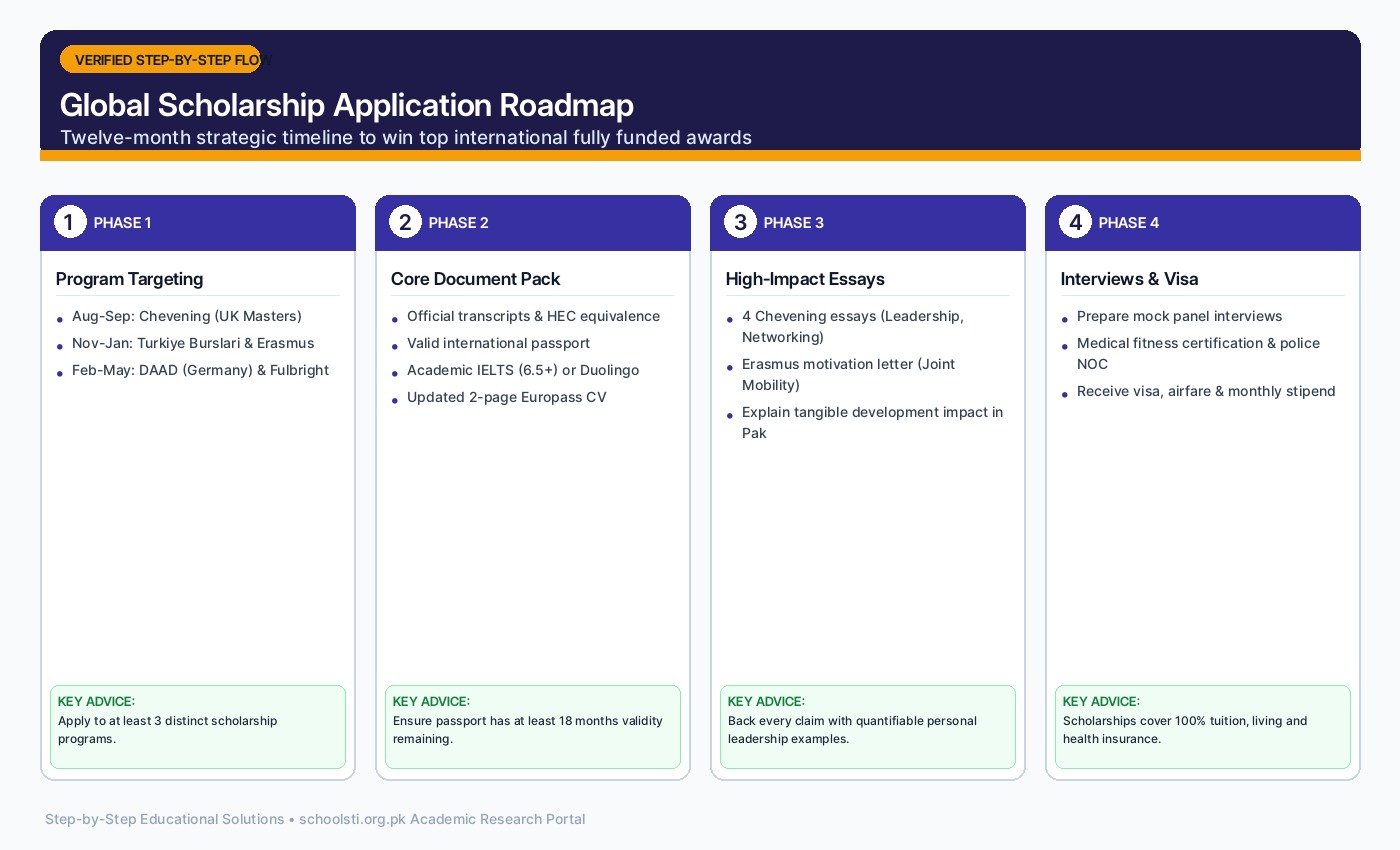
Winning a flagship scholarship is a twelve-month project, not a weekend task. The students who succeed almost always started a year early: researching programs, sitting their English test with time to retake it, and drafting essays over several months. Follow this timeline and adjust the months to match your target programs' typical windows.
- Months 12 to 10 before deadline: research and shortlist List every scholarship you qualify for with its degree levels, fields, age limits, and experience rules, then pick two or three targets. Reading past winners' profiles helps you judge your own competitiveness.
- Months 10 to 9: fix your documents Begin HEC attestation of degrees and transcripts now — queues and corrections take weeks. Renew your passport if it expires within two years, and request recommendation letters from people who know your work well.
- Months 9 to 7: take the English test Book IELTS or your programs' accepted test early enough to allow a retake. Most programs expect roughly band 6.5 to 7.5 — check each program's typical requirement and aim one band above the minimum.
- Months 7 to 5: draft your essays Draft your statement of purpose, study plan, and leadership essays over several rounds. Each must answer why this program, why this country, and why you — with concrete examples, not slogans. Get feedback from a teacher, senior, or mentor.
- Months 5 to 3: apply to universities where needed Erasmus Mundus and many DAAD programs require program admission first. Submit those university applications within their own deadlines, which often close before the scholarship deadline.
- Months 3 to 1: submit scholarship applications Complete each online form carefully, upload attested documents in the required format, and submit at least a week early. Portals slow down in the final days, and late submissions are not accepted.
- Deadline to decision: prepare for interviews Shortlisted candidates are usually interviewed two to four months after the deadline. Rehearse your study plan, career goals, and how you will use the degree in Pakistan. Dress formally and test your connection for online interviews.
- After selection: medical, visa and pre-departure Complete your medical, apply for the student visa, attend any pre-departure briefing, and arrange accommodation. Carry attested copies of every document when you travel.
Eligibility Checklist Before You Apply
Run through this checklist honestly before investing months of effort. Missing even one requirement usually means automatic rejection, however strong the rest of your profile.
- Nationality and residence: you must be a Pakistani citizen, and some programs require residence in Pakistan when you apply.
- Degree recognition: your degree must be from an HEC-recognized university, with attestation required before or soon after selection.
- Academic thresholds: many programs expect a strong division or CGPA — check that your percentage converts acceptably.
- Age limits: Turkiye Burslari and MEXT set age ceilings for undergraduate and some postgraduate categories.
- Work experience: Chevening expects about two years; several DAAD postgraduate courses expect two years after the bachelor's.
- English proof: an IELTS, TOEFL or equivalent score at the program's typical level, taken within its validity period.
- Return intent: Australia Awards and Chevening both expect you to return home for a set period after the degree.
If you miss one item, fix it and target the next cycle. A year spent gaining experience or improving your English is a year invested, not lost.
Costs You May Still Pay Yourself
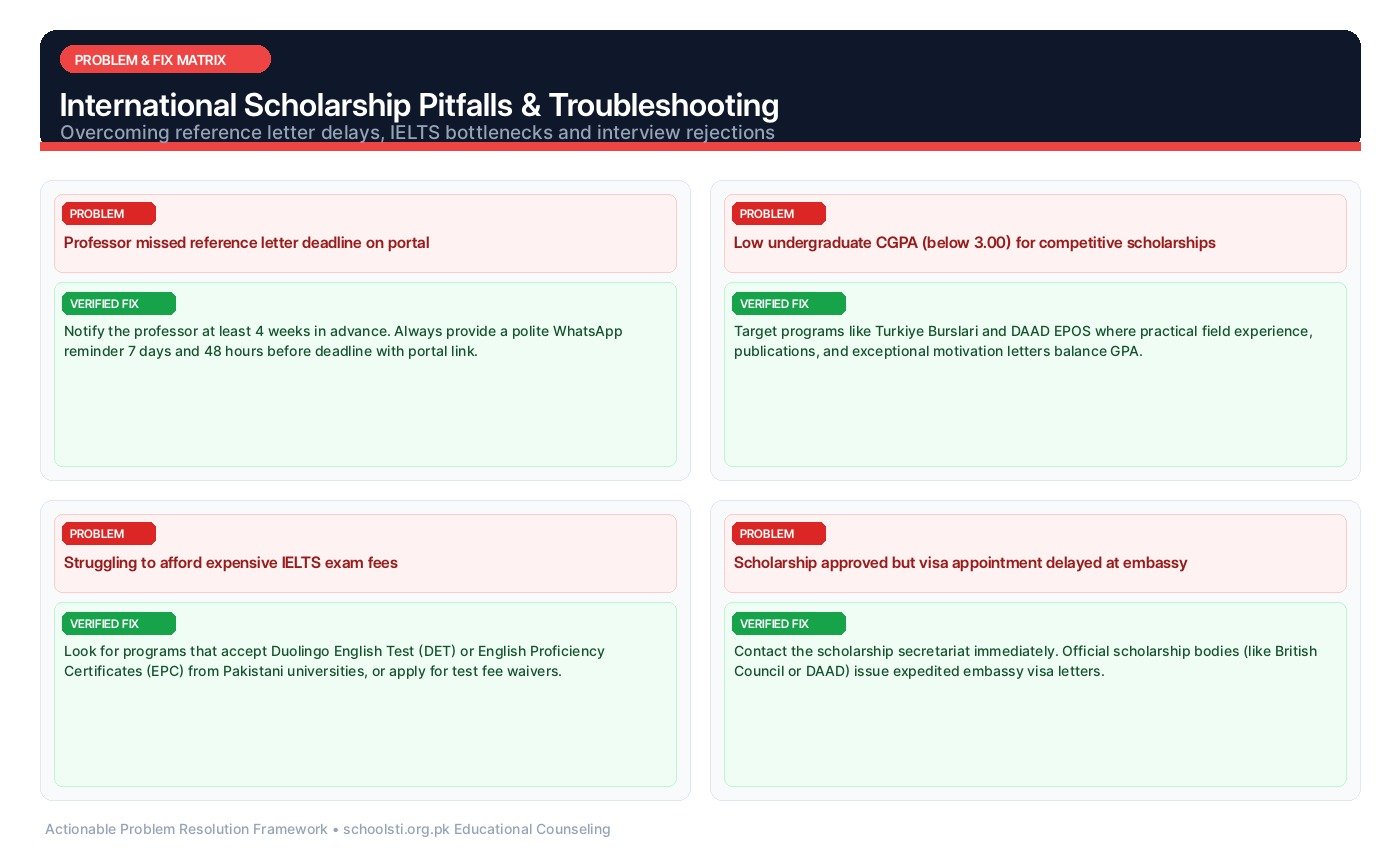
Even fully funded awards leave pre-departure costs with you. The table below gives approximate ranges in Pakistani rupees for realistic budgeting — rough estimates only, reviewed October 2026, so verify current official figures with the test centers, HEC, and embassies.
| Expense | Approximate Cost (PKR) | Notes |
|---|---|---|
| IELTS test fee | Approximately 70,000 to 90,000 | Per attempt; budget for a possible retake |
| HEC degree attestation | Approximately 1,000 to 5,000 per document | Varies by document type; courier adds more |
| Passport issuance or renewal | Approximately 5,000 to 15,000 | Depends on pages and urgent versus normal processing |
| Student visa application fee | Approximately 80,000 to 200,000 | Varies widely by country; UK and Australia are at the higher end |
| Medical examination | Approximately 15,000 to 40,000 | Panel-physician medicals required by several countries |
| Initial settling costs | Approximately 100,000 to 250,000 | Warm clothing, laptop, and expenses before the first stipend arrives |
Troubleshooting: Common Student Problems & Verified Solutions
Real-world issues reported by Pakistani applicants and students, with actionable step-by-step solutions:
⚠️ Problem: You missed the application deadline.
✅ Verified Solution: Flagship scholarships run on strict annual cycles, so a missed deadline usually means waiting a full year. Use the time well: improve your English score, gain work experience, and draft essays early so your next application is far stronger. Set reminders for the month applications typically open.
⚠️ Problem: Your essays and statement of purpose feel weak.
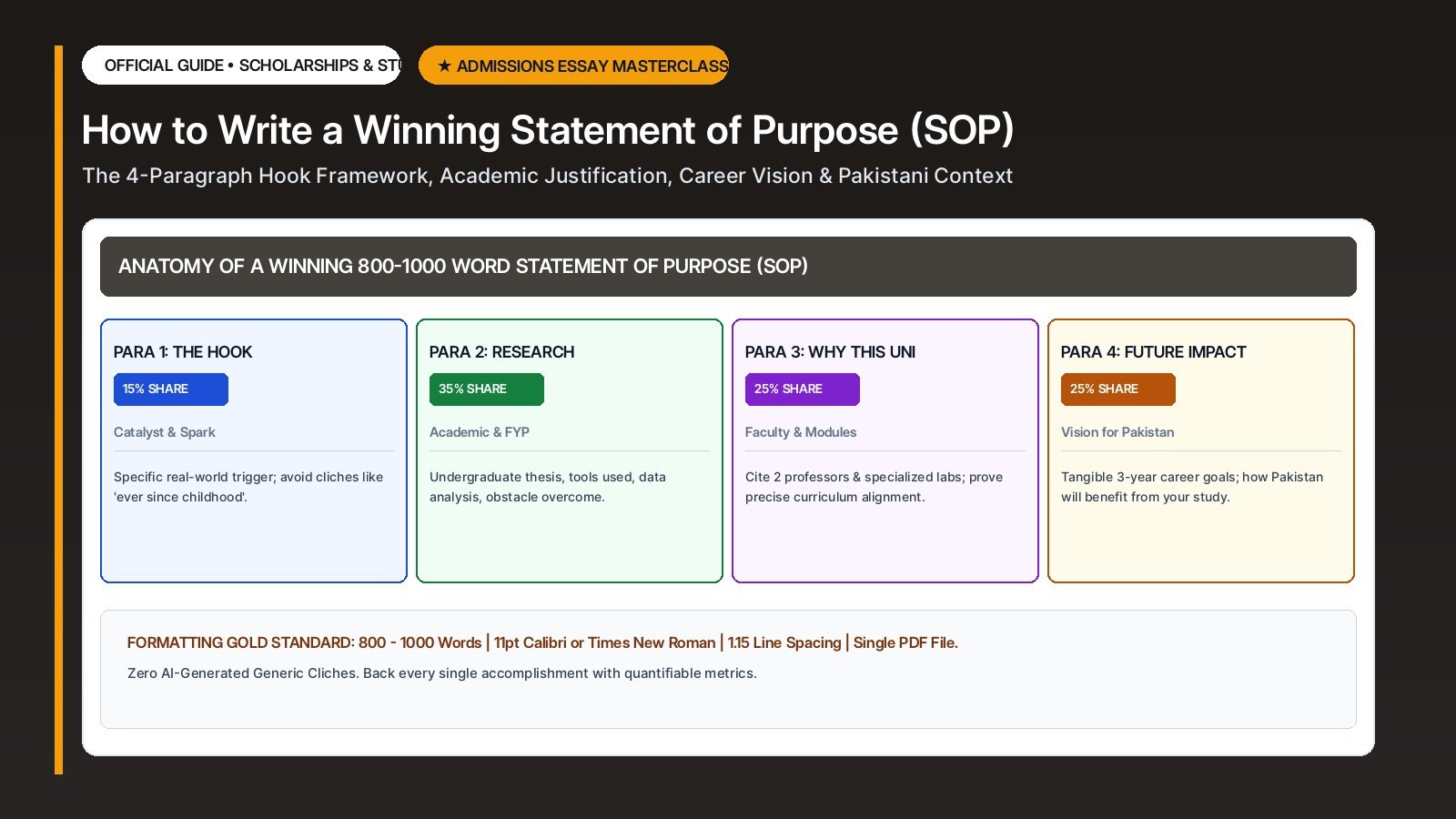
✅ Verified Solution: Weak essays are vague — claims like 'I am passionate' with no evidence. Rewrite each claim as a concrete story: what you did, what changed, what you learned. Ask two people who know your work to review the drafts, and see our SOP guide for a paragraph-by-paragraph structure.
⚠️ Problem: Your IELTS score falls short of the requirement.
✅ Verified Solution: Find which module drags your band down — often writing or speaking — and train it specifically for four to six weeks before retaking. Many candidates gain a full band this way. Book early so the new score arrives before the deadline.
⚠️ Problem: Your application was rejected. Should you reapply?
✅ Verified Solution: Yes — reapplying is normal, and many winners succeeded on a second or third attempt. Request feedback if offered, then fix the weakest part of your profile: scores, experience, essays, or interview performance. Keep your old application to show clear improvement.
⚠️ Problem: Your degree is not recognized or attestation is stuck.
✅ Verified Solution: First confirm your university and campus are HEC-recognized. Fix any name or date mismatches through your university before approaching HEC. Start at least six months before deadlines, and keep receipts and tracking numbers for every submission.
⚠️ Problem: You lack the two years of work experience Chevening requires.
✅ Verified Solution: Count internships, part-time roles, volunteer leadership, and freelance work — Chevening accepts a broad definition of experience. If still short, target Turkiye Burslari or Erasmus Mundus, which weigh academics more, and reapply to Chevening once your experience is complete.
Frequently Asked Questions (FAQ)
Clear, direct answers to common questions about Top Fully Funded Scholarships for Pakistani Students Abroad (Chevening, Turkiye Burslari, Erasmus Mundus):