What the PEEF Scholarship Is and Who Runs It
The Punjab Educational Endowment Fund — PEEF — is a Government of Punjab initiative that awards scholarships to talented students who cannot afford their education. Unlike one-time charity, it is a structured, recurring program: every year, partner colleges, universities, and institutions across Punjab nominate deserving students, and PEEF releases stipends to support them through their studies.
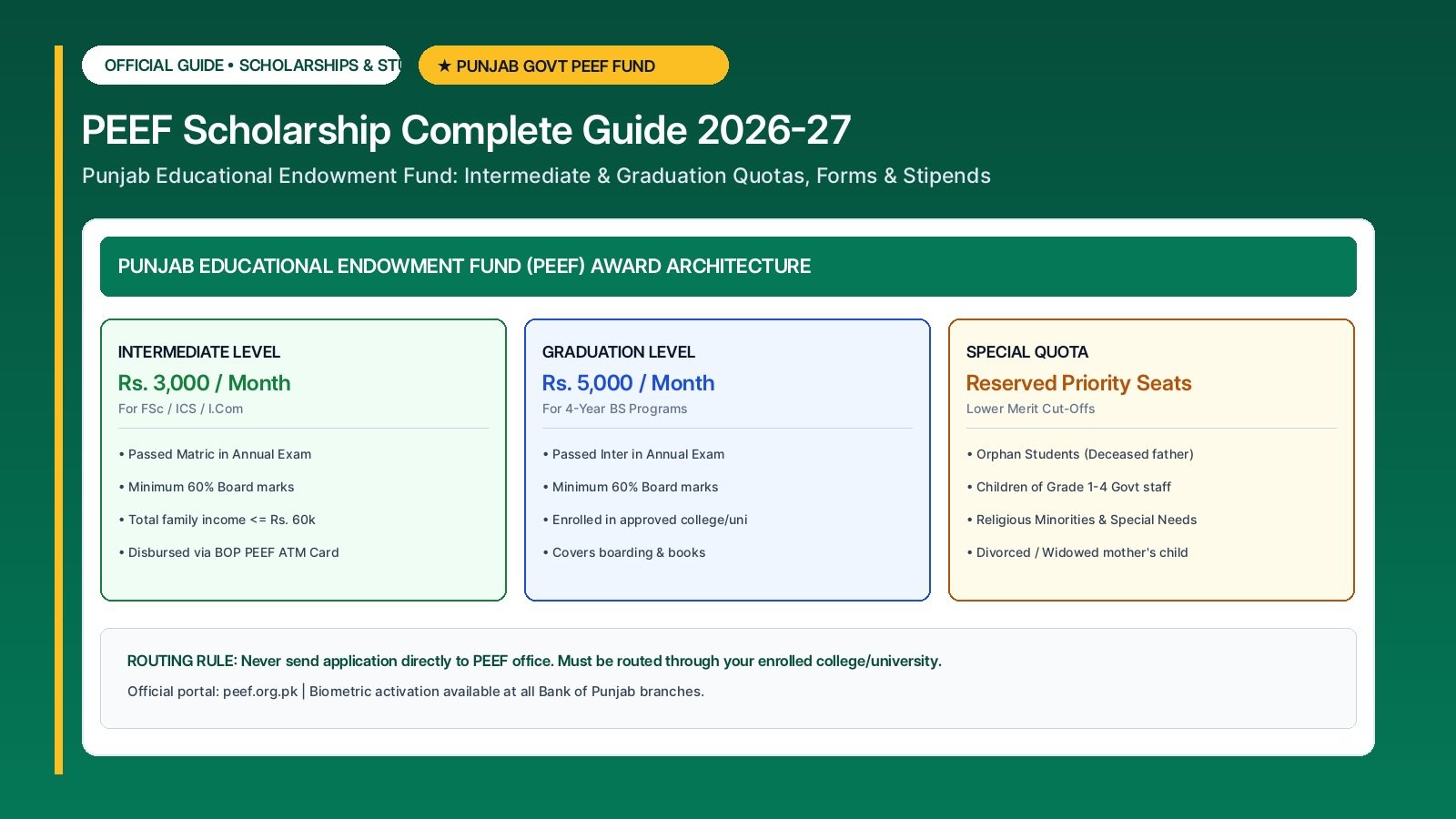
PEEF covers three academic levels — intermediate, graduation, and master's — and reserves special quotas for students in difficult circumstances: orphans, students from minority communities, children of government servants in lower pay scales, special (disabled) students, children of martyrs, and children of divorced or widowed females. This makes it one of the most inclusive scholarship programs in the province.
The scholarship is merit-cum-need: you must have strong marks in your last board or university examination, and your family income must fall below the published ceiling. Applications are routed through your own institution, not sent directly to PEEF's head office — a point many first-time applicants get wrong.
PEEF Scholarship Categories and Approximate Monthly Stipends
The table below shows the main categories and the approximate monthly stipend each level carries. Figures marked with an asterisk are indicative ranges only — PEEF revises amounts and quotas from time to time, so verify the current official figures on the PEEF website or your institution's notice board; reviewed October 2026.
| Category | Study level covered | Approximate monthly stipend* |
|---|---|---|
| Intermediate scholarship | FA, FSc, ICS, ICom and equivalent programs | Approximately PKR 2,000 to 3,000 per month* |
| Graduation scholarship | BA, BSc, BS, BBA and equivalent programs | Approximately PKR 3,000 to 5,000 per month* |
| Master's scholarship | MA, MSc, MS and equivalent programs | Approximately PKR 5,000 to 8,000 per month* |
| Special quotas | All levels — orphans, minorities, children of government servants, special students, children of martyrs, children of divorced or widowed females | As announced in the quota package* |
Eligibility Criteria: The Five Conditions You Must Meet
PEEF applies its criteria strictly. Check all five before you apply:
- Punjab domicile — you must hold a domicile of a Punjab district. This is the single most common reason for rejection among otherwise strong applicants.
- Minimum marks — typically at least 60 per cent marks in your last board or university annual examination. The exact cutoff is announced with each cycle, so verify the current criterion; reviewed October 2026.
- Family income below the ceiling — your parents' or guardians' combined monthly income must fall below the published low-income ceiling. The ceiling is revised periodically — verify the current official figure; reviewed October 2026.
- Full-time regular enrollment — you must be enrolled as a regular (not private) student at a PEEF partner institution for the relevant level.
- No other scholarship — you must not be receiving any other scholarship or stipend for the same program.
For special quotas, you must additionally provide the relevant proof — for example, a death certificate of the parent for the orphan quota, or a disability certificate for the special students quota. The accepted documents for each quota are listed in the FAQs below.
| PEEF Category | Academic Level | Minimum Board Marks | Monthly Stipend | Payment Mode & Disbursement |
|---|---|---|---|---|
| Intermediate Level (Day Scholar) | 11th & 12th Class (FSc/ICS) | 60% Marks in Matric | Rs. 1,500 / Month | BOP PEEF ATM Card (Quarterly transfer) |
| Intermediate Level (Boarder) | 11th & 12th Class (Hostel) | 60% Marks in Matric | Rs. 3,000 / Month | BOP PEEF ATM Card (Quarterly transfer) |
| Graduation Level (Day Scholar) | 4-Year BS Degree Programs | 60% Marks in Intermediate | Rs. 3,500 / Month | Direct bank account transfer via Bank of Punjab |
| Graduation Level (Boarder) | 4-Year BS Degree Programs | 60% Marks in Intermediate | Rs. 5,000 / Month | Direct bank account transfer via Bank of Punjab |
| Special Quota (Orphans/Grade 1-4) | Inter & Graduation Levels | Special lower merit cut-offs | Full prescribed level stipend | Dedicated priority processing queue |
Step-by-Step: How to Apply for the PEEF Scholarship
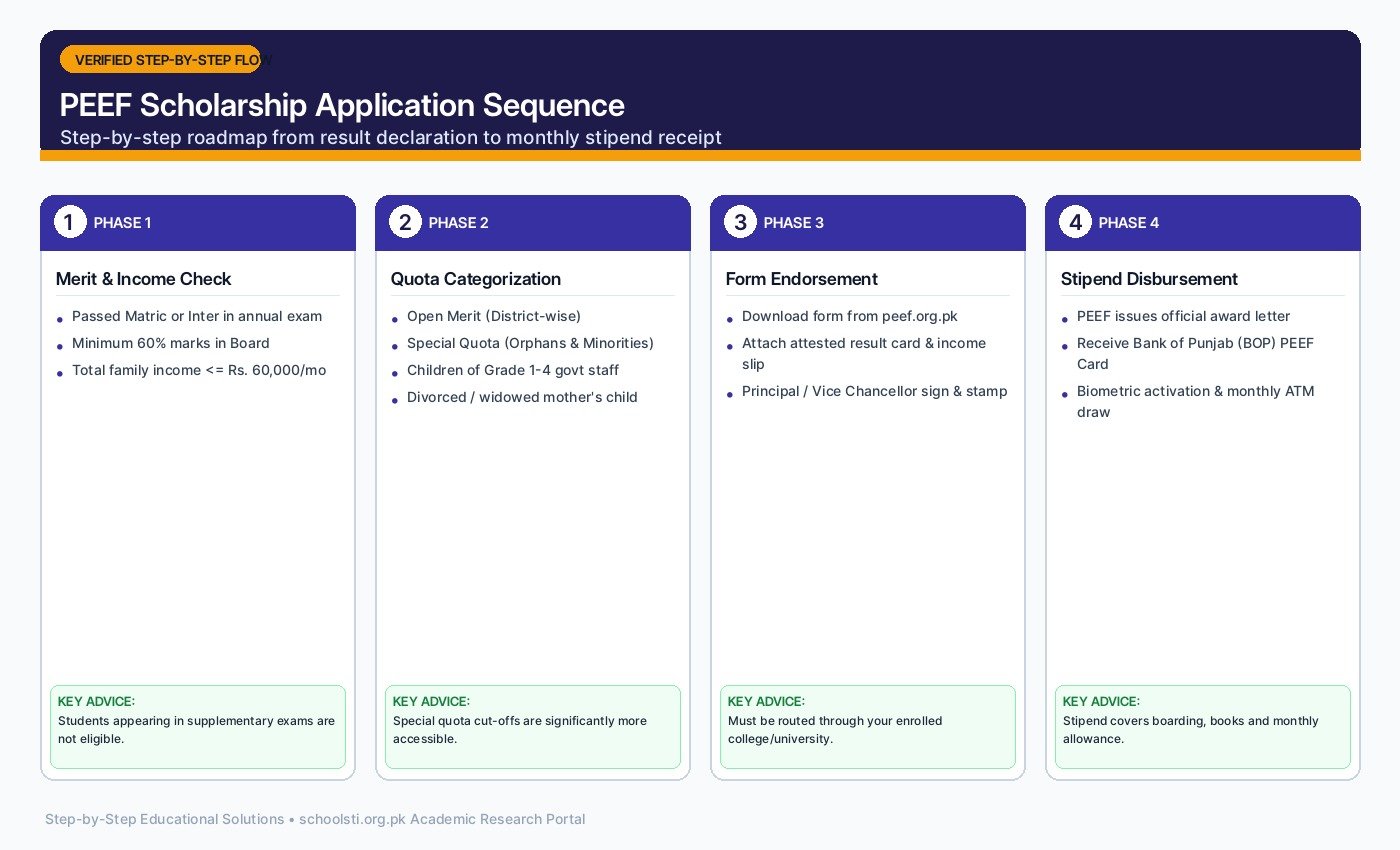
PEEF applications move through your institution — the college or university you study in — not through a direct online portal to PEEF. Follow these steps in order.
- Watch for the announcement at your institution PEEF announces scholarships through partner institutions each year. Check your college or university notice board, the institution's website, and class announcements in the first weeks of the academic session. Do not wait for a newspaper advertisement — the internal deadline at your institution comes first.
- Collect the application form Get the prescribed PEEF application form from your institution's scholarship or student affairs office. Fill it in carefully and double-check the spellings of your name and your father's name against your CNIC and result card — mismatches cause verification delays.
- Prepare your documents Attach attested copies of your result card or DMC showing the required marks, your Punjab domicile certificate, your CNIC or B-form, your father's or guardian's CNIC, an income certificate or affidavit proving family income, recent photographs, and — for special quotas — the relevant proof document such as a death certificate or disability certificate.
- Get the income certificate right The income certificate is the most scrutinised document in the file. For salaried parents, attach salary slips; for retired government servants, the pension book; for business or informal work, an income affidavit on stamp paper. Deliberately understating income is fraud and leads to cancellation of the award.
- Submit to your institution before the internal deadline Hand your complete file to the designated office at your institution and take a receiving stamp or acknowledgement. Late or incomplete files are not forwarded to PEEF. Keep one full photocopy set of everything for yourself.
- Institutional shortlisting and PEEF approval Your institution's committee verifies documents, shortlists candidates against the criteria, and forwards nominations to PEEF. PEEF's board gives the final approval and issues award letters through the institution — so all updates reach you via your college or university, not directly.
- Receive the award and arrange disbursement Once approved, the stipend is released according to the announced schedule — usually through your institution or into a bank account in your name. Open or activate your bank account early so payments are not held up by inactive-account issues.
Renewal, Disbursement and Keeping Your PEEF Scholarship
A PEEF scholarship continues year to year, but it is not automatic. Each year you must submit a continuation or renewal form with your latest result, and your institution confirms that you still meet the marks, attendance, and income conditions. Students who drop below the required performance or stop attending regularly lose the award.
Disbursement follows an official schedule after PEEF releases funds to institutions — small delays of a few weeks are common at the start of a session, so do not panic if the first installment arrives late. Keep your bank account active and your contact number updated with the institution's focal person so payment messages reach you.
If you change institution, inform both your old and new institution immediately. Transfers are possible between partner institutions subject to approval, but a gap in enrollment or an unreported move can suspend your payments.
Troubleshooting: Common Student Problems & Verified Solutions
Real-world issues reported by Pakistani applicants and students, with actionable step-by-step solutions:
⚠️ Problem: My domicile is from another province — can I still apply?
✅ Verified Solution: PEEF's general categories require Punjab domicile, so applicants from other provinces are not eligible for the main quotas. Check whether your own province runs a similar endowment fund — several do — and ask your institution about federal or HEC need-based options that accept students from all provinces.
⚠️ Problem: My marks are just below the 60 per cent cutoff
✅ Verified Solution: The cutoff is applied strictly and there are no exceptions for near-misses. Focus on your current year's examinations — if you cross the required marks in the next annual result, you can apply in the following cycle. Do not submit a weak application hoping for leniency; it will simply be rejected.
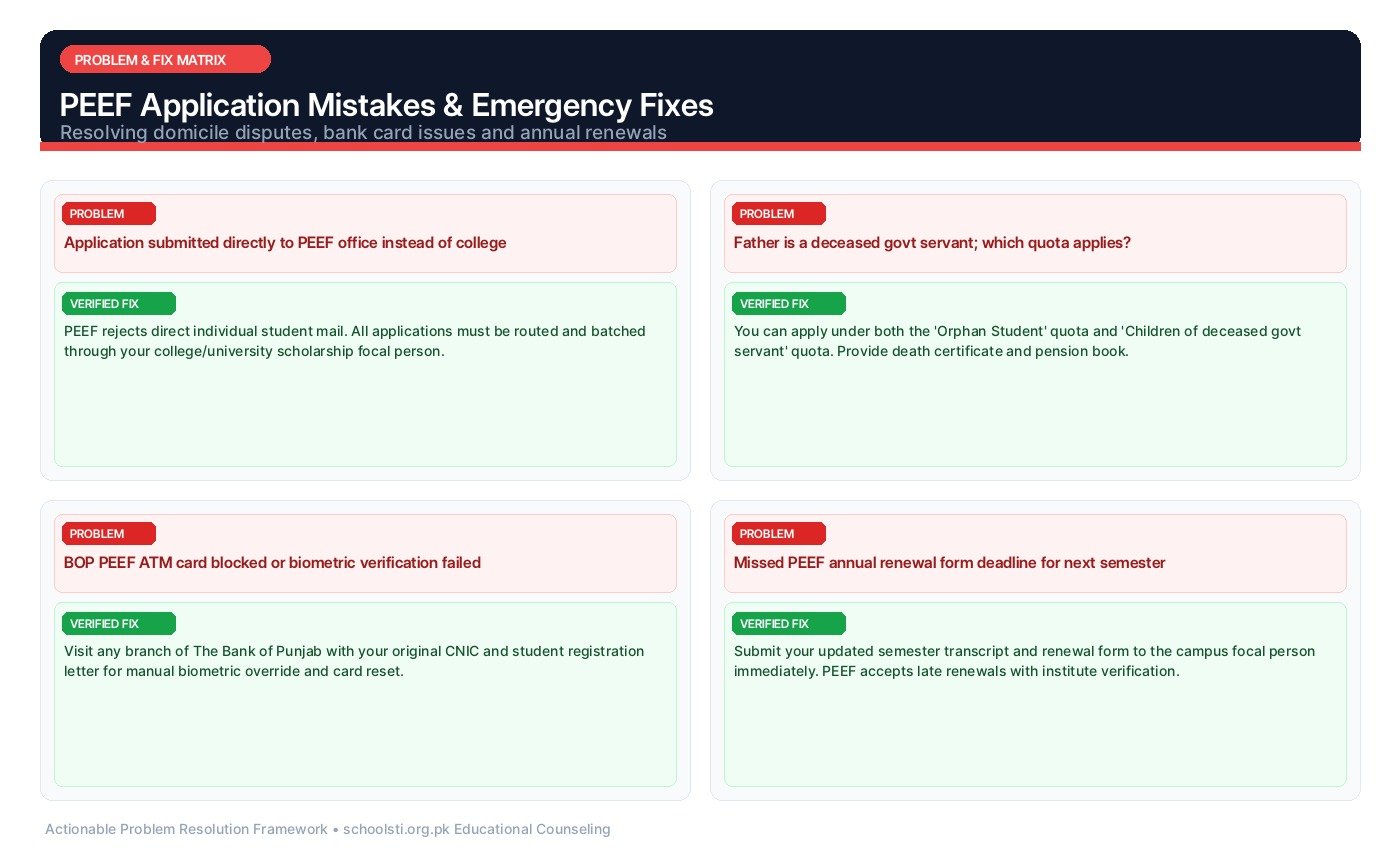
⚠️ Problem: I sent my application directly to PEEF's head office
✅ Verified Solution: PEEF does not accept direct applications from students — files must come through your institution's committee. Retrieve your file if possible and submit it properly through your college or university before its internal deadline. A direct submission will not be processed.
⚠️ Problem: My stipend has not arrived months after the award
✅ Verified Solution: First confirm with your institution's focal person that your name is on the approved list and that your bank account details are correct and active. Disbursement happens in batches after fund release, so short delays are normal — but if an entire installment cycle has passed, ask the focal person to raise the matter with PEEF through official channels.
⚠️ Problem: What do I need to do to renew the scholarship next year?
✅ Verified Solution: Submit the continuation form with your new result card, updated income proof if asked, and attendance confirmation from your department. You must still meet the marks and income conditions. Missing the renewal deadline is treated as withdrawal — mark the date as soon as your institution announces it.
⚠️ Problem: I am changing my college or university mid-degree
✅ Verified Solution: Inform the scholarship focal persons at both institutions in writing before you move. Your scholarship can usually transfer if the new institution is also a PEEF partner and you still meet the criteria, but the transfer needs approval — an unreported move can freeze your stipend until the record is corrected.
Frequently Asked Questions (FAQ)
Clear, direct answers to common questions about PEEF Scholarship Complete Guide: Eligibility Criteria, Stipend Amount & Application Forms: