What an SOP Is and What Admission Committees Look For
A statement of purpose is a short essay — typically 500 to 1000 words, though you must check each university's own limit — explaining who you are, what you have studied and achieved, why you want this particular program, and where you plan to go after it. It is the only part of your application in your own voice, which is why committees read it carefully.
Tutors reading hundreds of SOPs ask four questions: can this applicant write and think clearly? Is there real evidence behind the claims — projects, grades, internships? Does the applicant understand what our program actually teaches, or is this generic? Are the career goals believable and connected to the degree? Concrete detail on all four wins; adjectives and slogans lose.
For Pakistani students there is an extra layer: committees abroad may not know your university, so briefly explain what matters — your major, thesis topic, and rank — instead of assuming they will look it up.
The Winning Structure, Paragraph by Paragraph
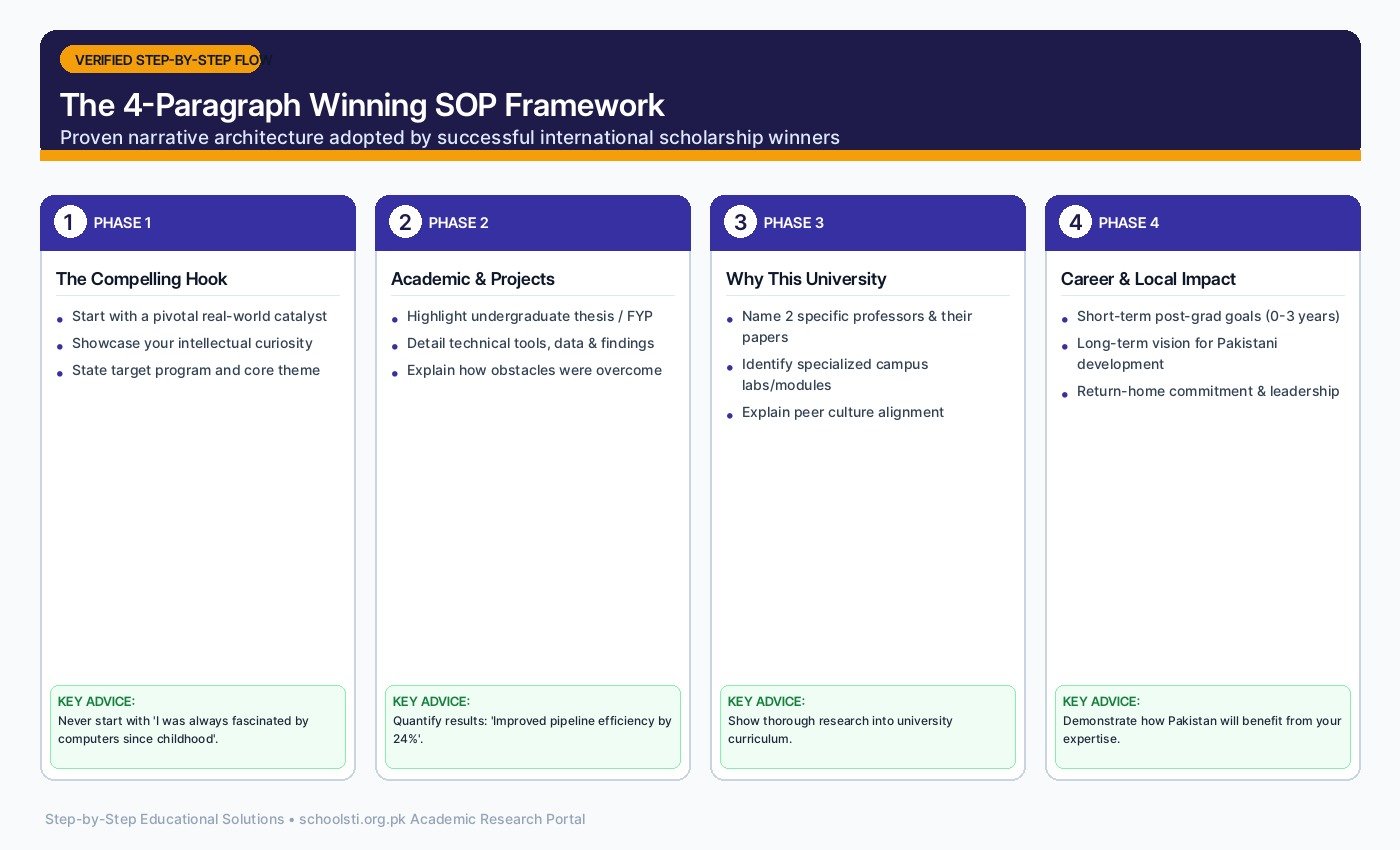
A strong SOP is a structured argument, not creative writing. Follow these seven moves in order, giving each its own paragraph or two. The fictional sample below shows the target tone: specific, honest, forward-looking.
Example paragraph (fictional student, illustrative only): Growing up in Multan, I watched small textile exporters in my father's circle lose orders because they could not read their own cost data. In my BBA at a public university in Punjab, I chose every analytics elective available and built my final-year project on inventory forecasting for a local garment unit, cutting their stock-outs by a fifth in the trial month. That project convinced me that data skills, applied to real businesses, are what Pakistan's SME sector is missing — and it is why I am applying to your MSc in Business Analytics.
The sample gives a concrete origin, specific academic choices, a measurable result, and a direct link to the program. Now build your own SOP with the steps below.
- Paragraph 1: the hook and your direction Open with the specific moment, problem, or curiosity pointing you toward this field, then state plainly which program you are applying to and why. Two to four sentences suffice — the hook earns attention, but the argument wins admission.
- Paragraphs 2 to 3: academic background Summarize your degree, major subjects, and the two or three most relevant courses or achievements. Mention your thesis or final-year project with its topic and one concrete outcome. If grades dipped in a semester, address it briefly and factually here.
- Paragraphs 3 to 4: relevant experience and projects Describe internships, jobs, freelance work, volunteer roles, or independent projects linked to the program. For each, say what you did, what skill it built, and what resulted — numbers beat adjectives every time.
- Paragraph 5: why this program, this university, this country This is the fit paragraph — the most important one. Name specific courses, research groups, labs, or faculty matching your interests, and explain why this country's approach suits your goals. The committee should feel this SOP could only have been written for them.
- Paragraph 6: career goals, short term and long term State your plans for the first two to three years after graduation and where you aim to be in ten. Keep goals ambitious but believable, and connect them to Pakistan where natural — panels value applicants with a clear plan for their degree.
- Paragraph 7: the closing End with two or three confident sentences tying your background to the program and restating your commitment, plus a brief thanks. Do not introduce new information here.
- Polish: read aloud and cut ruthlessly Read the full draft aloud to catch awkward sentences, then cut every sentence that adds no evidence or argument. Check the word count against the limit, and have at least one other person read it before submission.
Common Mistakes: Do's and Don'ts
Most rejected SOPs fail for the same handful of reasons. Use this table as a final checklist — if your draft breaks any rule in the left column, rewrite that part.
| Do | Don't |
|---|---|
| Open with a specific experience or problem that led you to the field | Open with a dictionary definition, a famous quotation, or 'Since I was a child...' |
| Back every claim with concrete evidence: projects, grades, roles, results | Praise yourself vaguely: 'I am hardworking, passionate, and dedicated' |
| Name specific courses, labs, or faculty at the target university | Send the identical SOP to every university with only the name changed |
| Explain gaps or low grades briefly and factually, then move on | Hide weaknesses and hope nobody notices, or write paragraphs of excuses |
| Keep the tone professional, confident, and honest | Exaggerate or invent achievements — verification checks happen |
| Stay within the word limit and answer the exact prompt given | Write 1,500 words for a 500-word limit, or answer a different question than asked |
| Mention financial hardship only if the prompt asks or it shaped your goals | Build the essay around hardship without linking it to academic purpose |
Tailoring Your SOP: University Applications vs Scholarship Essays
A university SOP and a scholarship essay are cousins, not twins. The SOP argues academic fit: why this program's curriculum matches your background and goals. The scholarship essay argues impact and character: why investing in you serves the mission.
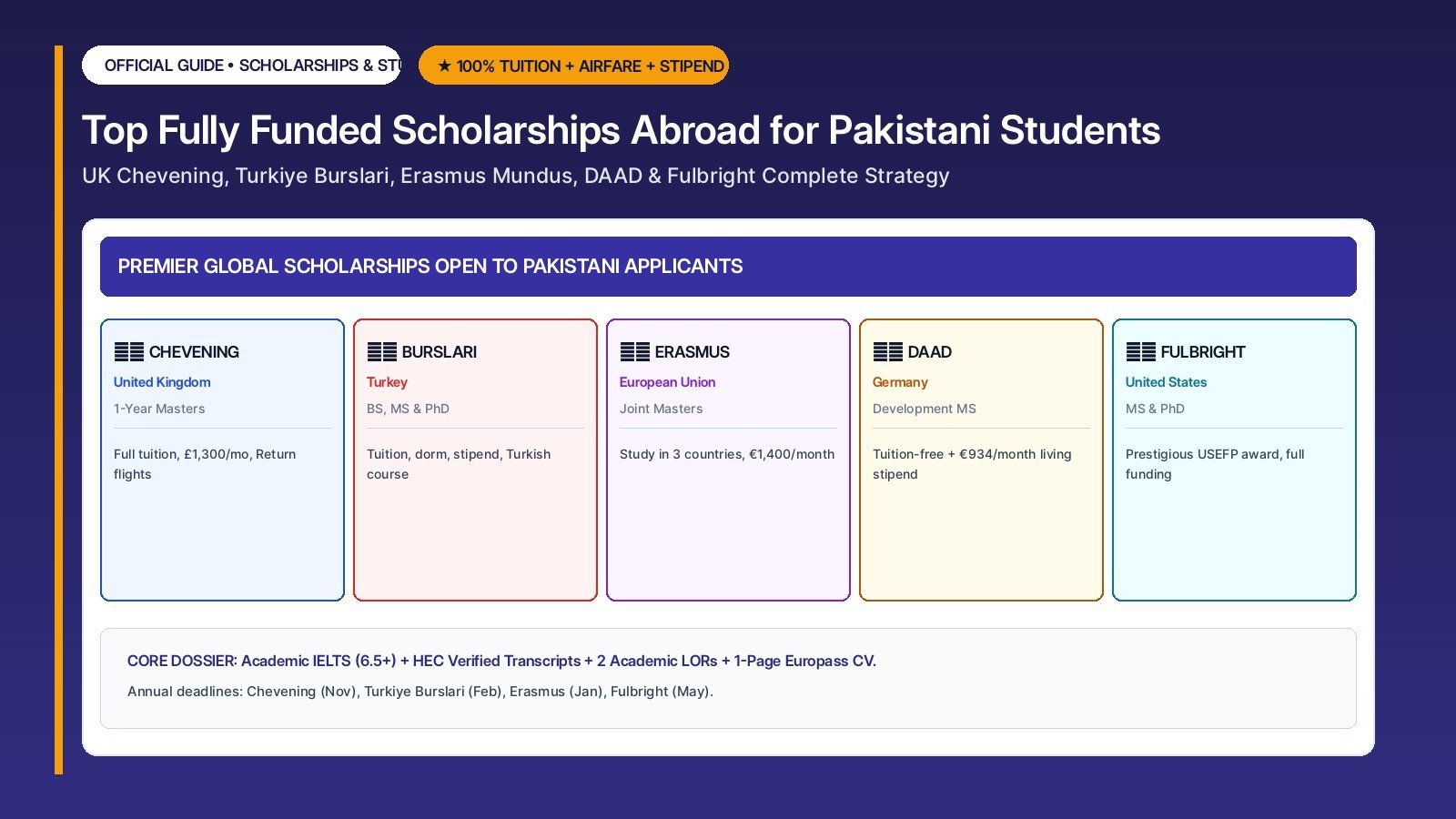
Chevening is the clearest example: instead of one general SOP, it asks four separate essays on leadership, networking, study plans, and career goals, each with a strict word limit. Leadership means real examples of influencing people or driving change, not a title once held. Turkiye Burslari and MEXT likewise want to hear why you chose their country and how the degree connects to your future contribution.
The practical method: write one strong master draft, then reshape it per target. Re-read each exact prompt, adjust the fit paragraph with program-specific details, and rebalance the emphasis — more academics for the university, more leadership and impact for the scholarship. Never submit the same file twice.
Word Length, Formatting, and Final Polish
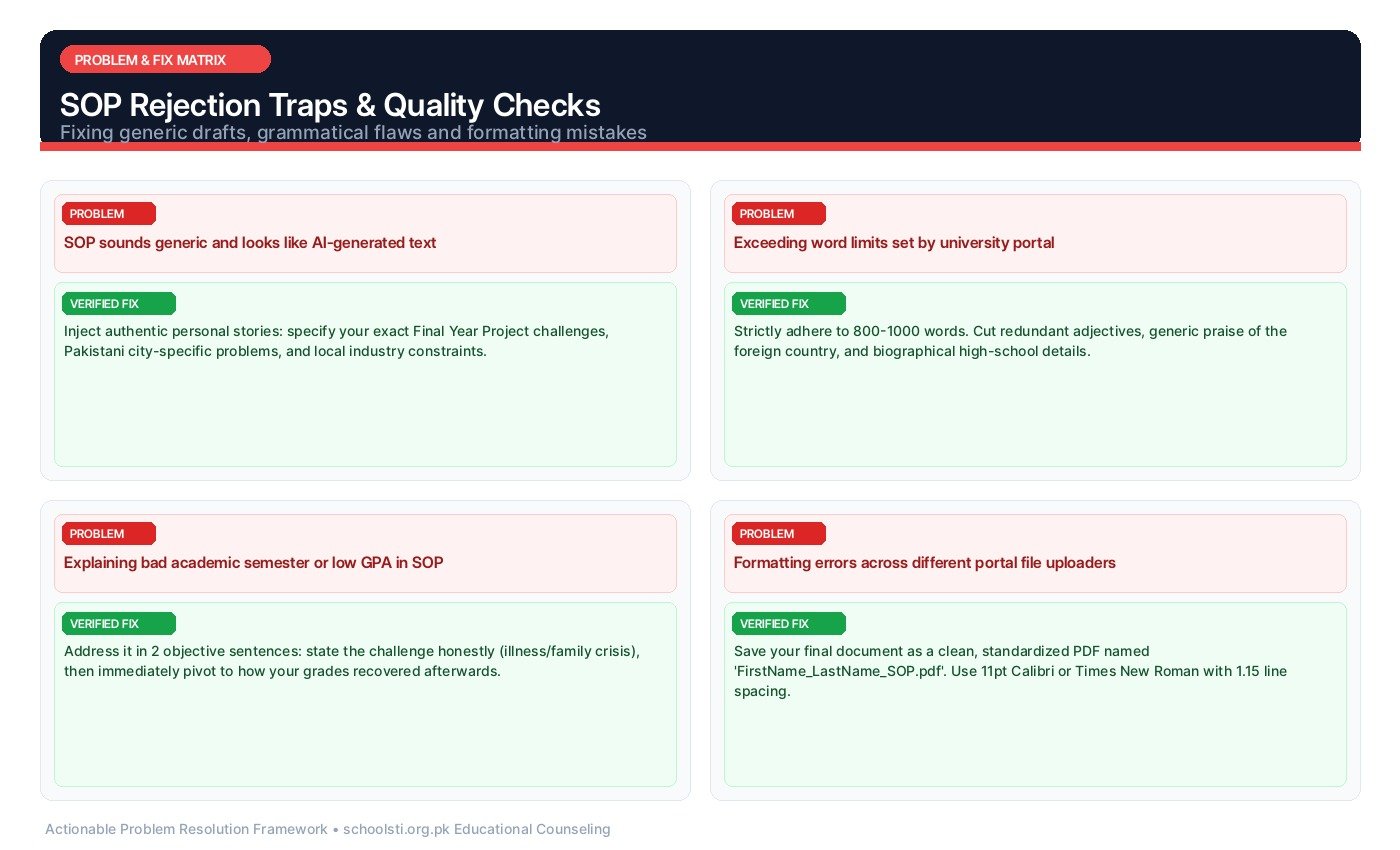
A typical SOP runs 500 to 1000 words, but the only number that matters is on the application page. Some programs cap at 500 words, others allow two pages, and scholarship essays set per-question limits. Going over signals you cannot follow instructions — trim until you fit.
Format simply: a readable font, sensible margins, and your name plus the program name in a header or footer in case pages separate. Save as PDF unless the portal asks otherwise, with a professional file name like YourName_SOP_ProgramName.pdf.
For the final polish, check three things. First, accuracy: every university, program, and professor name spelled correctly — a wrong university name instantly looks careless. Second, flow: each paragraph leading into the next. Third, language: correct grammar and varied sentences, without thesaurus-speak. Then submit a day or two early, since portals slow near deadlines.
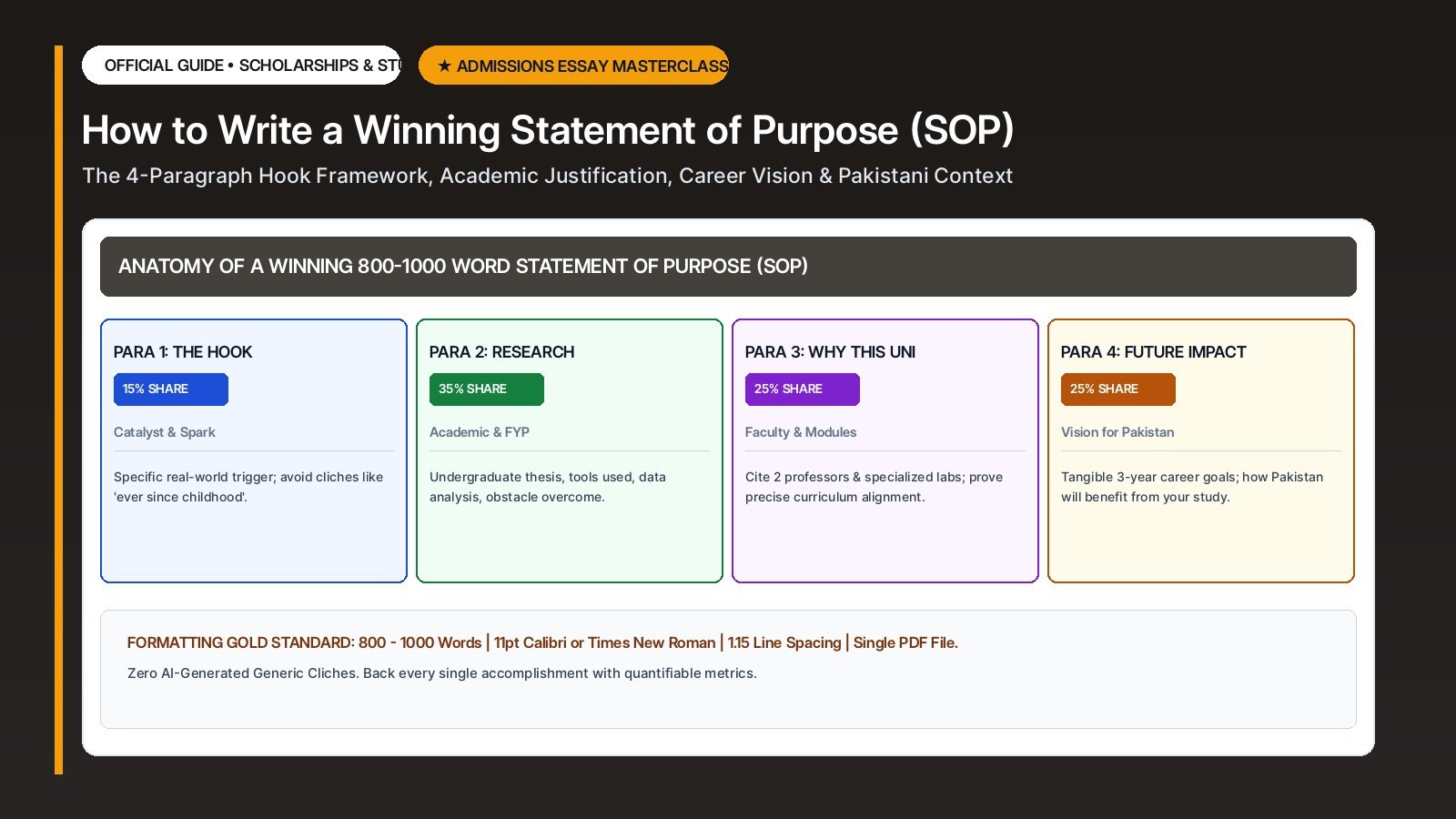
| SOP Component | Recommended Length | Primary Objective | What to Include | Fatal Error to Avoid |
|---|---|---|---|---|
| Paragraph 1: The Hook | 120 - 150 Words | Engage the admissions committee | Specific real-world trigger & research focus | Cliche: "Ever since childhood I loved computers" |
| Paragraph 2: Academic Background | 250 - 300 Words | Demonstrate technical competence | Final Year Project, tools used, data findings | Listing courses without showing practical results |
| Paragraph 3: Why This University | 200 - 250 Words | Prove deliberate institutional fit | Name 2 specific professors, labs & specialized electives | Copy-pasting generic praise of university rankings |
| Paragraph 4: Career & Vision | 180 - 200 Words | Articulate return on investment | Concrete 3-year career goals & impact in Pakistan | Vague promises like "I want to help poor people" |
Troubleshooting: Common Student Problems & Verified Solutions
Real-world issues reported by Pakistani applicants and students, with actionable step-by-step solutions:
⚠️ Problem: Your SOP sounds generic, like a template.
✅ Verified Solution: Generic SOPs come from abstract claims with no stories. Force one concrete detail into each paragraph: a project name, course code, professor's research area, a number. If a sentence could appear in anyone's SOP, rewrite it until it could only be yours.
⚠️ Problem: You have no research experience to write about.
✅ Verified Solution: Research is only one kind of evidence. Course projects, internships, freelance work, volunteer teaching, and a solid final-year project all count. Describe what you did and learned — committees value initiative and analytical thinking, not just published papers.
⚠️ Problem: Your English writing feels weak.
✅ Verified Solution: Clear and simple beats fancy and wrong. Write short sentences, use plain words, and run a free grammar checker. Then ask an English teacher, a senior, or a strong-English friend to review it — two careful readers catch most problems.
⚠️ Problem: The word limit is far shorter than your draft.
✅ Verified Solution: Cut in layers: remove repeated ideas, keep only the strongest example per point, then tighten sentences word by word. For a 500-word limit, aim for 480 — a short, sharp essay beats a cramped, over-limit one.
⚠️ Problem: No professor is available to review your SOP.
✅ Verified Solution: Ask a senior who studied abroad, an internship mentor, or a college teacher. Pakistani applicant communities also run peer-review exchanges. Even one careful outside reader dramatically improves a draft.
⚠️ Problem: You worry about plagiarism or AI-detection flags.
✅ Verified Solution: Write from your own experiences in your own words, using AI tools only for grammar checks or brainstorming — never to generate paragraphs. Keep your drafts to show the essay evolved through your own revisions if ever questioned.
Frequently Asked Questions (FAQ)
Clear, direct answers to common questions about How to Write a Winning Statement of Purpose (SOP) for Foreign Universities (With Sample Structure):