Two Need-Based Schemes, One Goal
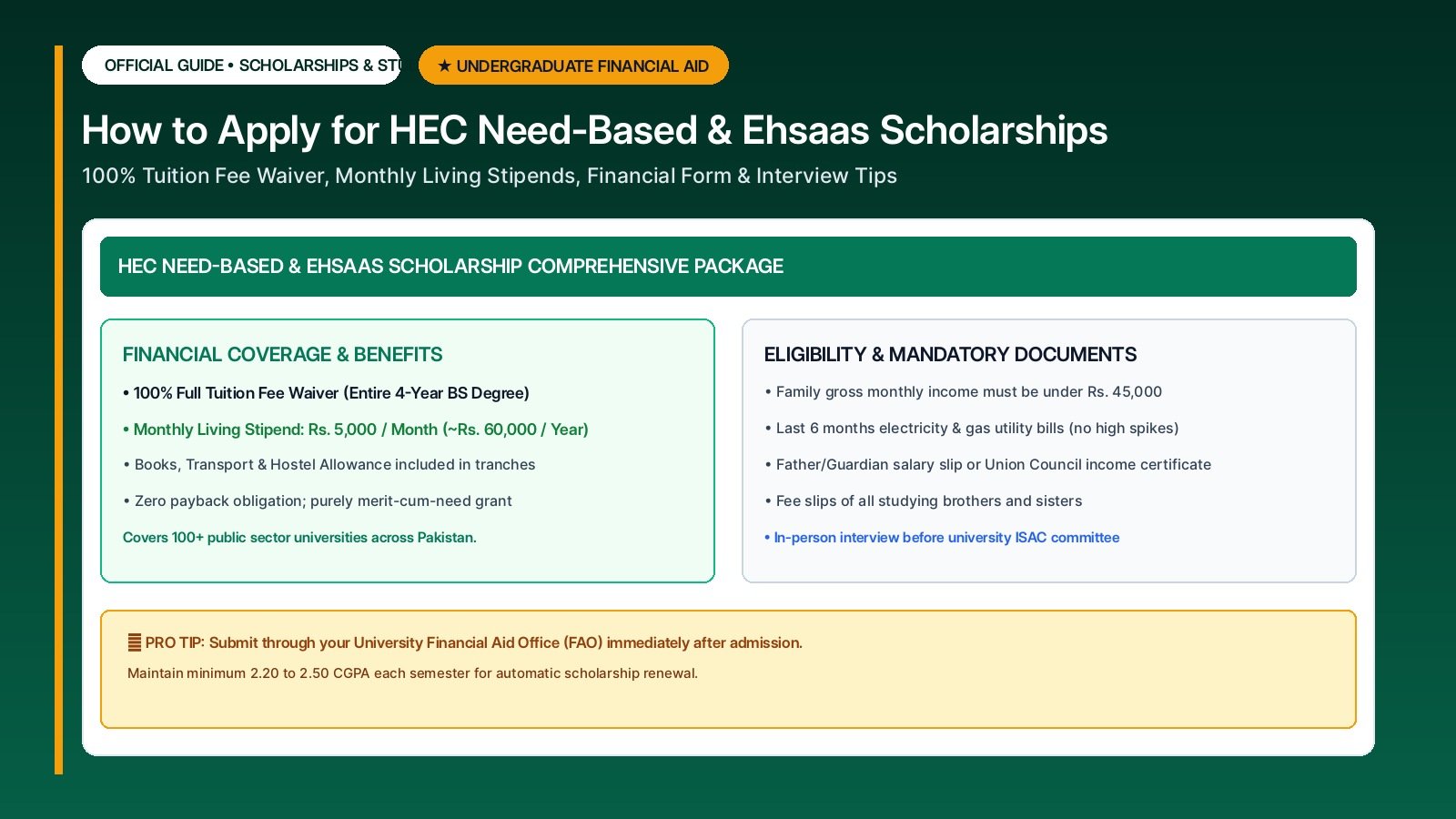
Pakistan has two flagship need-based scholarship schemes for undergraduate students, and they are often confused with each other: the HEC Need-Based Scholarship and the Ehsaas (now Benazir) Undergraduate Scholarship. Both exist for one purpose — to make sure that a talented student is never forced to abandon a degree simply because the family cannot afford the fee.
The HEC Need-Based Scholarship is awarded to students enrolled in HEC-recognised public sector universities and degree-awarding institutions. Funding slots are allocated to participating institutions, and each university selects its own deserving students through a defined verification process. It is the older, institution-driven route to need-based support.
The Ehsaas Undergraduate Scholarship, continued under the Benazir Income Support Programme umbrella, works at a much larger national scale — typically more than 50,000 awards per year across Pakistan and Azad Jammu and Kashmir, with approximately 50 per cent of the awards reserved for female students as per policy. It covers tuition fees along with a stipend component to help with living and study expenses. Because the two schemes share the same HEC online portal and similar eligibility logic, this guide explains them side by side so you can apply to the right one with confidence.
Eligibility Checklist: Do You Qualify?
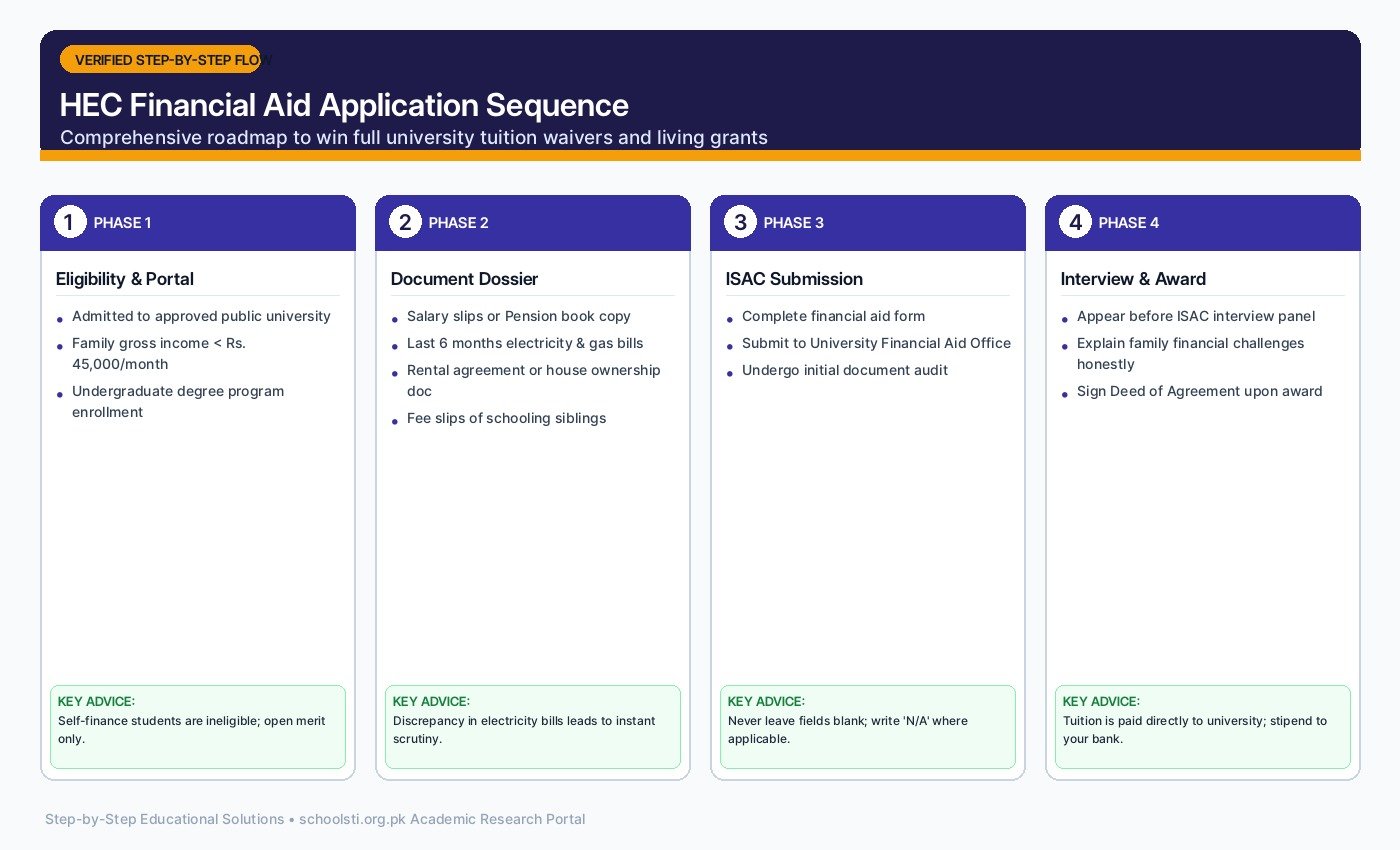
Before you touch the application form, run through this checklist honestly. Applying when you clearly fail a criterion wastes your time and the committee's time.
- You are a Pakistani or Azad Jammu and Kashmir national.
- You are enrolled in an undergraduate degree program (typically a four or five-year program) at a public-sector university or institution recognised by HEC.
- Your family's monthly income falls below the published income ceiling for the scheme — this ceiling sits in the low-income band and is revised from time to time, so verify the current official figure on the HEC portal; reviewed October 2026.
- You are not receiving any other scholarship, stipend, or financial assistance for the same program.
- You can produce documentary proof of income and admission when the university asks for verification.
If you tick every box, you are a genuine candidate. If you fail even one — for example, you study at a private university or already hold another scholarship — these two schemes are not for you, and you should look at alternatives rather than risk rejection.
HEC Need-Based vs Ehsaas Undergraduate Scholarship: Side-by-Side Comparison
The table below compares the two schemes on the points students ask about most. Treat coverage figures as indicative: exact tuition and stipend components are announced with each cycle, so verify the current official figures before you rely on them — reviewed October 2026.
| Feature | HEC Need-Based Scholarship | Ehsaas / Benazir Undergraduate Scholarship |
|---|---|---|
| Who can apply | Undergraduate students of HEC-recognised public-sector universities and degree-awarding institutions | Undergraduate students of public-sector universities and institutions across Pakistan and AJK |
| Scale of awards | Limited slots allocated per participating institution | Typically more than 50,000 awards per year nationwide |
| Gender provision | No separate national quota announced | Approximately 50 per cent of awards reserved for female students, as per policy |
| Coverage | Tuition fee plus a stipend component for study expenses | Tuition fee plus a stipend component for living and study expenses |
| Degree levels | Undergraduate programs only | Undergraduate programs only |
| Application route | Apply on the HEC online portal; your university verifies documents and recommends candidates | Apply on the HEC online portal; an institutional committee shortlists candidates and HEC gives final approval |
| Other scholarships | Not allowed to hold any other scholarship at the same time | Not allowed to hold any other scholarship at the same time |
Step-by-Step: Applying Through the HEC Online Portal
Both schemes are applied for through the HEC online portal. The process below is the standard route — follow it in order, and do not skip the verification stage, because that is where most applications are decided.
- Confirm the announcement and your university's participation Read the current scholarship announcement on the HEC online portal and check that your university or institution is listed as a participating public-sector institution. Announcements open for a limited window each cycle, so note the closing date immediately — late applications are not accepted.
- Create your account on the HEC online portal Register with your CNIC number, an active email address, and a mobile number you can access. Use your own details — not a friend's or an agent's — because all future communication and the final award list link back to this account.
- Fill in the application form completely Enter your personal details, academic record, and family income information exactly as they appear on your documents. The income section decides your need ranking, so be precise and honest — inflated or understated figures are caught during verification.
- Upload your supporting documents Attach clear scans of your CNIC or B-form, admission letter or enrollment proof, fee receipts, domicile, and income proof such as salary slips, a pension book, or an income affidavit. Blurry or missing documents are the top reason applications stall at verification.
- Review and submit before the deadline Read the whole form once more, confirm every upload is attached, and submit. Save or print the acknowledgement slip — it is your proof of application if anything goes wrong later. Submit at least a day before the deadline to survive portal slowdowns.
- University verification and committee review Your university's focal person checks your documents, and the institutional scholarship award committee assesses financial need — sometimes through a short interview or scrutiny session. Respond quickly if the committee asks for an additional document.
- Final approval and disbursement HEC reviews the recommended lists and issues the final award. Tuition fees are normally settled directly with your institution, while the stipend component is released to you in installments. Keep your bank account details updated with your institution so payments are not delayed.
After You Apply: Verification, Award and Keeping the Scholarship
Once you submit, your university's focal person and the institutional scholarship award committee verify your documents, and in many cases a short interview or scrutiny session is held to confirm financial need. HEC then reviews the recommended lists and issues the final award. Tuition fee is normally settled directly with the institution, while the stipend component is released to the student in installments.
The scholarship is not a one-time prize — it continues for the duration of your degree as long as you meet the continuation criteria: satisfactory academic progress, regular attendance, unchanged financial circumstances, and no disciplinary action. Most institutions re-verify income and results each academic year, so keep your documents updated.
If your financial situation improves significantly, or you accept another scholarship, you must inform your institution. Concealing a change can lead to cancellation of the award and recovery of the disbursed amount.
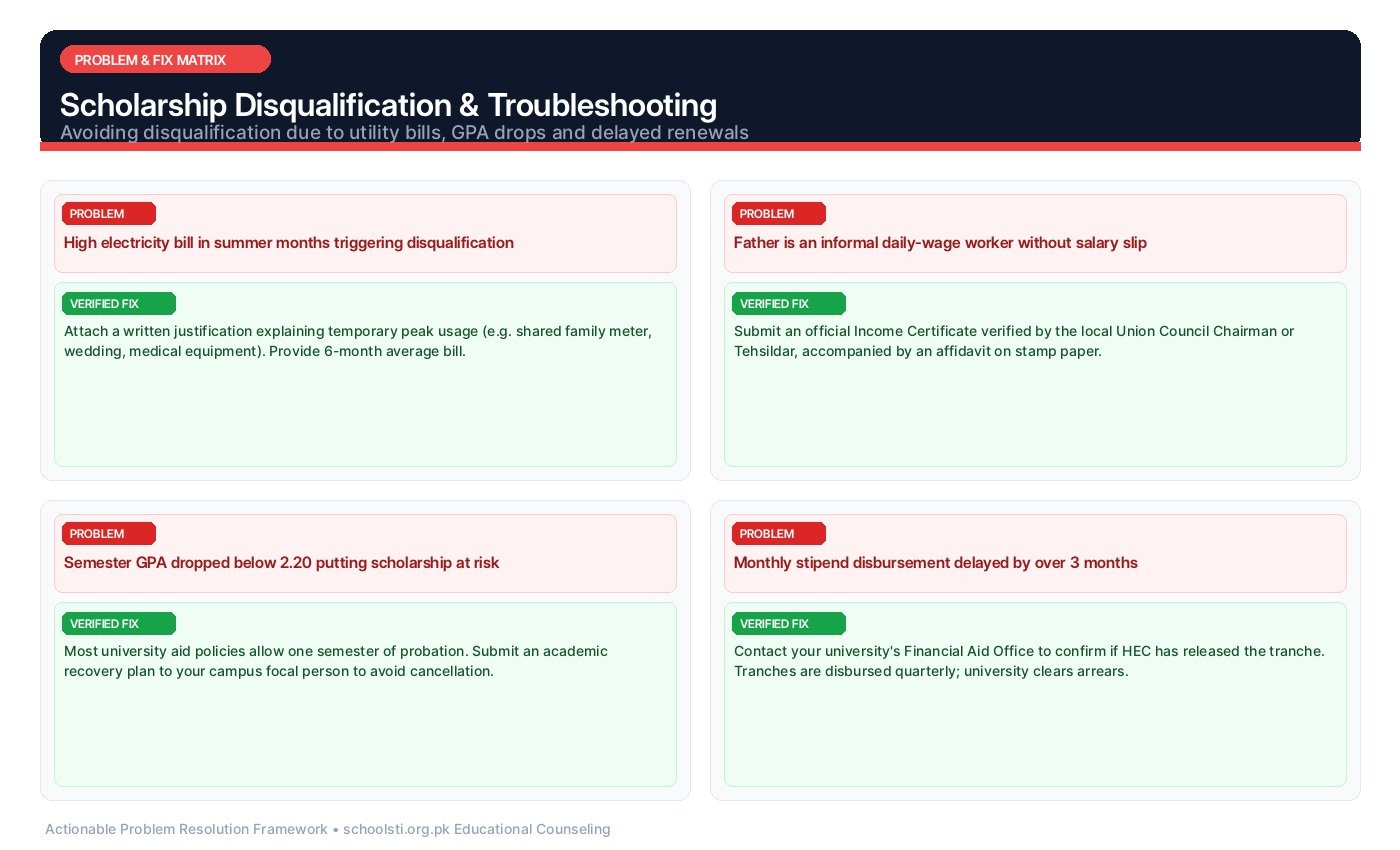
Troubleshooting: Common Student Problems & Verified Solutions
Real-world issues reported by Pakistani applicants and students, with actionable step-by-step solutions:
⚠️ Problem: My application was rejected because income documents were missing or incomplete
✅ Verified Solution: The committee cannot assess need without proof. Arrange salary slips of the earning member, a pension book if applicable, or an income affidavit on stamp paper, and keep them ready before the next cycle opens. Ask your university focal person exactly which document format they accept — requirements vary slightly between institutions.
⚠️ Problem: The HEC portal shows errors or logs me out while I am filling the form
✅ Verified Solution: Use a desktop browser or a stable mobile browser during off-peak hours, clear your cache, and save the form as a draft after every section. Keep your CNIC, email access, and mobile number handy because the portal may send verification codes. If the error persists for more than a day, report it through the portal's complaint section with screenshots.
⚠️ Problem: My university does not appear in the list of participating institutions
✅ Verified Solution: Only HEC-recognised public-sector universities and institutions take part. Private universities and unrecognised institutions are not covered. Confirm your institution's status on the HEC portal list — if it is genuinely absent, these two schemes cannot help you, and you should explore provincial or institutional scholarships instead.
⚠️ Problem: I missed the application deadline
✅ Verified Solution: Deadlines for these schemes are strict and extensions are rare. Prepare your complete document file now — income proof, domicile, CNIC, admission letter — so you can apply on day one of the next cycle. Follow your university notice board and the HEC portal announcements so the next deadline does not pass unnoticed.
⚠️ Problem: I am already receiving another scholarship — can I still apply?
✅ Verified Solution: No. Both schemes require that you are not availing any other scholarship or financial assistance. You must choose one. Accepting two awards for the same program is treated as a violation and leads to cancellation and recovery of funds. Declare your status honestly on the form.
⚠️ Problem: I submitted the form twice by mistake
✅ Verified Solution: Contact your university's scholarship focal person immediately and ask them to withdraw or ignore the duplicate entry, keeping the complete one. Duplicate submissions can confuse verification and, in some cycles, lead to disqualification — so report it yourself rather than hoping nobody notices.
Frequently Asked Questions (FAQ)
Clear, direct answers to common questions about How to Apply for HEC Need-Based and Ehsaas Undergraduate Scholarships (Eligibility & Form Guide):