What HEC Foreign Degree Equivalence Means
HEC equivalence (sometimes called recognition or equation) is the official determination of which Pakistani qualification your foreign degree corresponds to — for example, whether your foreign bachelor's equals a Pakistani 16-year bachelor's or master's. Employers, universities, and government departments in Pakistan use this equivalence to place you on the correct pay scale, eligibility list, or admission merit.
Equivalence is different from attestation. Attestation (covered in our HEC attestation guide) verifies a Pakistani degree's genuineness. Equivalence evaluates a foreign degree's level and standing. If you studied abroad, you need equivalence; if you studied in Pakistan, you need attestation.
The single most important eligibility factor is recognition: HEC grants equivalence only for degrees from foreign institutions that are recognised and accredited in their own country. A degree from an unaccredited institution — including many cheap online-only setups — will be refused no matter how much you paid for it. Research recognition before enrolling anywhere, not after graduating.
Eligibility Rules: Foreign vs. Online Degrees
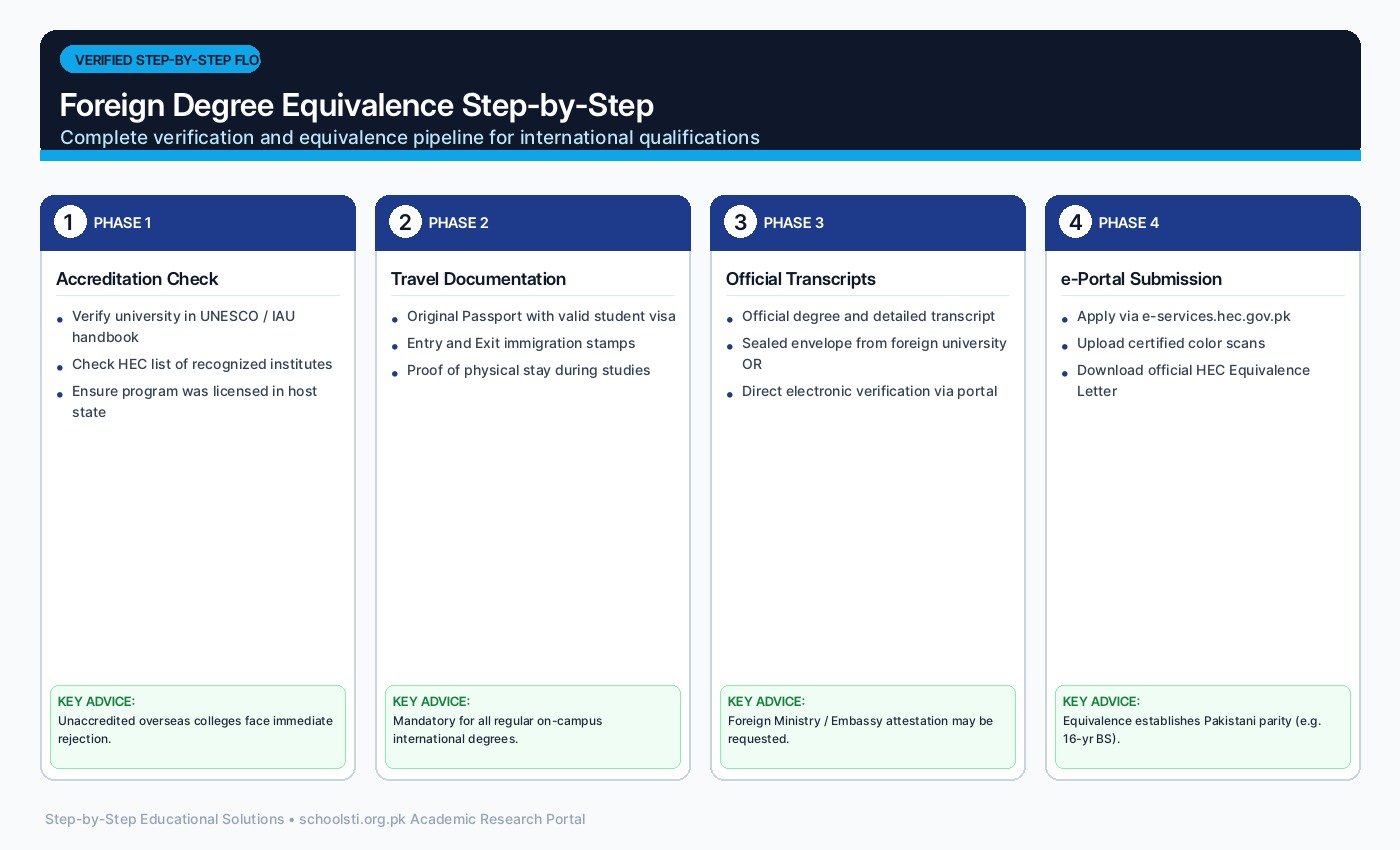
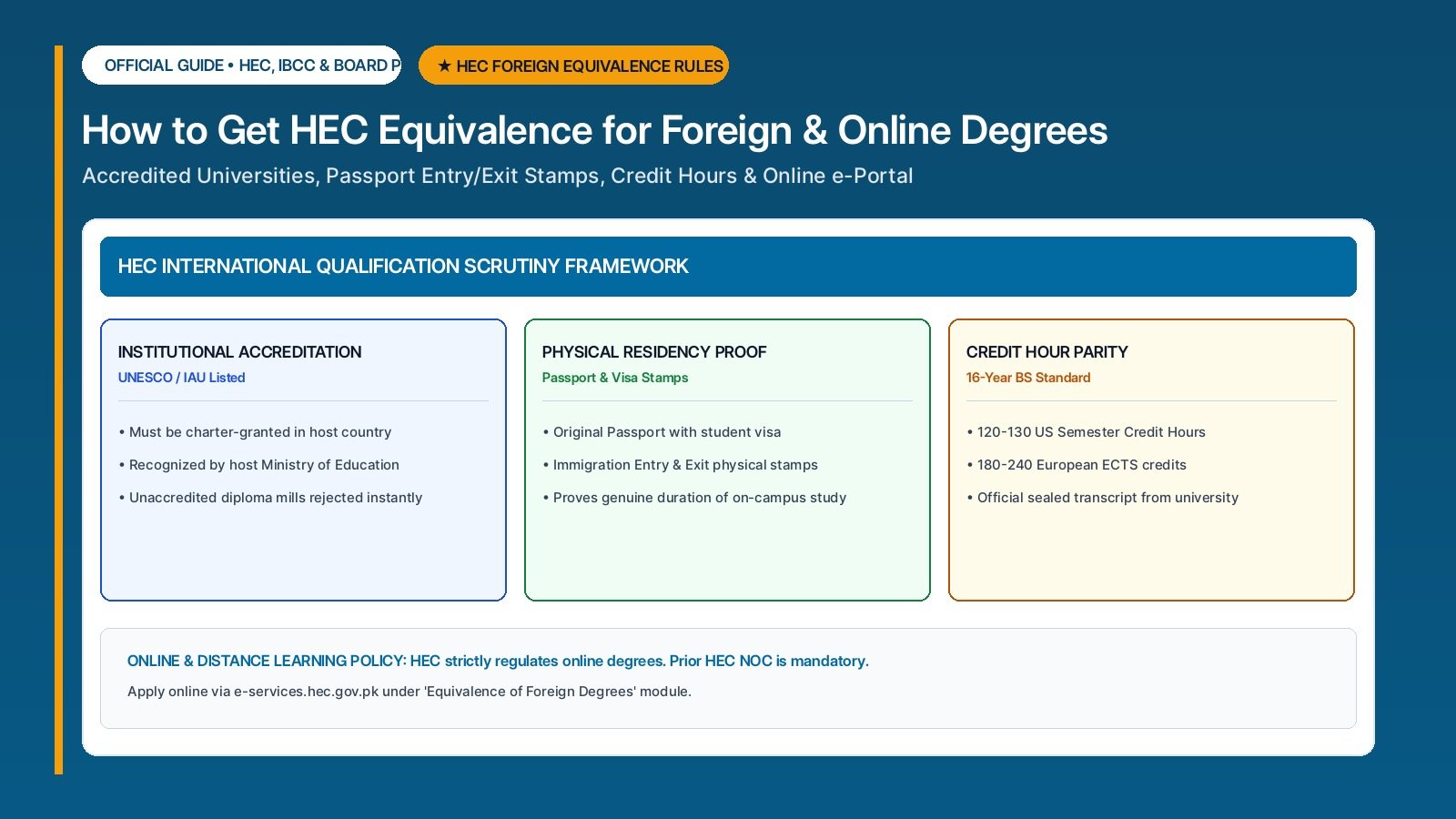
HEC applies published criteria to decide equivalence, and the rules are stricter than many students expect. The table below summarises the key checkpoints — confirm the current detailed policy on the official HEC website, because these criteria are updated periodically.
| Checkpoint | What HEC looks for | Common rejection reason |
|---|---|---|
| Institution recognition | University recognised/accredited in its home country | Unaccredited or diploma-mill institution |
| Program duration | Duration comparable to the Pakistani equivalent level | One-year bachelor's or unusually short programs |
| Mode of study | Regular on-campus preferred; online/distance under special policy | Online degree not covered by current policy |
| Entry qualification | You met the program's own admission requirements | Admitted without the required prior qualification |
| Transcript completeness | Full official transcript with all semesters | Incomplete or unverifiable transcripts |
| Residency/attendance | Evidence of genuine study where required | Degree bought without real study |
Online and Distance Degrees: The Extra Scrutiny
Online and distance-learning foreign degrees sit in a special category. HEC has historically treated them with extra caution, and policies have shifted over the years — some periods allowed equivalence for accredited online programs under conditions, others restricted it. Because this is a moving policy area, the only safe approach is to check HEC's current published policy on online and distance degrees before you enrol or before you apply.
If you already hold an online foreign degree, gather evidence of the program's accreditation, its curriculum, and your genuine participation (enrolment records, coursework, examination records). The stronger your documentation, the smoother the evaluation. Degrees from well-known accredited universities with established online programs fare far better than degrees from obscure online-only entities.
A practical warning: HEC may ask for verification directly from the awarding institution, and slow or uncooperative foreign universities delay cases for months. Choose institutions with responsive registrar offices — it matters more than students realise.
Step-by-Step: Applying for HEC Equivalence Online
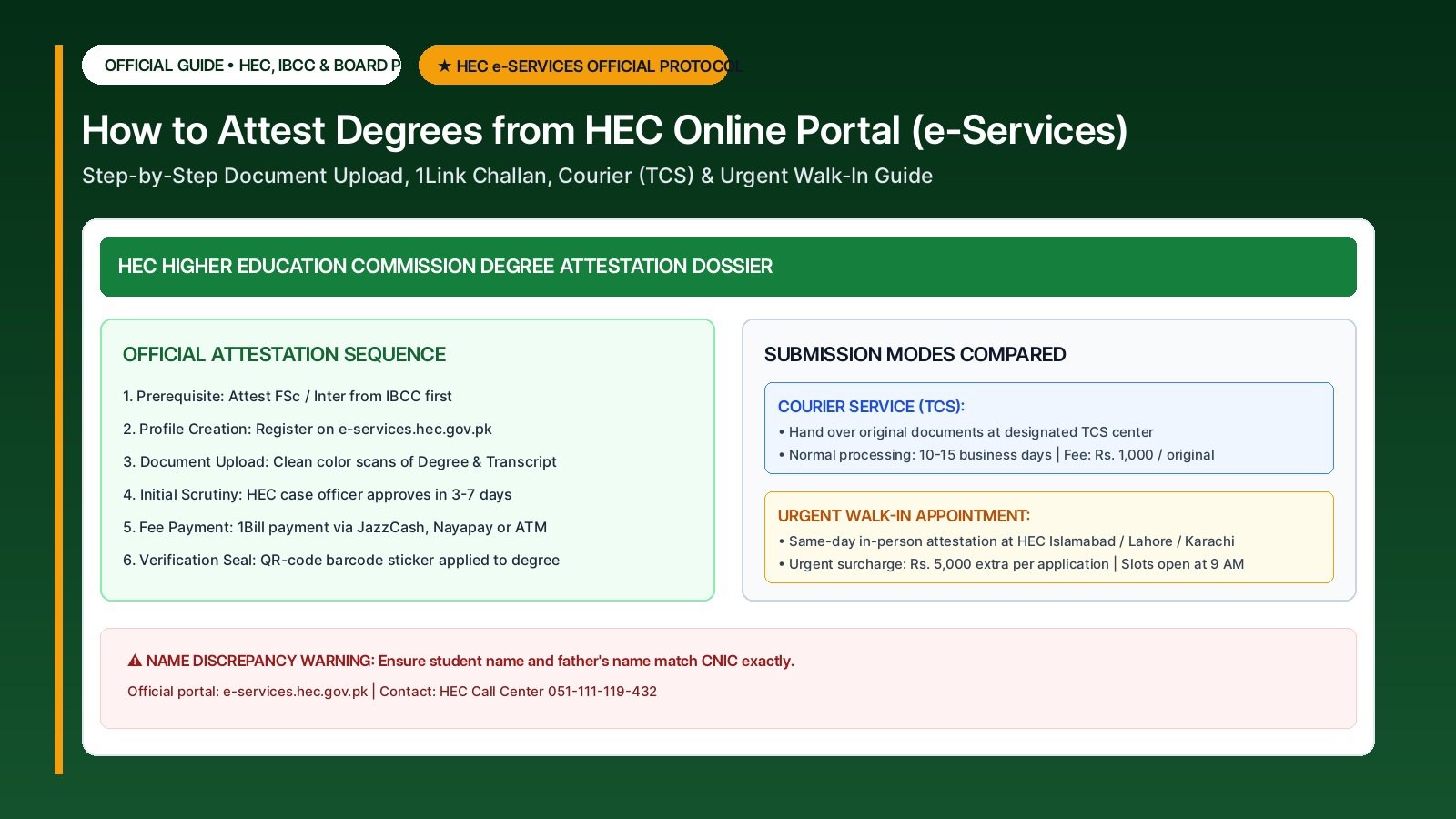
Equivalence applications run through the HEC e-services portal, the same system used for attestation. Complete the steps below carefully — incomplete files are the main cause of long delays.
- Create your portal account and profile Register on the HEC e-services portal with your CNIC, email, and mobile number. Complete your personal and education profile, entering your foreign institution's exact name, country, program title, and study dates.
- Select the equivalence service Choose the foreign degree equivalence option and the level you are seeking equivalence for (bachelor's, master's, MS/MPhil, or PhD level). Selecting the wrong level creates confusion later, so match it to your actual foreign qualification.
- Upload your documents Upload colour scans of your foreign degree, complete official transcript, CNIC or passport, and any prior Pakistani qualifications. For online degrees, include enrolment and accreditation evidence as the portal requests. Every scan must be sharp and fully readable.
- Get documents attested as required HEC typically requires your foreign degree and transcript to be attested by the Pakistani embassy or consulate in the degree country, or through the announced verification channel. Check the current attestation requirement on the portal — it is a frequent stumbling block.
- Pay the equivalence fee The portal generates a fee challan after scrutiny of your initial submission. Equivalence fees are revised periodically — as per the latest published fee schedule, verify on the official website, reviewed October 2026. Keep the paid receipt safe.
- Respond to verification queries HEC may verify your degree directly with the foreign institution, which takes time. Monitor your portal messages and email closely — if HEC asks for an additional document or clarification, respond within days, not weeks, to keep your file moving.
- Receive your equivalence certificate Once evaluation completes, HEC issues the equivalence certificate stating the Pakistani level your degree corresponds to. Check every detail — your name, institution, program, and the granted level — before accepting it, and keep the original safe.
| Foreign Degree Origin | Standard Duration | Minimum Credits Required | HEC Pakistani Equivalence | Key Verification Caveat |
|---|---|---|---|---|
| United Kingdom (UK 3-Year Bachelor) | 3 Academic Years | 120 UK Credits (approx. 90 ECTS) | 16-Year BS Degree Equivalent | Engineering degrees require PEC accreditation compliance |
| United States & Canada (4-Year BS) | 4 Academic Years | 120 - 130 Semester Credit Hours | 16-Year BS Degree Equivalent | Must show regional accreditation (e.g. SACS, NECHE) |
| European Union (Bologna System BS) | 3 to 4 Years | 180 to 240 ECTS Credits | 16-Year BS Degree Equivalent | Passport immigration entry/exit stamps verified by HEC |
| China & Central Asia (MBBS / BS) | 5 to 6 Years | Full Clinical Internship included | Subject to PMDC / HEC test | Must pass National Examination Board (NRE) test in Pak |
| Online / Distance Learning Degrees | Variable | Full coursework compliance | Equivalence restricted | Requires prior HEC NOC before foreign enrollment |
Documents Checklist, Fees and Realistic Timelines
Keep this checklist ready before you start: foreign degree (original), complete official transcript, CNIC or passport copy, embassy attestation or verification as required, prior Pakistani qualifications (matric/intermediate or bachelor's as applicable), recent photographs, and the fee receipt. Missing embassy attestation is the most common reason files stall, so arrange it early — consulates have their own processing times.
Timelines vary widely. Straightforward cases with cooperative foreign institutions can complete within a few working weeks; cases needing direct verification from slow-responding universities can take several months. There is no honest way to promise a fixed date, so apply the moment your documents are ready and build buffer time into any job or admission plan.
Fees follow the published HEC schedule and differ by the level of equivalence sought. As per the latest published fee schedule, confirm the current fee on the official HEC portal — verify on the official website, reviewed October 2026 — and pay only through the portal-generated challan.
Troubleshooting: Common Student Problems & Verified Solutions
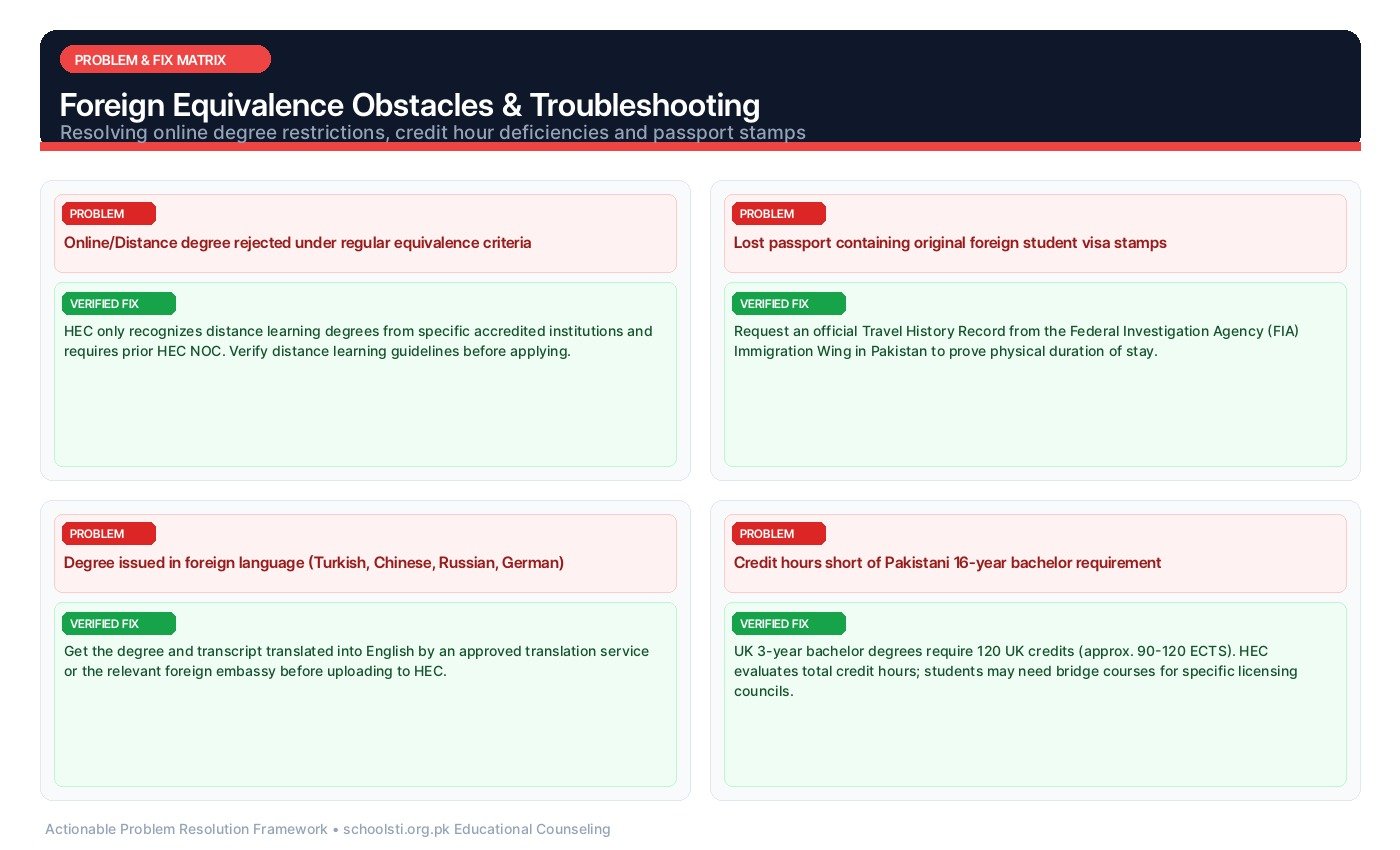
Real-world issues reported by Pakistani applicants and students, with actionable step-by-step solutions:
⚠️ Problem: HEC says my foreign university is not recognised
✅ Verified Solution: Ask HEC in writing for the specific recognition criterion your institution failed, then check that claim against the institution's home-country accreditation body. If the institution truly is unaccredited, equivalence is not possible — focus on damage control (transferring credits to a recognised university) rather than repeated applications.
⚠️ Problem: My case is stuck because the foreign university is not responding to verification
✅ Verified Solution: Contact the university's registrar office yourself — by email and phone — and request them to respond to HEC's verification query, giving them your reference details. Universities prioritise student-initiated requests. If the institution has closed down, inform HEC and ask what alternative evidence (archived records, accreditation body confirmation) they will accept.
⚠️ Problem: I cannot get embassy attestation because there is no Pakistani mission in that country
✅ Verified Solution: Check the portal for the alternative verification channel HEC announces for such cases — policies exist for countries without a Pakistani mission, often involving the foreign ministry of the degree country or a designated mission nearby. Do not skip this step hoping it will be waived; raise it with HEC support and follow their written instruction.
⚠️ Problem: My online degree application was refused under the current policy
✅ Verified Solution: Read the refusal letter carefully to see whether it is a documentation issue (fixable) or a policy exclusion (not fixable for that program). If it is a policy exclusion, your realistic options are a recognised top-up or a new degree from a recognised institution — repeated applications against a clear policy will not succeed.
⚠️ Problem: The equivalence level granted is lower than I expected
✅ Verified Solution: HEC maps your degree to the Pakistani level its duration, content, and standing justify — for example, a three-year foreign bachelor's may not equal a four-year Pakistani one. You can seek clarification of the evaluation criteria applied to your case, and in some situations complete additional recognised study to reach the higher level.
⚠️ Problem: My name differs between my passport, foreign degree, and CNIC
✅ Verified Solution: Align your documents before applying: get the foreign institution to correct its record if the error is theirs, or prepare an affidavit and supporting documents explaining the variation. HEC verifies against exact records, so unresolved name differences stall the file indefinitely.
Frequently Asked Questions (FAQ)
Clear, direct answers to common questions about How to Get HEC Equivalence for Foreign and Online University Degrees in Pakistan: