Why a Digital Skill Is the Smartest Side Project for a Student
A college degree is valuable, but in Pakistan today it is rarely enough on its own. Thousands of graduates enter the job market every year, and entry-level salaries often fail to cover rising living costs. A digital skill changes this equation because it lets you earn from your laptop while you are still studying, with no office, no shop, and no startup capital required.
Digital work is uniquely student-friendly: one to two hours a day between classes, free practice tools, and small freelance projects on weekends or during semester breaks. Unlike a part-time shop job, freelancing builds a portfolio and a professional reputation that compounds over time — work from your second year of college can still be winning you clients years later.
Pakistan has one of the largest freelance workforces in the world, and international clients regularly hire Pakistani talent for web development, design, writing, and marketing work. They judge the quality of your portfolio and your reliability, not your degree title or your city. That is the opportunity: a student in Multan, Sukkur, or Abbottabad can earn from clients in London or Dubai without leaving home.
The Top 5 High-Income Digital Skills Compared
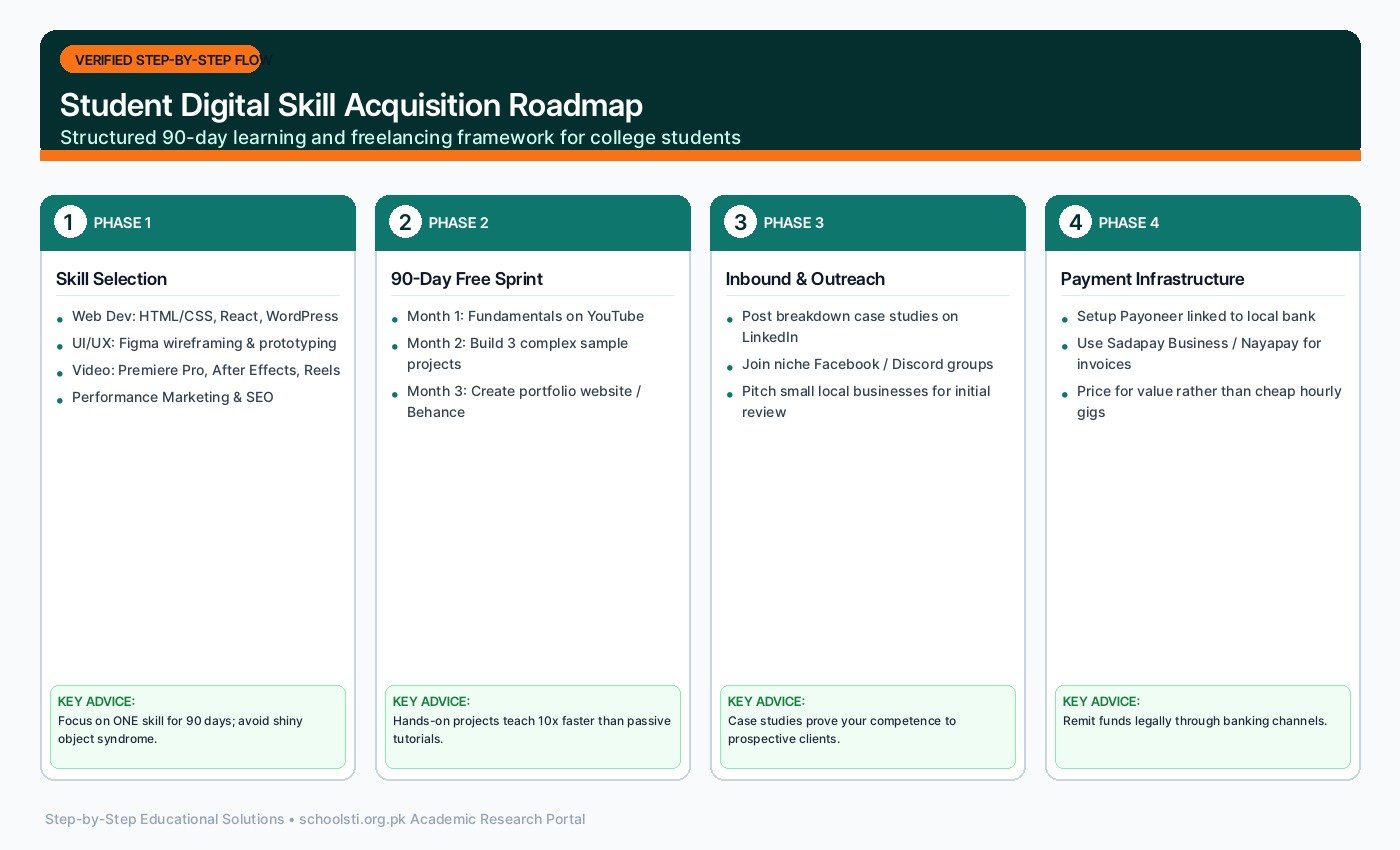
The five skills below share one trait: each can be learned for free, practiced on a basic laptop, and sold to real paying clients within a few months. They sit at different points on the difficulty-versus-income spectrum, so there is a realistic entry point for every student.
Read the table carefully. Learning time assumes one to two focused hours per day. Earning potential shows typical starting ranges reported by Pakistani freelancers — these vary widely by city, client type, and your own portfolio, reviewed October 2026. They are starting points, not ceilings: experienced professionals in all five fields earn far more.
| Skill | Typical learning time | Typical starting earning potential in PKR | Where to learn free |
|---|---|---|---|
| Freelance web development | 3–6 months of daily practice | Rs. 50,000–150,000/month freelancing or full-time; typical starting ranges, vary by city/employer, reviewed October 2026 | freeCodeCamp, The Odin Project, YouTube channels on HTML/CSS/JavaScript |
| Graphic design & UI-UX | 2–4 months of daily practice | Rs. 30,000–80,000/month freelancing or junior roles; typical starting ranges, vary by city/employer, reviewed October 2026 | Google UX Design foundations (audit free), Canva Design School, YouTube tutorials on Figma |
| Content writing & copywriting | 1–3 months of consistent writing | Rs. 25,000–60,000/month freelancing or content roles; typical starting ranges, vary by city/employer, reviewed October 2026 | HubSpot Academy free courses, practice blogs, YouTube channels on SEO writing |
| Video editing | 2–4 months of daily editing | Rs. 30,000–70,000/month freelancing or agency work; typical starting ranges, vary by city/employer, reviewed October 2026 | YouTube tutorials on CapCut, DaVinci Resolve (free software), Premiere Pro trial projects |
| Digital marketing & SEO | 2–3 months of study plus practice | Rs. 30,000–70,000/month freelancing or marketing roles; typical starting ranges, vary by city/employer, reviewed October 2026 | Google Digital Garage, HubSpot Academy, Semrush Academy free courses |
A Closer Look at Each Skill
1. Freelance web development
Web developers build the websites and applications the whole internet runs on, starting with HTML, CSS, and JavaScript, then moving to modern tools like React or WordPress development. Day-to-day work means turning designs into working pages, fixing bugs, and adding features clients request. It takes the longest to learn on this list, but it also has the deepest demand: almost every business on earth needs web work, and good developers are rarely without projects.
2. Graphic design and UI-UX
Designers create the visual layer of brands and products — logos, social media graphics, posters, and app interfaces. UI-UX designers go further, planning how users move through an app or website. Daily work is creative and visual: iterating on layouts in Figma or a similar tool and presenting concepts to clients. If you have an eye for aesthetics and enjoy making things look beautiful, this is the most enjoyable path on the list.
3. Content writing and copywriting
Writers produce the words businesses need: website pages, blog articles, product descriptions, email newsletters, and social media captions. Copywriting — writing that persuades people to buy or sign up — pays better than general writing because it directly affects a client's revenue. The barrier to entry is the lowest here: if you can write clear English (or Urdu for local clients), you can start practicing today by writing sample articles on topics you already know.
4. Video editing
Every YouTuber, business, and influencer needs an editor. Daily work means cutting raw footage, adding subtitles and effects, syncing music, and packaging videos for platforms like YouTube, TikTok, and Instagram. Short-form video has exploded the demand for editors, and clients pay per video, so your income scales with your speed. Free tools like DaVinci Resolve and CapCut are genuinely professional-grade, so software cost is zero.
5. Digital marketing and SEO
Digital marketers help businesses get found and win customers online. SEO specialists optimize websites to rank on Google; social media marketers run campaigns and content calendars; paid-ads specialists manage advertising budgets. This skill suits analytical minds: daily work involves data, testing, and strategy. It pairs beautifully with the other skills — a writer who understands SEO, or a designer who understands marketing, is worth far more than either alone.
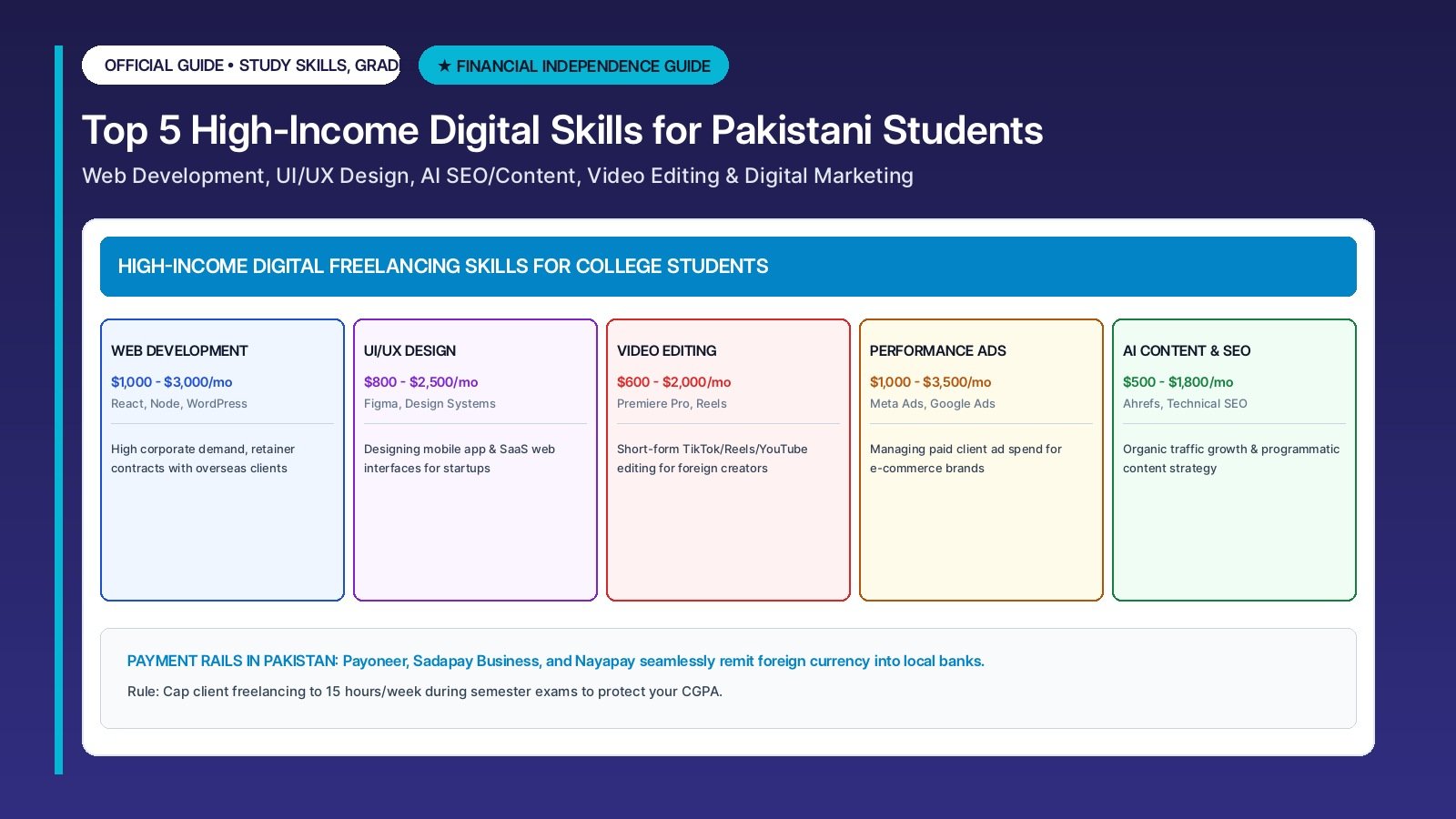
| Digital Skill | Learning Curve | Core Free Tools to Learn | Starting Hourly Rate | Monthly Retainer Potential | Best Client Market |
|---|---|---|---|---|---|
| Full-Stack Web Development | 4 to 6 Months | HTML, CSS, JavaScript, React, Next.js | $15 - $35 / Hour | $1,000 - $3,000 / Month | US & European tech startups, software houses |
| UI/UX Design | 3 to 4 Months | Figma, FigJam, Mobbin, Design Systems | $15 - $30 / Hour | $800 - $2,500 / Month | SaaS founders, mobile app agencies, product teams |
| Video Editing (Short-Form) | 2 to 3 Months | Adobe Premiere Pro, After Effects, CapCut | $10 - $25 / Hour | $600 - $2,000 / Month | YouTube creators, TikTok & Instagram e-commerce |
| Performance Marketing & Ads | 3 to 5 Months | Meta Ads Manager, GA4, TikTok Ads | $20 - $40 / Hour | $1,000 - $3,500 / Month | Shopify dropshippers, e-commerce brands |
| AI Content & Technical SEO | 2 to 3 Months | Ahrefs, Google Search Console, Screaming Frog | $12 - $25 / Hour | $500 - $1,800 / Month | B2B software blogs, niche publishers |
Your 90-Day Action Plan: Zero to First Paying Client
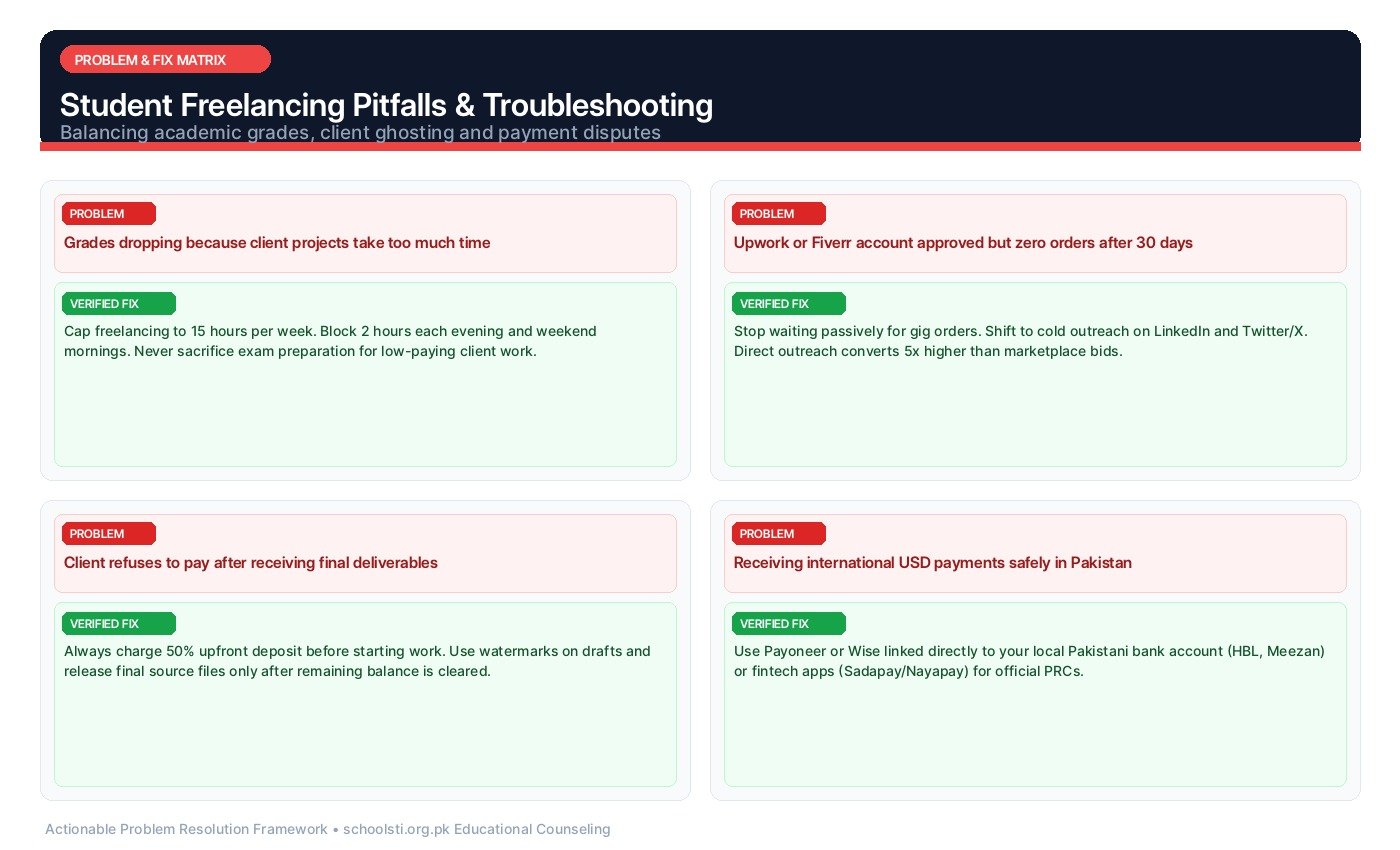
Ninety days is a realistic window for a college student studying one to two hours daily, and this plan works for any of the five skills. The structure never changes: learn the fundamentals, build proof, then approach clients.
- Days 1–7: Choose and commit Pick ONE skill from the list above based on your interest and the comparison table. Tell a friend or family member your choice — a public commitment makes quitting harder. Set a fixed daily time slot, even if it is just 60 minutes after dinner.
- Days 8–30: Learn the fundamentals Follow one free structured course end-to-end instead of jumping between random videos. Take notes in your own words. The goal is not mastery — it is understanding the vocabulary and basic workflow of the skill well enough to attempt small projects.
- Days 31–45: Build three practice projects Create three complete pieces of work: three websites, three logo designs, three articles, three edited videos, or three SEO audits. They do not need to be perfect. Finished and imperfect beats unfinished and ambitious every time.
- Days 46–55: Polish and publish a portfolio Put your three best projects on a free portfolio: a simple website, a Behance or Dribbble profile for designers, a Medium blog for writers, or a YouTube playlist for editors. Write one paragraph under each project explaining what you made and the tools you used.
- Days 56–65: Study how clients buy Read freelance job postings on platforms like Upwork and Fiverr, plus Pakistani freelancer Facebook groups. Note the exact words clients use — your proposals must speak their language, not textbook language.
- Days 66–75: Send your first 20 pitches Apply to small, realistic jobs — not big-budget ones. Keep each pitch short, reference the client's specific need, and link your portfolio. Expect mostly silence; ten thoughtful pitches beat a hundred copied templates.
- Days 76–85: Take a small or free trial project If a client hesitates, offer a small paid test task or — only once — a free sample for a genuine business. Deliver it early and communicate clearly. One delighted small client who refers you is worth more than any certificate.
- Days 86–90: Deliver, get a review, raise your price Finish the work professionally, ask politely for a written review or testimonial, and add the project to your portfolio. Your second client should pay more than your first. Repeat the pitch cycle with your new proof, and you are officially freelancing.
Balancing College Studies with Skill Learning
Your degree still matters, and sacrificing your grades for freelancing is a bad trade. Treat skill learning like a scheduled subject, not a hobby squeezed into leftover time: block a fixed daily slot — early morning or evening — and protect it the way you protect a class. One focused hour daily beats a chaotic five-hour weekend binge.
Use the academic calendar to your advantage. Semester breaks are gold: two to three weeks of full-day practice can equal two months of evening study. During exam season, drop skill learning to maintenance mode (fifteen minutes of review) or pause entirely. A simple rule: studies first during exams, skill first during breaks, both in balance during regular weeks.
Watch for the warning signs of overload: falling grades, constant tiredness, or dreading both your coursework and your practice. If that happens, reduce your skill-learning time rather than your sleep. Burnout kills more freelancing careers than competition ever does.
Troubleshooting: Common Student Problems & Verified Solutions
Real-world issues reported by Pakistani applicants and students, with actionable step-by-step solutions:
⚠️ Problem: I cannot decide which skill to learn first.
✅ Verified Solution: Give your top two candidates a one-week trial each: one beginner tutorial series plus one tiny project per skill. Choose the one you reached for voluntarily on day eight. Still torn? Pick content writing or video editing — both offer the shortest path to a first paid project.
⚠️ Problem: I do not have a laptop — only a smartphone.
✅ Verified Solution: Content writing, social media marketing, and basic graphic design via mobile apps like Canva are genuinely possible on a phone — many students start this way. For web development, UI-UX, or serious video editing, you will eventually need a computer: consider a used or refurbished laptop, or check whether your college computer lab allows practice hours. Start with what you have; upgrade when your first earnings allow it.
⚠️ Problem: My college studies are suffering because of skill learning.
✅ Verified Solution: Cut skill-learning time in half immediately and move it to a fixed slot that never touches study hours. During exams, pause completely — a paused plan resumes, but failed subjects cost you a full semester. Remember the hierarchy: your degree is the foundation, the skill is the accelerator. Never sacrifice the foundation.
⚠️ Problem: I finished learning but cannot find any clients.
✅ Verified Solution: The usual cause is a weak portfolio or generic pitches, not a lack of skill. Start with at least three finished portfolio pieces. Rewrite your pitches to mention the client's specific problem in the first two lines. Lower your initial prices to win the first two or three reviews, then raise them. And tell everyone you know — relatives with businesses, teachers, local shops — that you offer this service; your first client is often one conversation away.
⚠️ Problem: My internet is slow and electricity goes out often.
✅ Verified Solution: Download tutorials for offline viewing whenever you have connectivity, and choose tools that work offline — DaVinci Resolve, VS Code, and Figma's desktop app all function without constant internet. Save your work locally and back it up to a USB drive. Many successful Pakistani freelancers built their careers around load-shedding schedules; a UPS or power bank for your router can keep you online through short outages.
Frequently Asked Questions (FAQ)
Clear, direct answers to common questions about Top 5 High-Income Digital Skills Pakistani Students Can Learn Alongside College: