First, the Honest Picture: You Are Not Alone
Every year, far more students sit the MDCAT than there are MBBS and BDS seats — especially in public colleges, where competition is intense. Most candidates, including hardworking ones, do not get a seat. That is a mathematics problem, not a verdict on your intelligence.
Feeling grief and panic right now is normal — give it a few days, but do not let feelings make your decisions. The students who recover fastest move quickly from why did this happen to what is my next smart move. This guide is built to take you there.
Nobody can guarantee a high-paying career in any field — be wary of anyone who does. What follows is a realistic map of fields where Pakistani graduates genuinely find work.
Should You Repeat? Making the Gap-Year Decision Honestly
A second MDCAT attempt is legitimate — but only under honest conditions. Repeat if you missed the cutoff narrowly, can name exactly what went wrong (syllabus gaps, time management, test anxiety), and have the financial and emotional support for one focused year. Students who repeat with a clear diagnosis improve far more often than those who repeat on hope alone.
Do not repeat purely to avoid embarrassment, if you missed by a huge margin with no clear fixable cause, if you are burned out, or if your family cannot afford another year of academy fees. A forced repeat costs you a year and your confidence — while that same year in a good BS programme would move you forward.
A middle path exists too: start a BS degree and prepare for the MDCAT alongside it, or improve FSc marks through board improvement exams where the rules allow. Check current policies on your board's and the testing body's official websites — as per the latest published policy, reviewed October 2026.
Whatever you choose, make it a decision, not a drift: write down your plan, timeline and backup option. An unstructured gap year is how time gets wasted.
Allied Health Sciences and BS Programmes Worth Your Attention
Here is what many students discover too late: the healthcare system needs far more than doctors. Hospitals, laboratories, pharmacies, rehabilitation centres and clinics across Pakistan employ large numbers of allied health professionals — and several of these fields face genuine shortages, which is good news for your employment prospects.
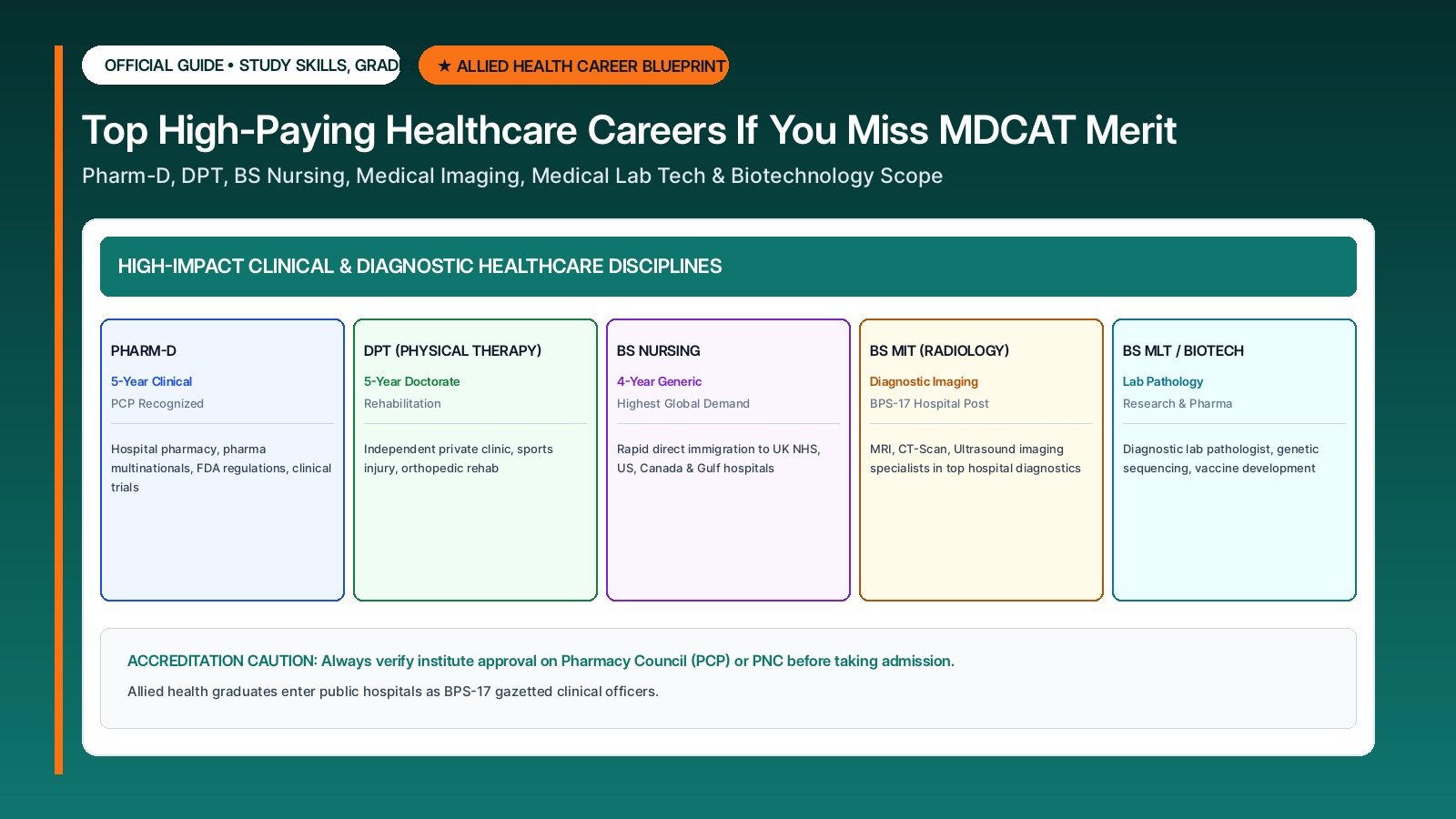
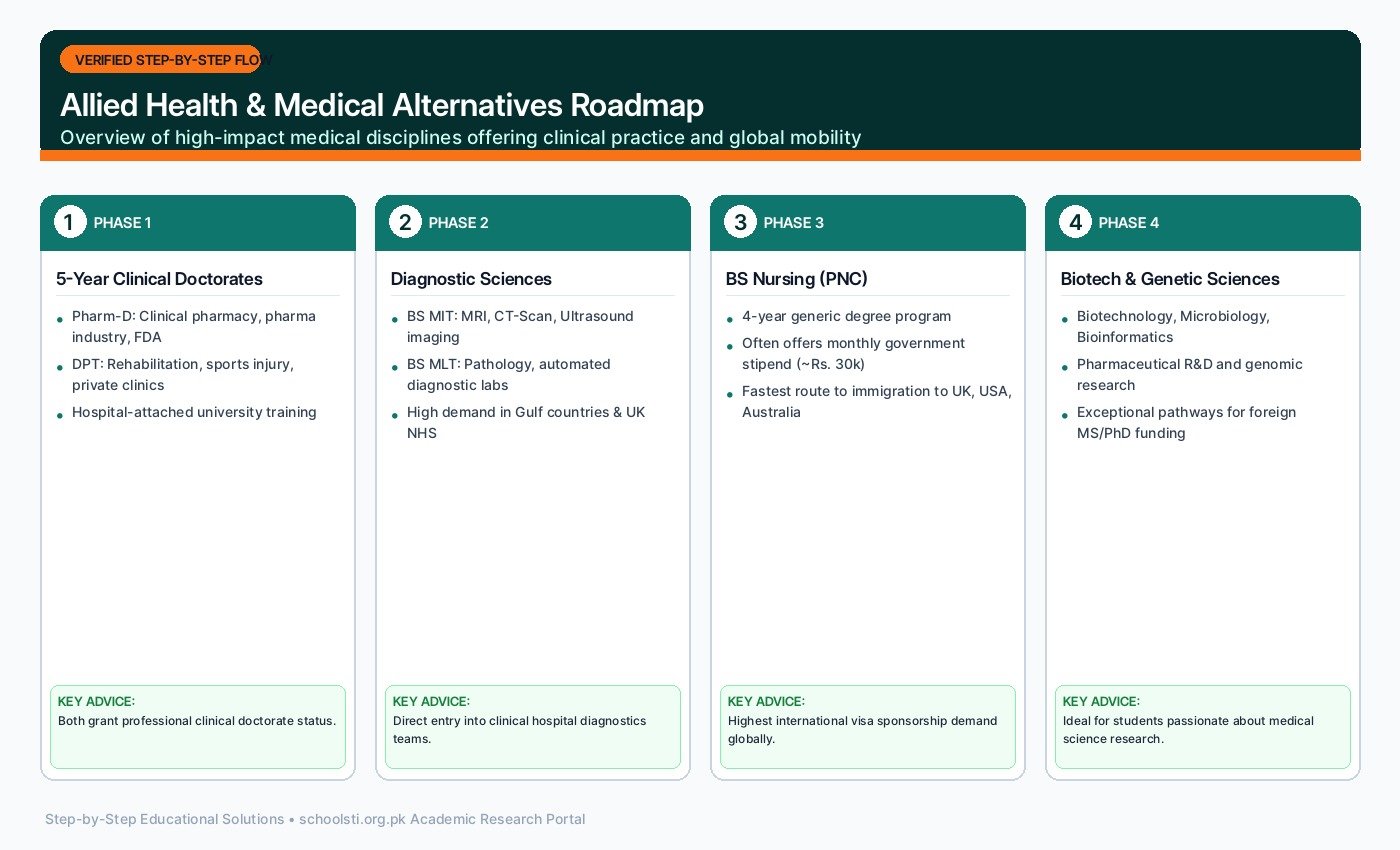
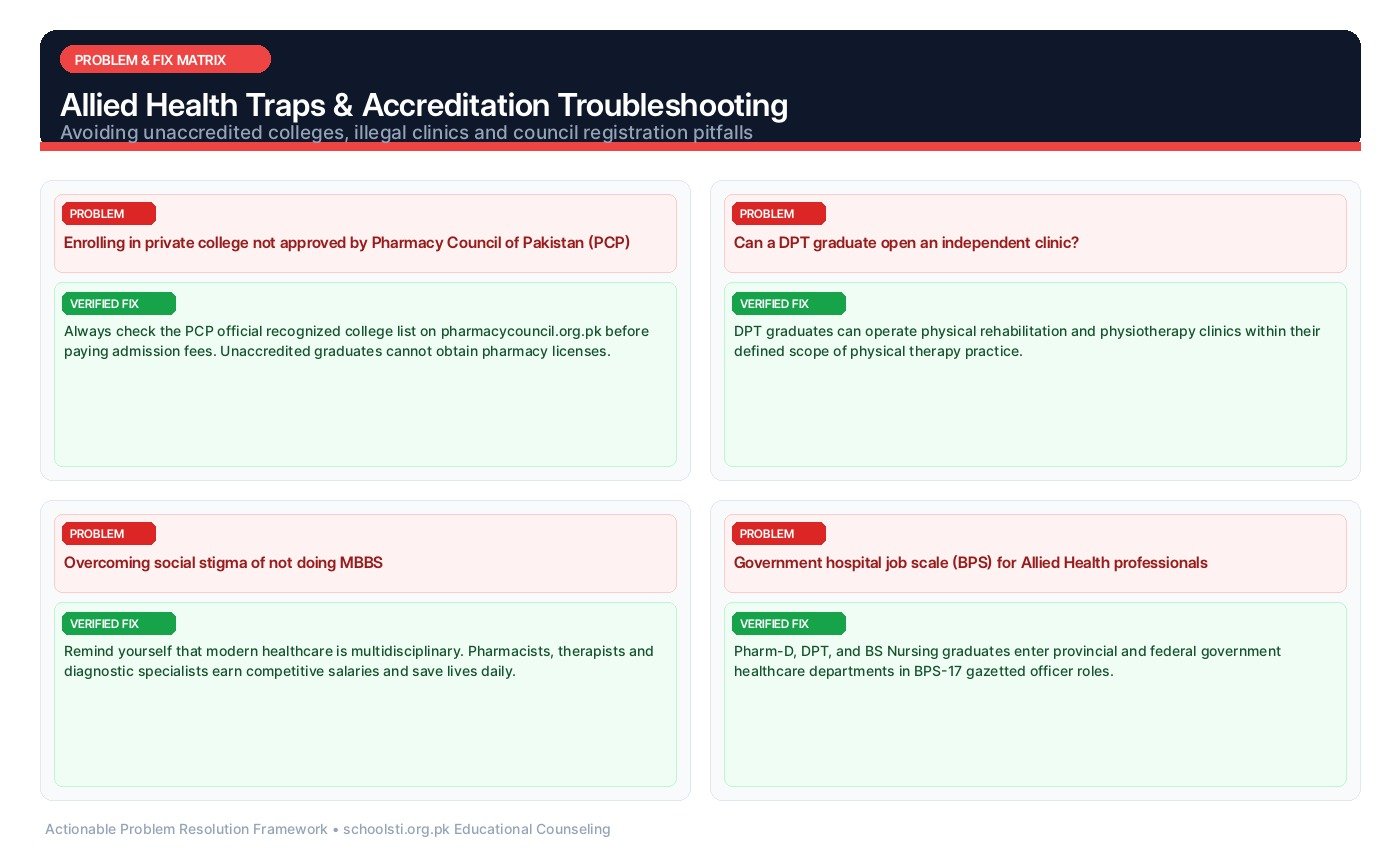
DPT (Doctor of Physical Therapy) is a five-year programme after which graduates work in hospitals, sports medicine, rehabilitation centres or their own clinics. Awareness of physiotherapy is growing, and private practice gives DPT graduates unusual independence for a non-MBBS field.
Pharm-D (Doctor of Pharmacy) opens doors in retail and hospital pharmacy, pharmaceutical companies (production, quality assurance, marketing), drug regulatory work and, with further study, clinical pharmacy. Pharmacists are legally required in many settings — that requirement creates stable demand.
BS Nursing deserves far more respect than it gets in Pakistan. Trained nurses are in chronic shortage locally and internationally, making nursing one of the most reliable routes to well-paid healthcare work abroad. If working overseas appeals to you, research this path seriously.
Medical technology programmes — BS Medical Laboratory Technology (MLT), BS Radiology and Imaging Technology, BS Emergency Technology, BS Optometry, BS Nutrition — train you for the diagnostic and technical backbone of modern medicine. Every hospital needs lab technologists and radiology staff, and private diagnostic labs keep expanding in every major city.
Figures below are typical starting ranges — they vary by city and employer, reviewed October 2026. Treat them as orientation, not promises, and confirm fee structures and accreditation on official websites before paying anything.
| Field | Typical Duration | Where Graduates Work | Typical Starting Range* |
|---|---|---|---|
| DPT (Physical Therapy) | 5 years | Hospitals, rehab centres, sports clinics, private practice | PKR 60,000–120,000/month |
| Pharm-D | 5 years | Pharmacies, pharma industry, hospitals, regulatory bodies | PKR 60,000–130,000/month |
| BS Nursing | 4 years | Hospitals locally; strong demand abroad | PKR 50,000–100,000/month locally; higher abroad |
| BS Medical Lab Technology | 4 years | Hospital labs, diagnostic chains, research labs | PKR 45,000–90,000/month |
| BS Radiology / Imaging | 4 years | Hospitals, diagnostic centres | PKR 50,000–95,000/month |
| BS Emergency Technology | 4 years | Emergency departments, rescue services, hospitals | PKR 45,000–85,000/month |
| BS Nutrition / Dietetics | 4 years | Hospitals, fitness industry, private consultancy | PKR 45,000–90,000/month |
Your 30-Day Recovery and Decision Action Plan
Do not try to plan your whole life this week. Just execute the next thirty days well — clarity comes from action, not from worrying. Follow this plan in order.
- Days 1–3: Grieve, then close the chapter Allow yourself to feel disappointed without making any big decisions. Write down what happened factually: your aggregate, where you lost marks, what went wrong. Facts, not self-blame — you will use this page later.
- Days 4–7: Research three alternative fields deeply Pick three fields from this guide. For each, find the degree structure, total fee, accreditation status and two working graduates to talk to — do not rely on academy counsellors selling admissions.
- Days 8–10: Get the money picture honest Sit with your parents and calculate what the family can actually afford: private MBBS versus allied-health fees versus a gap year. Put real numbers on paper, including hostel and living costs.
- Days 11–14: Talk to people doing the work Speak to a DPT graduate, a pharmacist or nurse, and someone who repeated the MDCAT. Ask: what is the daily work like, what do you earn now, what would you do differently? Ten such conversations beat a hundred prospectuses.
- Days 15–20: Shortlist and verify institutions Shortlist two or three accredited institutions for your chosen field. Verify accreditation on the official websites of the relevant councils and HEC — never trust an admission office's claim alone, as per the latest published policy, reviewed October 2026.
- Days 21–25: Decide: repeat, pivot, or both Make the call using everything you gathered: a structured repeat with a diagnosed plan, a full pivot into an allied-health BS, or a BS admission with MDCAT preparation alongside. Write the decision and its timeline on one page.
- Days 26–30: Take the first irreversible step Submit the admission application, enrol in the repeat programme, or register for board improvement — whichever your decision requires. A plan becomes real the day you take an action you cannot undo with a shrug. Then stop looking back.
Non-Medical Pivots That Still Use Your Science Base
Your two years of FSc pre-medical are not wasted even if you leave healthcare entirely. Several strong fields value the discipline and science foundation you built.
Computing: many BS Computer Science, Software Engineering and IT programmes admit pre-medical students (some require an additional mathematics course — verify on each university's official website, as per the latest published policy, reviewed October 2026).
Business and management: BBA programmes generally accept all intermediate backgrounds. With your science discipline, it can lead into marketing, HR, banking and entrepreneurship.
Psychology and social sciences: BS Psychology is open to pre-medical students and leads toward clinical or counselling psychology with further study. English literature, media studies and education suit students who discover they love people and ideas more than laboratories.
Civil service and government: the CSS exam and most government jobs care about your bachelor's degree and preparation, not about the MDCAT. A solid BS in any field followed by serious CSS preparation is a completely respectable route that thousands take.
The principle is simple: pick the pivot you can commit to for four years, not the one that sounds impressive at a family gathering. Commitment converts any reasonable degree into a career; prestige without commitment converts nothing.
How to Talk to Parents About Plan B
In many Pakistani families, doctor ya kuch nahi is an emotional investment — money, hope and social pride went into the MDCAT attempt. Admitting it did not work out feels like failure, so students hide or agree to paths they hate. There is a better way.
First, lead with respect and facts, not defensiveness. Show them this guide's career table, the fee comparison you prepared, and names of accredited institutions. Parents resist Plan B mainly because they have never seen one spelled out — answer beta, phir kya karoge? with a written plan.
Second, bring an ally: an older cousin, a teacher or a family friend whose opinion your parents respect. A neutral adult saying DPT mein bhi acha mustaqbil hai carries weight that your own arguments sometimes cannot.
Third, give them time. Present the plan, answer questions, and let them think for a few days. Most parents come around when they see you are serious and moving forward — what frightens them is not the alternative field, it is the fear that you have given up.
Troubleshooting: Common Student Problems & Verified Solutions
Real-world issues reported by Pakistani applicants and students, with actionable step-by-step solutions:
⚠️ Problem: My parents say it is MBBS or nothing — they will not hear about alternatives.
✅ Verified Solution: Do not fight the dream; redirect it with evidence. Prepare the fee comparison (private MBBS versus DPT/Pharm-D), the career table from this guide, and one or two success stories of allied-health graduates. Ask for a single meeting with a teacher or elder they respect present. Parents usually soften when they see a concrete, respectable, affordable plan instead of vague reassurance.
⚠️ Problem: I am afraid a gap year will make me look like a failure.
✅ Verified Solution: A structured gap year with a clear study plan, a diagnosed improvement strategy and a deadline is not failure — it is a strategy that thousands of successful doctors used. What looks bad is a drifting year with no plan. If you repeat, treat it like a full-time job from day one, track weekly progress, and tell people your plan confidently instead of apologising for it.
⚠️ Problem: Private MBBS fees are far beyond what my family can afford.
✅ Verified Solution: Then rule private MBBS out cleanly instead of torturing yourself over it — debt taken for a degree is a financial decision, not a loyalty test. Redirect that same ambition into DPT, Pharm-D or nursing, where total fees are a fraction and employment is real. A debt-free graduate in a growing field starts adult life ahead of a indebted one, whatever the degree title.
⚠️ Problem: I failed the MDCAT twice and feel completely hopeless.
✅ Verified Solution: Two attempts with honest effort is enough data: the marginal return on a third attempt is usually low, and your confidence is now the limiting factor, not your knowledge. Pivot deliberately — choose an allied-health or BS field, commit fully, and let yourself succeed at something new. Many students discover their real aptitude only after the MDCAT chapter closes.
⚠️ Problem: All my friends got into medical colleges and I cannot face them.
✅ Verified Solution: Their success does not cancel your future — in five years, nobody will remember who got in on the first attempt, but everyone will see who built a career. Limit contact with result-talk for a few weeks, focus on your 30-day plan, and reconnect when you have your own direction to talk about. True friends will respect the comeback more than they pitied the setback.
Frequently Asked Questions (FAQ)
Clear, direct answers to common questions about What to Do If You Don't Clear MDCAT? (Top Alternative High-Paying Medical & Allied Fields):