Understanding Exam Anxiety: You Are Not Alone
If your heart races before an exam, your palms turn sweaty, or your mind goes blank when you lift the question paper, you are not broken. You are experiencing exam anxiety — one of the most common struggles among students in Pakistan, from board exams to MDCAT, ECAT, and CSS.
Anxiety is your body's alarm system. A little adrenaline sharpens focus, but too much floods the brain with stress hormones and crowds out working memory — that blank feeling is worry blocking knowledge, not missing knowledge. In our culture the pressure can feel heavier: results are announced publicly, relatives compare marks at every gathering, and many students carry their family's hopes on their shoulders. Naming this honestly is not ungratefulness — it is the first step toward managing anxiety instead of being ruled by it.
Your During-the-Paper Calm-Down Protocol
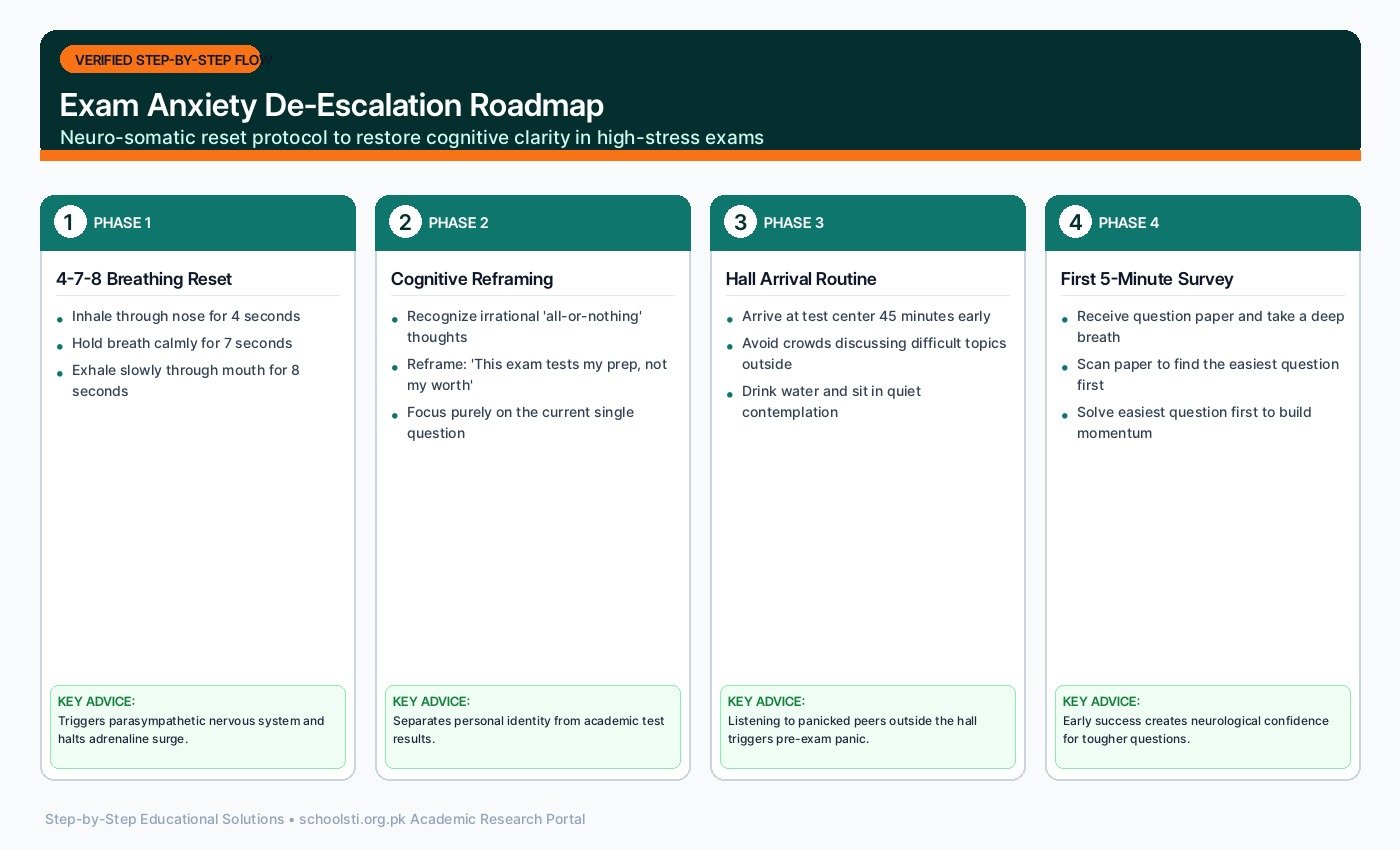
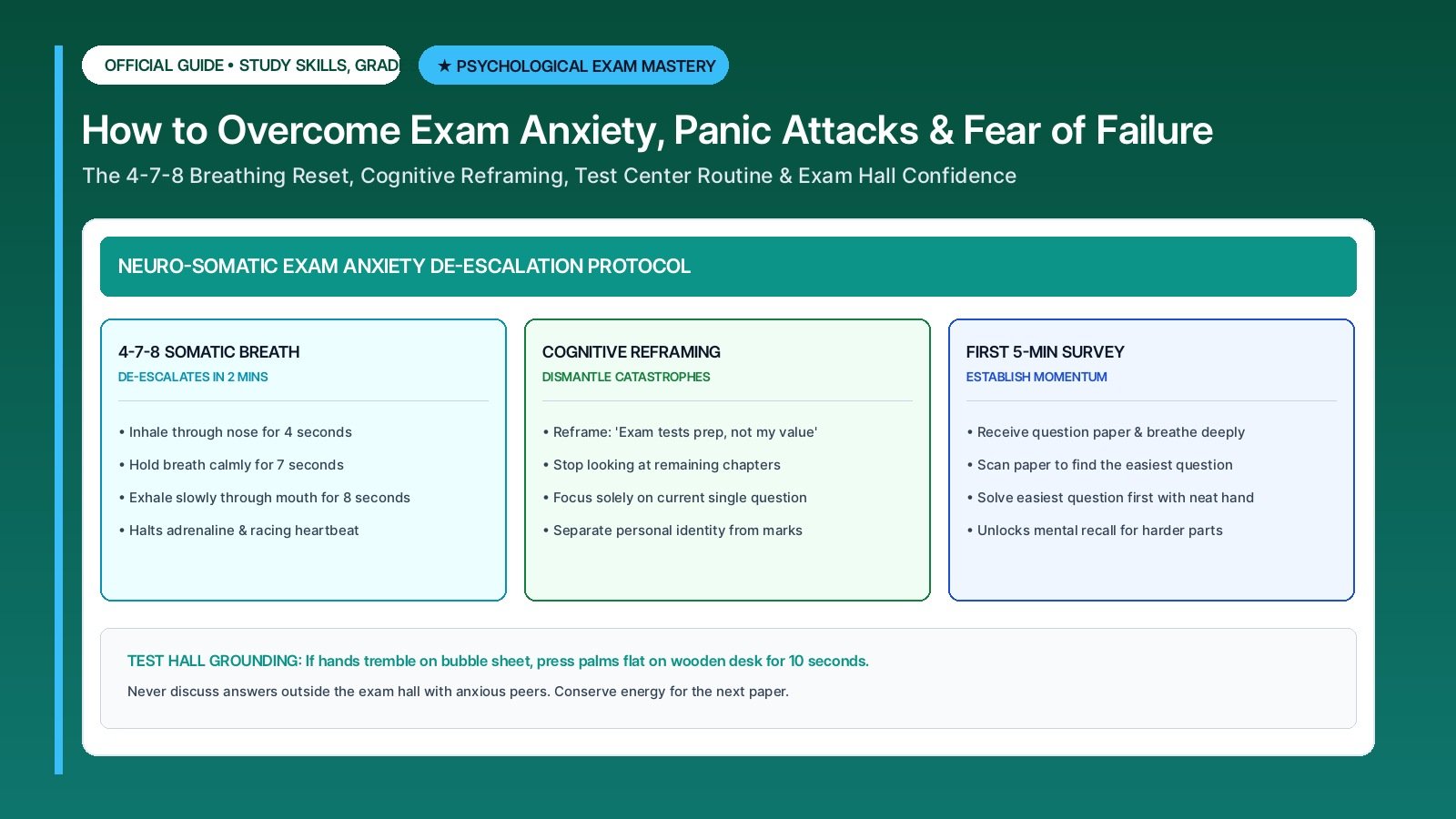
When panic rises mid-paper, do not fight it — guide your body back to calm. Practice this protocol at home first so it feels familiar on exam day. It takes about three minutes and can be done quietly at your desk.
- Box Breathing (4-4-4-4) Set your pen down and sit straight. Breathe in through your nose for 4 counts, hold for 4, breathe out through your mouth for 4, and hold empty for 4. Repeat this cycle four times. Slow breathing lowers your heart rate and tells your nervous system that the danger has passed.
- The 5-4-3-2-1 Grounding Technique Silently name 5 things you can see, 4 you can touch, 3 you can hear, 2 you can smell, and 1 you can taste. This pulls your mind out of the worry spiral and anchors it in the present moment, where the paper is manageable.
- Release Muscle Tension Clench your fists and shoulders tightly for 5 seconds, then let go completely. Repeat with your arms and legs if you have time. When muscles relax, the mind follows — this silent method is called progressive muscle relaxation.
- Reframe Your Self-Talk Replace I will fail with I prepared well and will do my best. Replace everyone is faster than me with I only need to finish my own paper. Your inner voice shapes your body's response — a kinder voice creates a calmer body.
- Skip, Breathe, and Return If a question freezes you, mark it and move to one you know. Answering easier questions rebuilds confidence and often jogs your memory for the harder ones. Never sit staring at one question — motion beats panic.
Before, During, and After: Your Complete Strategy
Anxiety management is not a one-day task. Give each phase — the night before, the morning, the paper itself, and the time after — its own simple rules.
| Phase | What to Do | What to Avoid |
|---|---|---|
| Night Before | Revise light notes, pack bag, sleep by 11 pm | Cramming new topics, studying past midnight |
| Exam Morning | Eat breakfast, reach the center 30 minutes early | Skipping breakfast, rushing at the last minute |
| Waiting Outside | Stay quiet, breathe slowly, avoid last-minute talk | Comparing preparation, panicking over rumors |
| During the Paper | Read all questions, attempt easy ones, watch time | Freezing on one question, staring at the clock |
| After the Paper | Rest and eat, prepare lightly for the next paper | Debating answers, calculating expected marks |
| Between Papers | Review weak areas calmly, keep a steady routine | All-nighters, excess caffeine and energy drinks |
Facing the Fear of Failure
Much exam anxiety is really fear of failure in disguise — fear of disappointing parents, losing face before relatives, or watching your future shrink. Say it plainly: one result does not decide your worth or your future. Board exams, entry tests, and even CSS can be retaken, and improvement exams exist exactly for students who want a second chance.
Redefine success before the exam, not after. Write down what a good result looks like, what an acceptable one looks like, and your backup plan for each — a supplementary exam, a well-used gap year, or an alternative field. A student with a Plan B walks into the hall lighter. Then talk to your parents before results, not after: choose a calm moment, say honestly how much pressure you feel, and ask for the support you need. If a direct talk feels impossible, ask a trusted teacher or elder to help you begin. Remember that countless successful Pakistani professionals — doctors, engineers, civil servants — survived a failed attempt or a disappointing result somewhere in their journey; resilience, not a flawless record, is what carried them forward.
Fuel Your Brain: Sleep, Food, and Movement
Your brain performs exactly as well as you treat your body. Students who sleep 7 to 8 hours remember more and panic less than all-night studiers — sleep is when the brain files away learning. Avoid energy drinks and limit tea and coffee in the evening, since caffeine mimics anxiety symptoms like a racing heart.
Eat regular meals with protein and fruit, drink plenty of water, and walk or exercise lightly for 20 minutes a day — movement burns off stress hormones and clears mental fog. Finally, spread your revision over weeks with a realistic plan: most panic is simply preparation arriving too late.
One more powerful habit: limit comparison. Mute class groups and skip mark-discussions in the final week — they feed anxiety without adding a single mark. Your only competition is your own yesterday; measure progress against your past papers, not someone else's highlights.
Troubleshooting: Common Student Problems & Verified Solutions
Real-world issues reported by Pakistani applicants and students, with actionable step-by-step solutions:
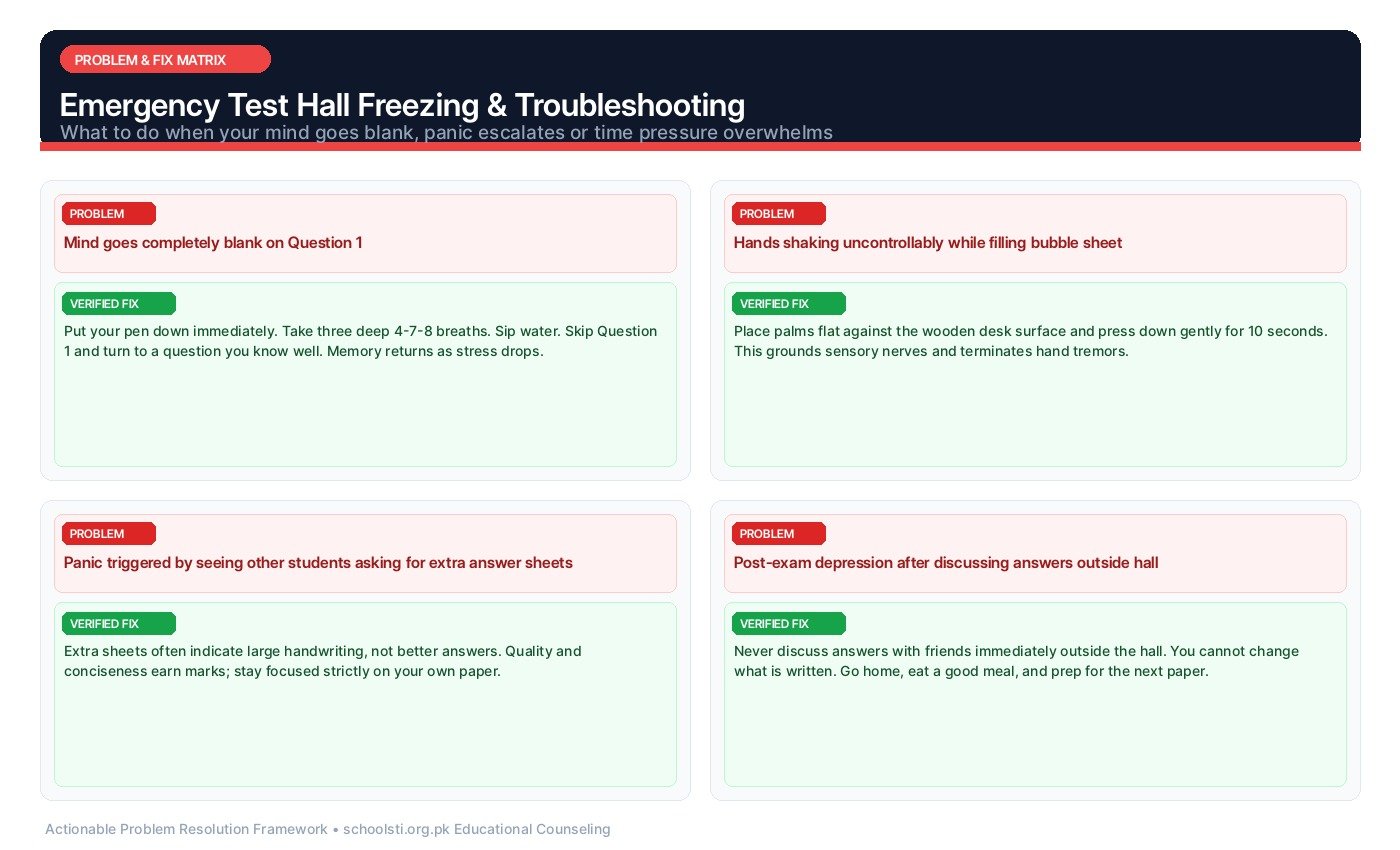
⚠️ Problem: My mind goes completely blank during the paper.
✅ Verified Solution: Set your pen down and do four slow rounds of box breathing, then the 5-4-3-2-1 grounding exercise. Start with the easiest question you can find — writing anything breaks the freeze, and memory usually returns within minutes. This is a stress response, not lost knowledge.
⚠️ Problem: I cannot sleep the night before an exam.
✅ Verified Solution: Stop studying an hour before bed and keep your phone away. Try slow breathing, and if thoughts race, write your worries on paper with a morning plan — the brain rests easier when it trusts the plan. Avoid sleeping pills unless a doctor advises them.
⚠️ Problem: I start crying or break down while studying.
✅ Verified Solution: Pause immediately — tears release pressure and are not weakness. Wash your face, drink water, and step outside for ten minutes. If breakdowns happen often, talk to someone you trust or a counselor. Studying through tears teaches your brain to fear the books.
⚠️ Problem: My parents' expectations are crushing me.
✅ Verified Solution: Their pressure usually comes from love and worry about your future, even when it hurts. Speak calmly before exam season about how it affects you, and ask for specific support — like quiet study time instead of constant questioning. If direct talk feels unsafe, ask a teacher or elder to mediate.
⚠️ Problem: I keep comparing myself with toppers and siblings.
✅ Verified Solution: Comparison is anxiety's favorite fuel. Mute anyone whose posts make you feel small during exam season — you only see their highlights. Measure yourself against your own last test, not someone else's result. Steady personal improvement is the only fair race.
⚠️ Problem: I feel nauseous or get headaches before exams.
✅ Verified Solution: These are common physical anxiety symptoms, not illness. Eat light, avoid excess caffeine, and keep water nearby — slow breathing usually eases nausea within minutes. If symptoms are severe or return before every exam for weeks, see a doctor and a counselor.
Frequently Asked Questions (FAQ)
Clear, direct answers to common questions about How to Overcome Exam Anxiety, Panic Attacks, and Fear of Failure: