How Examiners Actually Check Your Paper
Here is the truth most students never hear: a board examiner checks hundreds of answer sheets in a few days. On your paper, they may spend only a few minutes — not reading every word, but scanning for keywords, headings, structure, and relevance against the official marking scheme.
This is why presentation matters. The examiner matches your answer against listed key points as fast as possible. If your answer is a dense wall of text, a tired examiner must dig for those points — and hard-to-find points get missed.
So the golden rule is simple: write for a tired examiner. Clear headings, underlined keywords, neat diagrams, and logical flow make your marks impossible to miss. Students with equal knowledge often differ by 10 to 20 marks purely because of presentation.
Presentation Fundamentals: The Non-Negotiables
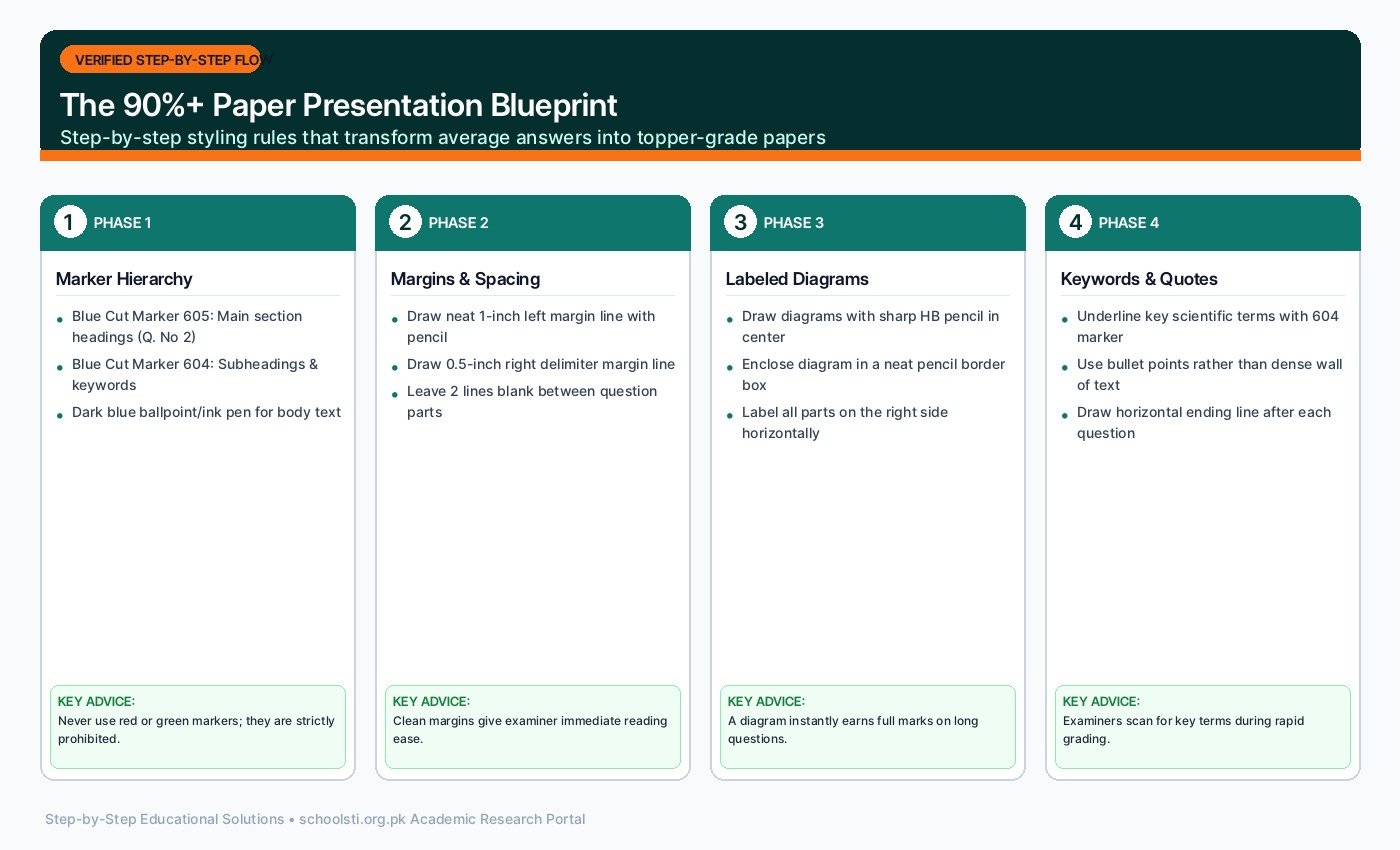
Set up your paper correctly before writing a single answer. These basics apply to every board subject, from Physics to Islamiat.
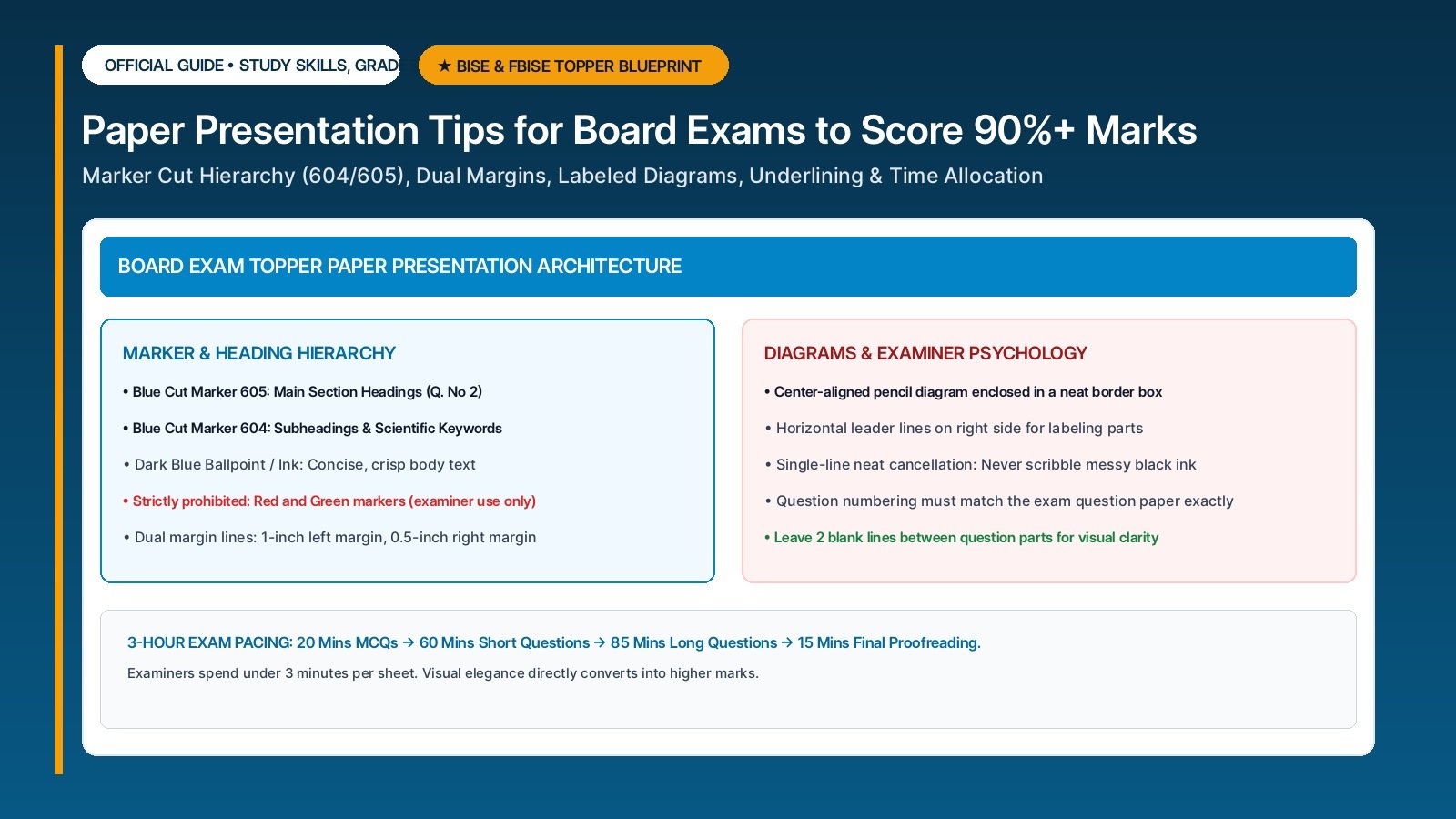
Margins and layout: Respect the printed left margin on every page. You do not need a fresh page for each question, but never cram two long answers into one block. Leave one blank line between answers so the examiner sees where each one ends.
Pen colours: The standard accepted practice is a blue pen for answers and a black pen for headings and underlining. This two-colour system makes your structure visible at a glance. Never use red or green — red belongs to the examiner.
Question numbers: Write the number clearly at the start of each answer, exactly as printed in the paper — for example, Q3 (b). Wrong or missing numbers can send your marks to the wrong question.
Diagrams: Draw in pencil where required and label every part neatly. A clean labelled diagram can secure full marks for that part even when your written explanation is brief.
Cutting mistakes: Never scribble a mistake into a black blob. Draw one clean horizontal line through the wrong word and continue writing.
Answer Structure for Every Question Type
Different questions need different structures. Matching the structure to the question type is one of the fastest ways to lift your score.
Short Questions (2–3 marks)
Be direct: 3 to 5 precise lines containing the defining keywords of the concept. Do not write a full page for a 2-mark question — it steals time from bigger questions. Give the definition first, add one clarifying line, and underline the key term.
Long Questions (5–10 marks)
Use introduction–body–conclusion. Open with one or two lines introducing the topic, divide the body with sub-headings and bullet points, and close with a one-line conclusion. Headings map directly onto the marking scheme, so a well-headed answer of one and a half pages routinely beats a heading-less answer of three pages.
Numericals (Physics, Chemistry, Mathematics)
Follow Given / Find / Solution / Unit every time. Write the given data with symbols, show each step clearly, and always write the final unit. Marks are allotted step-wise, so correct steps and formula earn most of the marks even if the final answer slips. Box the final answer.
Islamiat and Pak Studies
These papers reward authentic references. In Islamiat, a correctly quoted verse or Hadith strengthens your answer — but only quote what you remember accurately, since a wrong reference hurts more than none. In Pak Studies, give dates, names, and events precisely, and shape answers with headings like causes, events, and results.
Time Management: The 3-Hour Paper Plan
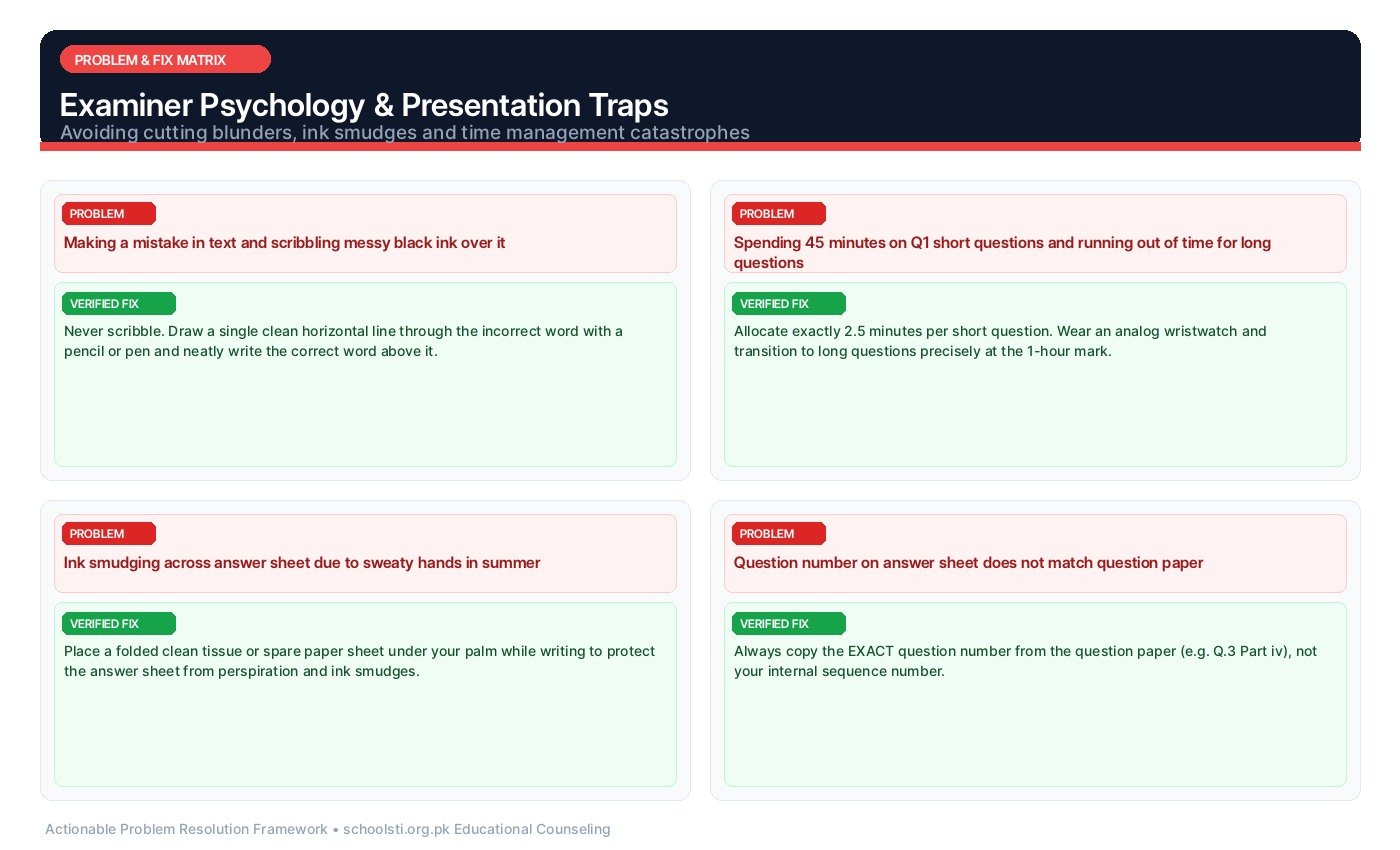
Most board theory papers run for 3 hours (180 minutes). Students who 'run out of time' almost always spent too long on the first questions. Divide your time before you start writing and stick to the plan.
Below is a realistic allocation for a typical 100-mark theory paper. Adjust the numbers to your paper's actual structure, but keep the principle: fixed time per section plus a protected revision slot.
| Section | Time | What to Do |
|---|---|---|
| Reading the paper | 10 min | Read all questions; mark easy, medium, and tough |
| Objective / MCQs | 15 min | Attempt all; never get stuck on one MCQ |
| Short questions | 55 min | To-the-point answers, keywords underlined |
| Long questions | 80 min | Headed answers; attempt strongest first |
| Revision round | 20 min | Check numbers, units, diagrams, roll number |
Your Exam-Day Attempt Sequence, Step by Step
Top scorers do not attempt the paper in printed order — they attempt it in strength order. Follow this sequence on exam day.
- Fill in your details first Write your roll number, name, and paper details exactly as on your roll number slip before touching any question. A wrong roll number is the most expensive two-minute mistake in board exams.
- Read the full paper for 10 minutes Read every question calmly. Tick the ones you can answer well, circle the uncertain ones, and cross the toughest. This map decides your attempt order.
- Attempt the objective section Start with MCQs while your mind is fresh. There is no negative marking, so answer every MCQ. Spend no more than a minute on any single one — mark it and move on.
- Attempt your strongest questions first Begin the subjective section with what you know best. Strong early answers build confidence and create a good first impression on the examiner.
- Tackle medium questions next Attempt the circled questions now. Even partial knowledge earns step marks — write the formula, the definition, or the diagram. Never leave a question completely blank.
- Handle the toughest questions last Attempt the crossed questions at the end. Your memory has been working in the background, and earlier questions may have triggered recall. Write whatever relevant structure you can.
- Use the final 20 minutes for revision Verify every question number, confirm all parts are attempted, check units and diagram labels, and ensure extra sheets are tied in order. Read your roll number once more.
Common Mistakes and How Examiners See Them
These are the mistakes examiners see most often, what each looks like from their side of the desk, and the simple fix. Avoiding these alone can protect 10 to 15 marks.
| Mistake | What the Examiner Sees | Fix |
|---|---|---|
| Wall of text, no headings | Marking-scheme points hard to find; may be missed | Sub-headings and bullets in every long answer |
| Wrong or missing question numbers | Marks recorded against the wrong question | Write Q numbers before starting each answer |
| Messy cutting and overwriting | Careless work; correct text hidden | One clean line through errors, then continue |
| Leaving questions blank | Zero marks, guaranteed | Attempt everything — partial steps earn marks |
| Missing units in numericals | Incomplete answer; unit marks lost | Always write the unit; box the final answer |
| Unlabelled or missing diagrams | Diagram marks lost despite good theory | Draw in pencil; label every part neatly |
| Extra sheets untied or unordered | Answers missed or marked out of sequence | Number sheets, write roll number, tie securely |
| Illegible rushed handwriting | Examiner guesses or skips your points | Slow down slightly; clear writing beats fast scrawl |
Troubleshooting: Common Student Problems & Verified Solutions
Real-world issues reported by Pakistani applicants and students, with actionable step-by-step solutions:
⚠️ Problem: My handwriting is bad and I worry it costs me marks
✅ Verified Solution: Examiners need readable handwriting, not beautiful handwriting. Write slightly larger than usual, space your words evenly, and form each letter fully instead of rushing. Practise one past paper per week under timed conditions — legibility improves fast with deliberate effort.
⚠️ Problem: I always run out of time and leave the paper incomplete
✅ Verified Solution: This is a planning problem, not a speed problem. Use the 3-hour allocation table with a wristwatch and enforce per-question limits. Attempt your strongest questions first so your best answers are never the unwritten ones. In the last 15 minutes, switch to bullet points — they are faster to write and easier to mark.
⚠️ Problem: I forget formulas and definitions mid-paper
✅ Verified Solution: Skipping the question and moving on usually helps — the formula often surfaces while you work on related questions. During preparation, write formulas out by hand on a one-page sheet per chapter; writing locks memory far better than reading. In the paper, derive from what you know: correct steps with the right method still earn step marks.
⚠️ Problem: I blank out completely on a question I studied
✅ Verified Solution: Do not stare at it — staring deepens the block. Move to the next question and return later with fresh eyes. When you return, jot down anything related: the chapter heading, a diagram, key terms. These retrieval cues often rebuild the answer. Thirty seconds of slow breathing genuinely helps recall under pressure.
⚠️ Problem: I get confused with extra sheets and their order
✅ Verified Solution: Take an extra sheet only when the main answer book is full. Number each sheet at the top, write your roll number on every one, and tie them securely in order at the end. Note the total count where the answer book asks. During revision, flip through the tied sheets once to confirm nothing is loose or out of sequence.
⚠️ Problem: I know the answers but still get low marks
✅ Verified Solution: Knowing content and presenting content are different skills, and board marking rewards the second. Get a past paper checked by a teacher specifically for presentation. Run through this list: headings and underlining, question numbers, units in numericals, labelled diagrams, all parts attempted, clean cutting. Most low-score surprises trace back to two or three of these.
Frequently Asked Questions (FAQ)
Clear, direct answers to common questions about Paper Presentation Tips for Board Exams (BISE & FBISE) to Score 90%+ Marks: