What You Actually Study in Each Group
After matric, every BISE board in Pakistan offers the same three big science tracks at intermediate level: FSc Pre-Medical, FSc Pre-Engineering and ICS (Intermediate in Computer Science). The compulsory subjects are the same across all three — Urdu, English, Islamiat in first year and Pakistan Studies in second year. What changes is the elective combination, and that combination quietly decides which university doors stay open for you later.
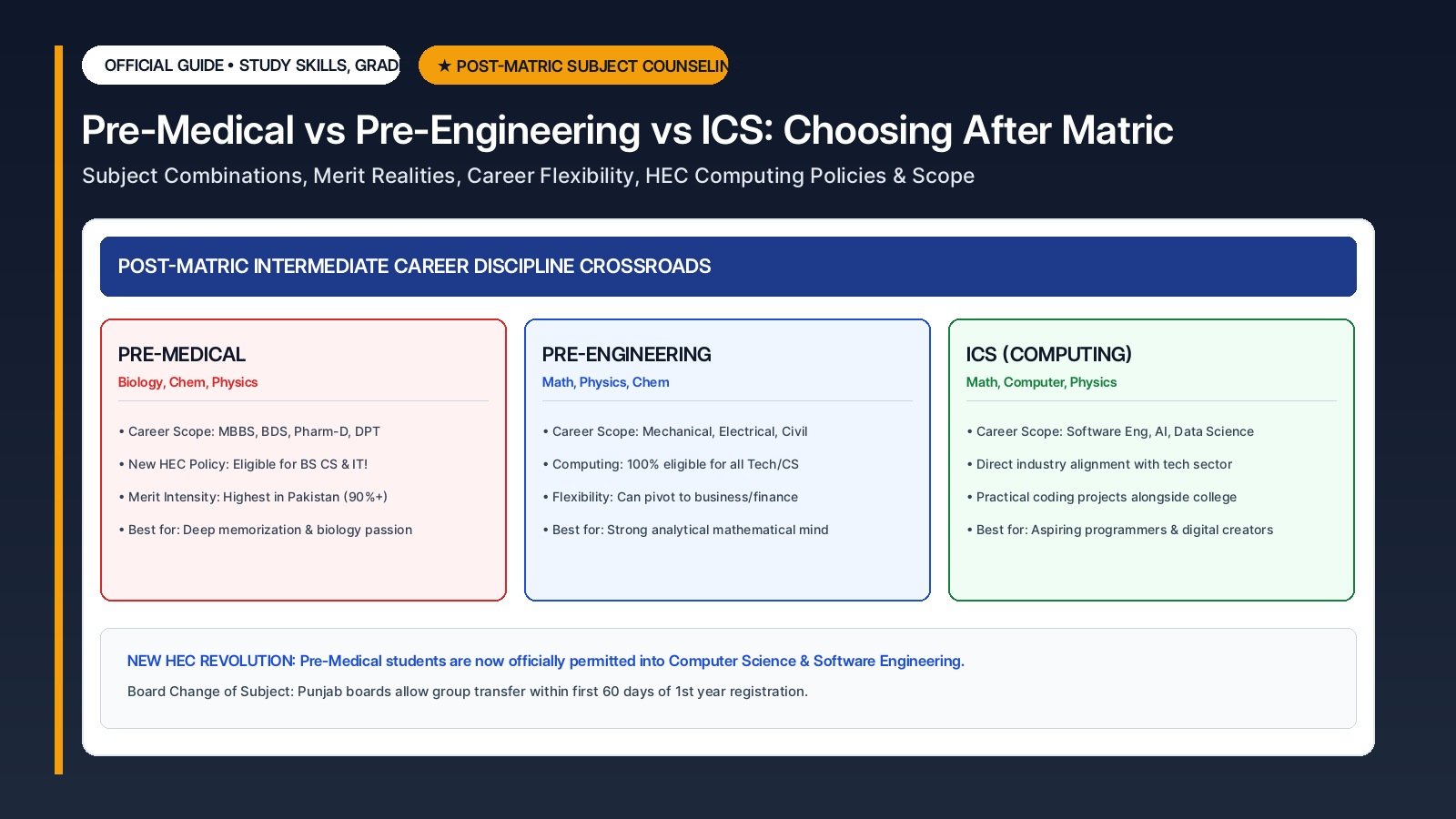
In pre-medical, your electives are Physics, Chemistry and Biology. You will spend two years on living systems in depth — anatomy, cell biology, genetics and organic chemistry — and it is the only FSc route that keeps the MDCAT pathway fully open.
In pre-engineering, your electives are Physics, Chemistry and Mathematics. Biology is replaced by maths — calculus, trigonometry, vectors, matrices and mechanics-flavoured physics problems. This combination builds the exact foundation that engineering entry tests and university engineering programmes assume you already have.
ICS replaces the traditional science trio with a computing-centred combination. The standard versions offered by most boards are ICS with Statistics, ICS with Mathematics, or ICS with Economics, always alongside Computer Science. The computer science syllabus introduces programming fundamentals, databases, networking basics and computer architecture — the real starting point of a software career. The table below lays out the combinations side by side.
| Group | Elective Subjects (Part I & II) | Best Known For |
|---|---|---|
| FSc Pre-Medical | Physics, Chemistry, Biology | MDCAT, MBBS/BDS, pharmacy, DPT, allied health |
| FSc Pre-Engineering | Physics, Chemistry, Mathematics | Engineering, architecture, CS, technology degrees |
| ICS (Statistics) | Computer Science, Statistics, (board variant) | Programming, data, business analytics |
| ICS (Mathematics) | Computer Science, Mathematics, (board variant) | Software, CS degrees, engineering tech |
| ICS (Economics) | Computer Science, Economics, (board variant) | Business, commerce-tech, management sciences |
Who Each Group Genuinely Suits: Honest Aptitude Guidance
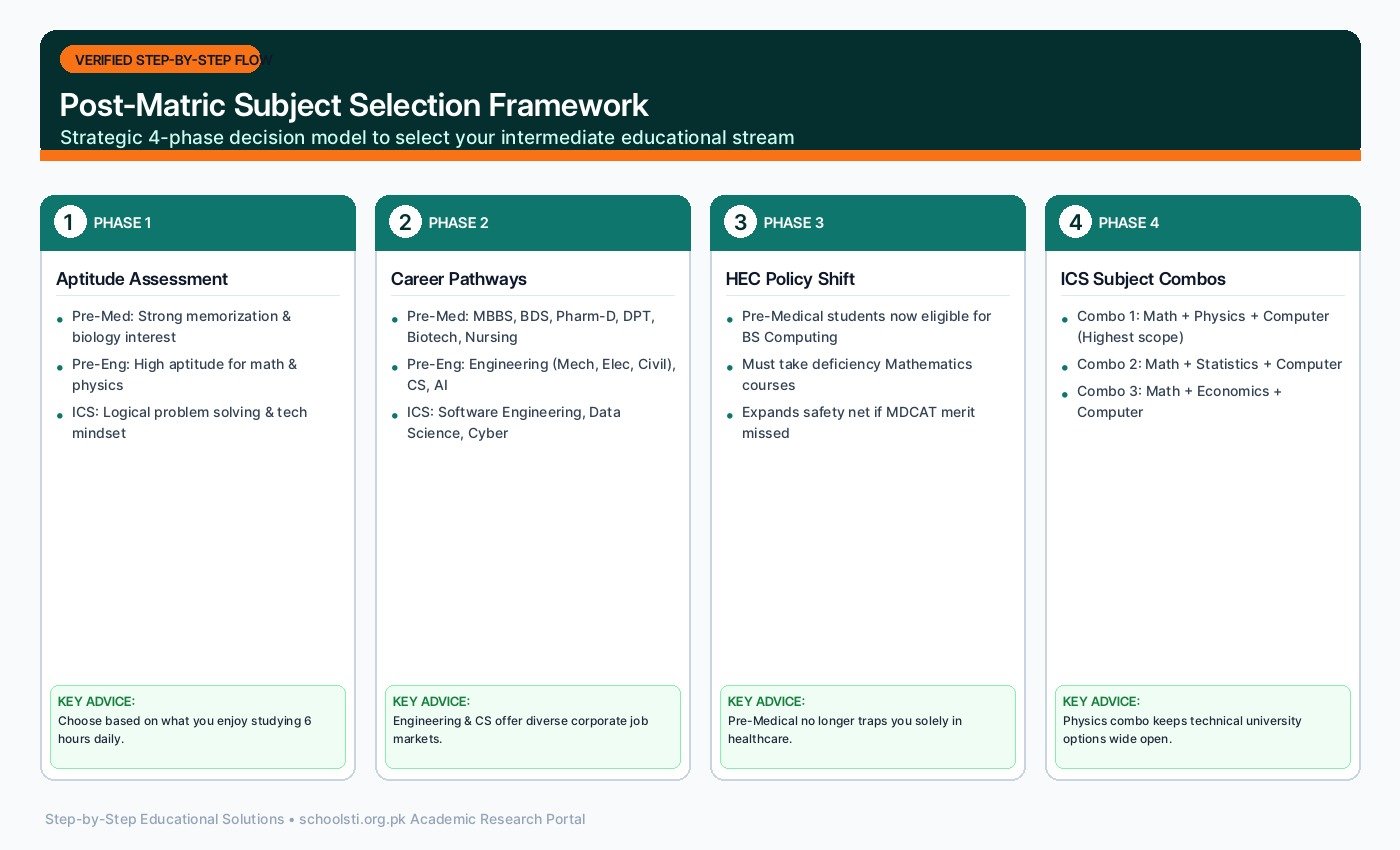
This is the section most guides skip, and it is the one that matters most. A subject group is not a status symbol — it is a two-year daily routine. Pick the one whose daily work you can actually tolerate and enjoy.
Pre-medical suits students who are comfortable with heavy memorisation, genuinely curious about the human body and living things, and patient enough for long study sessions. If you enjoyed matric biology, can revise definitions repeatedly without losing your mind, and accept that medicine is a long road, pre-medical is a natural fit. It does not suit students who pick it only because relatives say doctor bano — that motivation burns out fast when organic chemistry arrives.
Pre-engineering suits students who like mathematics and logical problem-solving. If you found matric maths satisfying rather than painful and enjoy physics numericals, this is your territory. It does not suit students who are weak in maths and hope FSc will be easier — it gets harder, and two years of struggling with calculus damages your overall marks.
ICS suits students who think logically, enjoy working on computers, and prefer understanding systems over memorising long theory. If you taught yourself a little coding, enjoy puzzles, or find biology memorisation exhausting, ICS can be a relief. ICS with Statistics is gentler than ICS with Mathematics, so pick the variant honestly. Note that ICS still demands consistent study — programming requires practice, not just reading.
Careers and University Doors Each Group Opens
Each group unlocks a different set of degree programmes, and understanding this map prevents the most common regret: reaching second year and discovering your dream degree needed a different combination.
From pre-medical, the headline route is the MDCAT for MBBS and BDS in public and private medical colleges. Beyond that sit genuinely strong options: Pharm-D (pharmacy), DPT (physiotherapy), BS Nursing, medical laboratory technology, radiology and imaging technology, emergency technology, optometry, nutrition sciences, biotechnology and genetics. Several of these do not require the MDCAT at all.
From pre-engineering, the routes include all PEC-recognised engineering disciplines (electrical, mechanical, civil, software, mechatronics and more), architecture (which also needs an aptitude test at most universities), BS Computer Science and related computing degrees, and technology programmes. Engineering entry tests vary by university, so check each university's published admission policy.
From ICS, the natural routes are BS Computer Science, Software Engineering, Information Technology, Data Science, Artificial Intelligence and business-tech hybrids like business analytics. ICS students can also enter BBA and management sciences comfortably. On merit: closing merits shift every year with applicant numbers and test difficulty, so never trust exact figures from memory or rumour. Treat any merit figure as indicative only and verify on the official website of the admitting university, as per the latest published policy — reviewed October 2026.
| Group | Major Degree Routes | Entry Test / Merit Notes |
|---|---|---|
| Pre-Medical | MBBS, BDS, Pharm-D, DPT, BS Nursing, MLT, Radiology | MDCAT for medical colleges; very high competition in public sector |
| Pre-Engineering | BSc Engineering, Architecture, BS CS, BS IT | University-specific entry tests; maths foundation essential |
| ICS | BS CS, Software Engineering, Data Science, BBA | Computing merit often high at top universities; no MDCAT route by default |
A 7-Day Decision Plan for Students and Parents
Do not decide in one emotional evening. Give this choice one structured week. Work through the plan below with a parent or teacher — it is designed to replace pressure and rumours with evidence about you.
- Day 1 — Write down your matric reality List your matric marks in maths, physics, chemistry, biology and computer science. Circle your two strongest and two weakest — this is your starting evidence.
- Day 2 — Rank what you enjoy, honestly For each elective subject, write one line: do I enjoy studying this, tolerate it, or dread it? A subject you dread for two years will cost you marks in every other subject too, because demotivation spreads.
- Day 3 — Interview two seniors from each group Ask students in FSc Part I or II of each group: what is the hardest part, how many hours do you study daily, and would you choose it again? Real routines beat prospectus promises.
- Day 4 — Map three careers, not one For each group, write three realistic careers you would be happy with — not just the headline one (not only MBBS, not only software engineer). If a group has only one career you want and ten you dislike, that is a warning sign.
- Day 5 — Check eligibility rules in writing Check the official websites of your board, the testing bodies and two or three target universities, and note the published eligibility criteria. Save the pages — policies change.
- Day 6 — Hold the family meeting Present your evidence calmly: your marks, your interests, your career map and the official eligibility rules. Parents usually push one option out of love and incomplete information — data turns the argument into a discussion.
- Day 7 — Decide and commit fully Choose, then stop second-guessing. Every group rewards full commitment and punishes half-hearted regret. Write your choice and your reasons on one page and keep it — on hard days in first year, it will remind you why you chose this path.
Switching Groups: Myths vs Reality
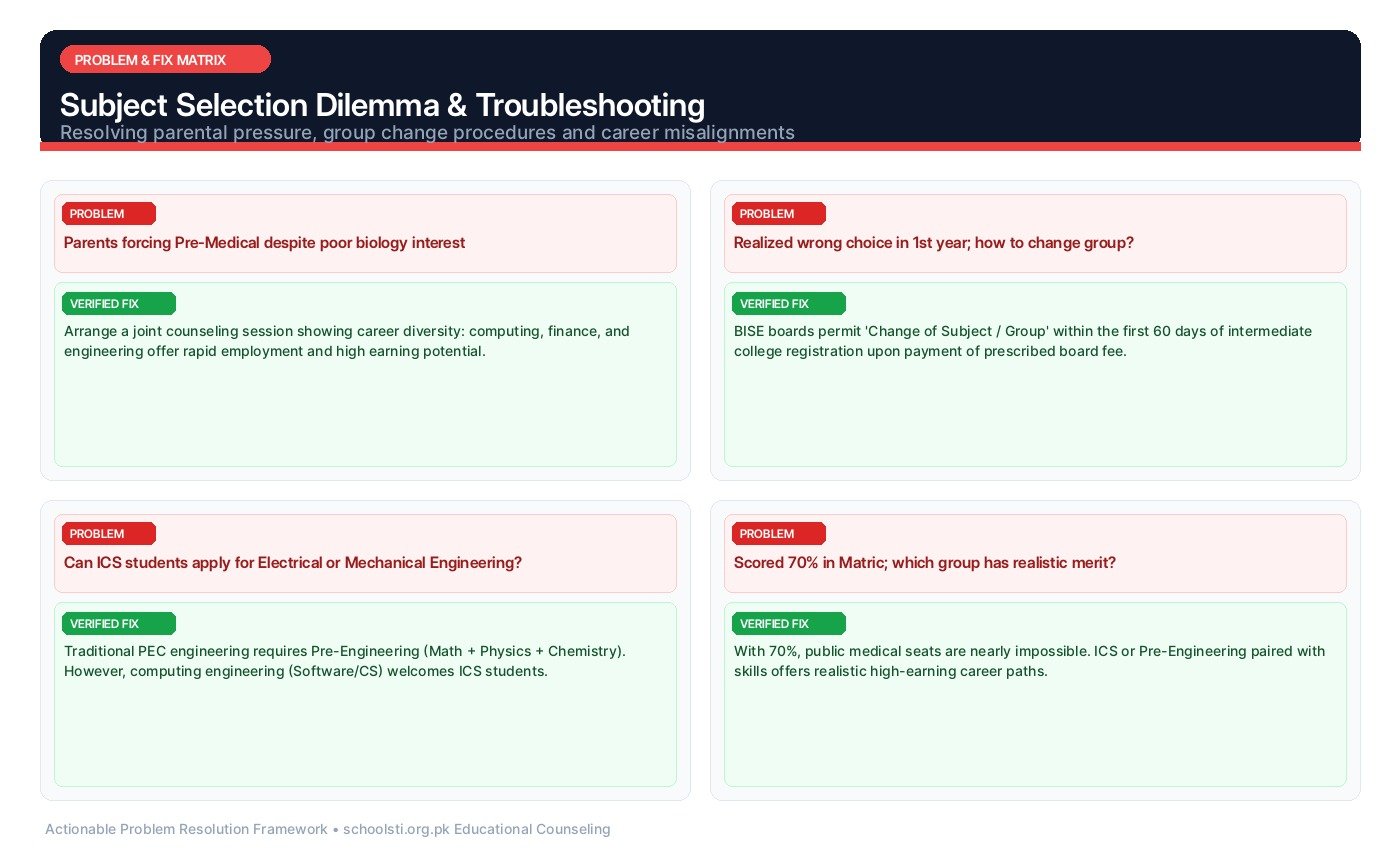
Myth: you can never switch groups after admission. Reality: boards do allow group changes within defined windows and rules, usually early in first year, but the exact procedure, deadlines and any conditions are set by each board. Because these rules change, confirm them on your board's official website rather than relying on what a senior did three years ago — as per the latest published policy, reviewed October 2026.
Myth: pre-medical students can never enter computing. Reality: many computing degrees accept FSc pre-medical students, though some universities require an additional mathematics course or set conditions. Check each university's published eligibility criteria — the rules differ between institutions.
Myth: ICS students can give the MDCAT and become doctors. Reality: medical college eligibility rules are set by the national regulator and have specific subject requirements at intermediate level. Do not assume — read the current MDCAT eligibility policy on the official website of the testing/regulatory body before planning around it, as per the latest published policy, reviewed October 2026.
Myth: switching is always a disaster. Reality: an early, well-planned switch (first few months of Part I) costs little. A late switch after Part I exams means repeating a year of the new combination's subjects. The real disaster is never the switch — it is staying two years in the wrong group out of embarrassment.
The practical takeaway: choose carefully now using the 7-day plan above, but know that an early correction is a sign of maturity, not failure. Just make every eligibility assumption earn its place by checking the official source.
Troubleshooting: Common Student Problems & Verified Solutions
Real-world issues reported by Pakistani applicants and students, with actionable step-by-step solutions:
⚠️ Problem: My parents want only MBBS and will not discuss anything else.
✅ Verified Solution: Do not argue against MBBS — argue with information. Prepare a one-page comparison showing how many students compete for how few public medical seats each year, plus two or three strong alternative careers from pre-medical (Pharm-D, DPT, MLT) with their demand. Parents pushing MBBS usually fear you will end up with nothing; showing them real backup plans inside the same group often softens the stance.
⚠️ Problem: I am weak in maths but I already picked pre-engineering.
✅ Verified Solution: Be brutally honest in the first month: if FSc maths feels impossible despite daily effort and tuition, speak to your college about a group change before the board's deadline passes. Staying means two years of low marks that close every door, including non-engineering ones. An early switch to ICS (Statistics) or pre-medical, if your aptitude fits, protects your overall percentage.
⚠️ Problem: I chose pre-medical but I hate memorising biology.
✅ Verified Solution: First distinguish dislike from difficulty — dislike of memorisation rarely improves, difficulty with effort does. If after two months of genuine effort you still dread every biology chapter, you are likely in the wrong group. Talk to your teachers about whether ICS or pre-engineering matches your strengths better, and check the group-change rules on your board's official website immediately.
⚠️ Problem: All my friends are taking ICS, but I actually like physics and maths.
✅ Verified Solution: Follow your aptitude, not your friend circle — you will make new friends in any group within weeks, but you will live with your subjects for two years. Students who pick pre-engineering for its own sake consistently outperform students who picked ICS just to stay with friends and then discover they dislike programming.
⚠️ Problem: My matric marks are too low for the group I want at a good college.
✅ Verified Solution: Separate the group from the college: a slightly less famous college with your right group beats a famous college with the wrong group. Also check evening shifts, nearby colleges and the merit lists of the second and third rounds — cutoffs often drop. Your intermediate marks matter far more for your future than your college's name.
Frequently Asked Questions (FAQ)
Clear, direct answers to common questions about Pre-Medical vs Pre-Engineering vs ICS: Complete Guide to Choosing Your Subject After Matric: