What a Strong LOR Contains (and What a Weak One Looks Like)
A recommendation letter is one of the few parts of your application you do not write yourself — which is exactly why admissions committees trust it. A strong LOR does not just say you are a good student; it proves it with specific stories, comparisons with your peers, and concrete details only a teacher could know. When a professor writes that you rebuilt a class project's database module in two weeks, or that you ranked in the top 5% of a 120-student class, the reader believes it because the evidence is right there on the page.
A weak LOR, by contrast, is vague praise that could describe anyone: hardworking, punctual, good student. Admissions officers read thousands of these and learn nothing from them. Worse, a generic letter quietly signals that the professor barely knew you — which hurts more than it helps. The table below shows the difference side by side.
The good news is that whether your letter ends up strong or weak is largely decided before the professor writes a single word — by whom you ask, when you ask, and what material you give them. This guide walks you through the whole process, including the exact emails to send.
| A weak, generic LOR says... | A strong, specific LOR says... |
|---|---|
| He is a good and hardworking student. | She ranked in the top 5% of my 120-student Data Structures course. |
| She always submitted assignments on time. | He rebuilt our final-year project's database module in two weeks after the original design failed. |
| I recommend him for your program. | I recommend her without reservation — she is among the strongest three students I have taught in six years. |
| Half a page long, with no examples at all. | One to two pages with specific stories and peer comparisons. |
| Sent from a personal email address, no letterhead. | On university letterhead, signed, sent from the professor's official email. |
How to Request a Recommendation Letter: Step by Step
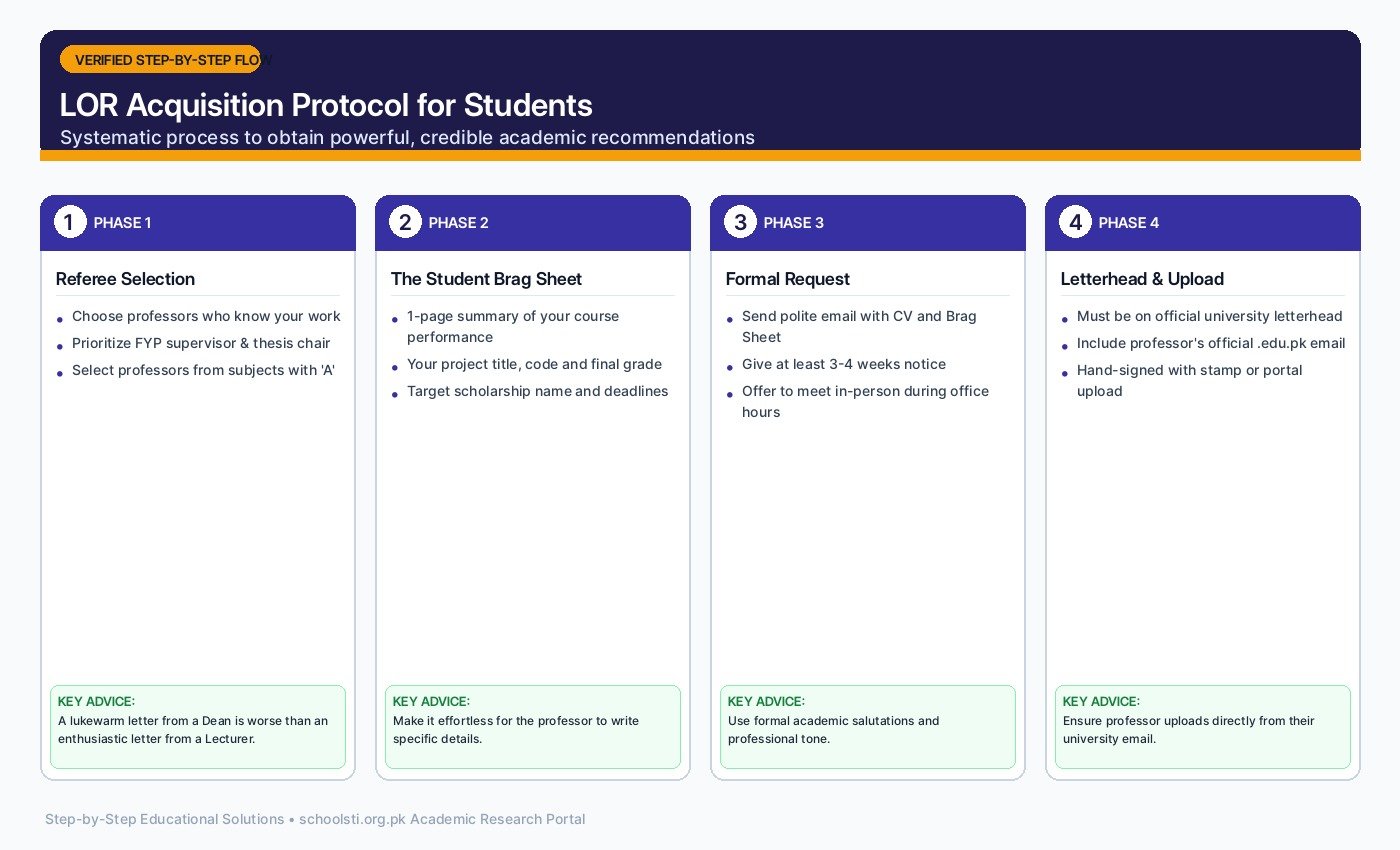
Requesting an LOR is a small project with a big payoff. Follow these five steps in order, and you will make it easy for your professor to say yes — and to write you a letter that actually helps.
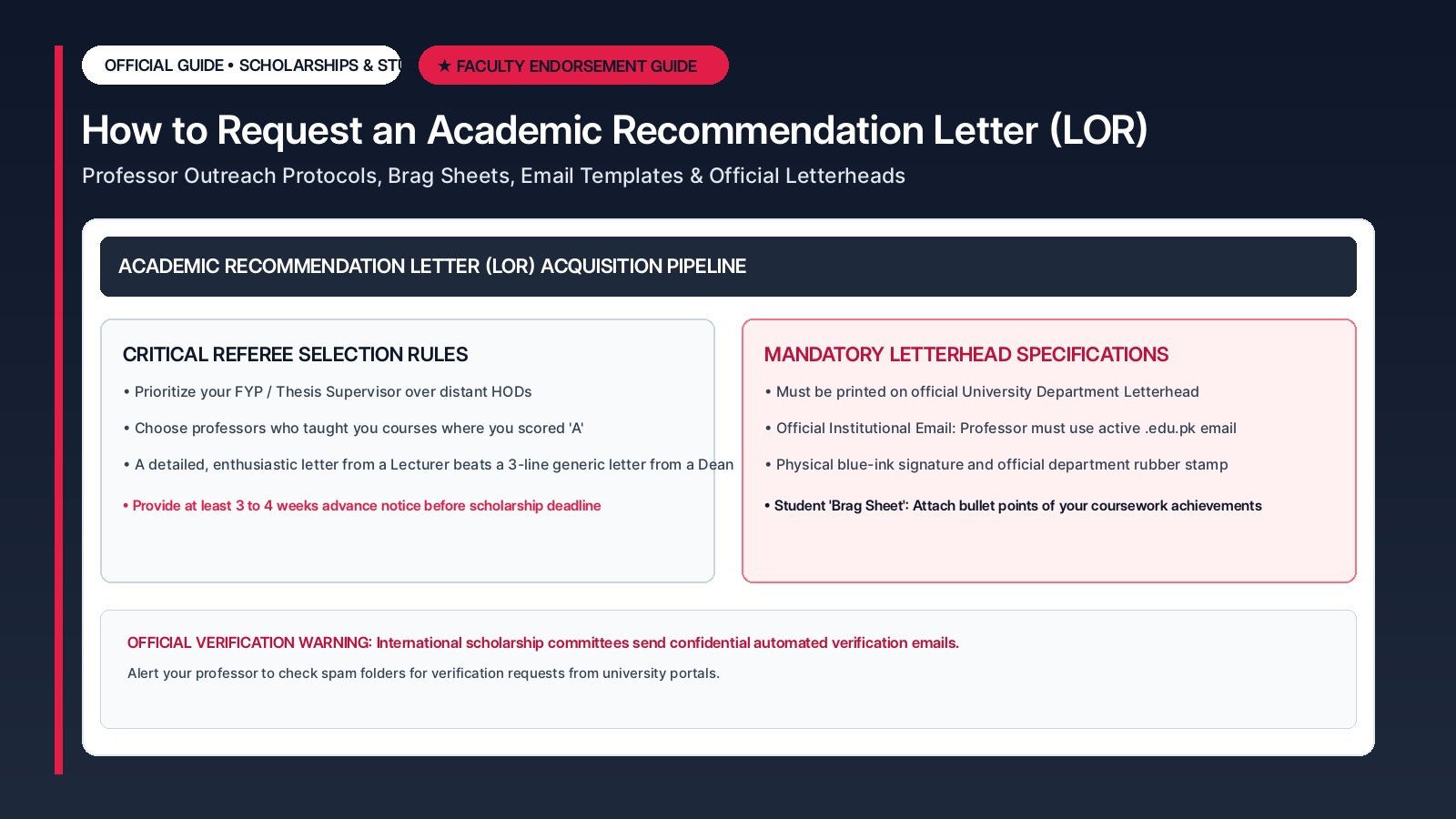
- Choose the right professor — someone who knows your work The best recommender is a professor who taught you recently, graded your assignments, or supervised your project or thesis. A famous professor who barely remembers your name will write a polite but empty letter; a lecturer who watched you work for a full semester will write a vivid one. Prefer professors from your final two years whose courses relate to the field you are applying to. Shortlist three to four names so you always have backups.
- Ask 4-6 weeks before your earliest deadline Timing is the most common mistake students make. Professors are busy, and a good letter takes real time to write. Ask at least four to six weeks before your earliest deadline — earlier if the deadline falls near exams or holidays. State the earliest deadline clearly in your first email so there are no surprises later.
- Prepare a complete recommender packet Never ask a professor to write from memory alone. Send one organised message with everything attached: your updated CV, a draft of your statement of purpose, a one-page list of bullet-point achievements and anecdotes from their course (your grade, your project, your presentation topic), and a clear list of universities with deadlines and how each letter is submitted (portal link or email address). Include your full name, student ID, department, and the semester you took their course. A complete packet is the difference between a detailed letter and a vague one.
- Send the first-request email (template below) Copy the template below, personalise every placeholder, and send it from your university email address if you have one. Subject: Request for Letter of Recommendation — [Your Full Name], [Course Name, Semester] Dear Professor [Last Name], I hope you are well. My name is [Your Full Name], and I took your [Course Name] class in [Semester and Year]. [One-line reminder, for example: I earned an A grade in your course and completed my term project on (topic).] I am applying to [Master's/PhD] programs in [Field] for the [for example, Fall 2027] intake, and I would be honoured if you could write a strong letter of recommendation for me. My earliest deadline is [Date]. To make this as easy as possible, I have attached my CV, a draft of my statement of purpose, and a short note on my work in your course. [If the university uses a portal: Once I enter your details, the university will email you a secure submission link.] I completely understand if your schedule does not allow it — please let me know either way, and I will be grateful for your honest answer. Thank you for your time, and for a wonderful course. Warm regards, [Your Full Name] [Student ID, Department, University] [Phone Number]
- Follow up once, politely (template below) If you hear nothing after 7-10 days, send one polite follow-up. Professors receive hundreds of emails; a gentle nudge is expected, not rude. Subject: Gentle reminder: recommendation letter due [Date] — [Your Full Name] Dear Professor [Last Name], I hope you are well. I am writing to follow up on my email of [Date of first email] about a letter of recommendation for my [Master's/PhD] applications. The deadline for [University Name] is [Date]. Please let me know if you need anything else from me — I can resend my CV, statement draft, or course notes immediately. And if the timeline does not work for you, I completely understand; just let me know. Thank you again for your support. Warm regards, [Your Full Name] [Student ID, Department, University] [Phone Number] If there is still no reply after this second nudge, move to your backup recommender instead of waiting until deadline week.
After They Say Yes: Set Your Professor Up for Success
Once a professor agrees, reply within a day: thank them warmly and send the full packet if you have not already. Confirm the earliest deadline and exactly how each university wants the letter — portal link, email address, or sealed envelope. Professors juggle many requests, so make yours the easy one to complete.
One week before each deadline, send a single short reminder with the submission link and the deadline in the first two lines. After the letter is submitted, thank them again — and later, tell them where you got in. Professors genuinely love hearing the outcome, and you may need their help again for scholarships or PhD applications.
On application portals you will usually be asked whether you waive your right to view the letter. Say yes. A waived, confidential letter is trusted far more by admissions committees because it signals the professor wrote candidly. Keeping the right to read it makes readers suspect the letter was written to please you.
| Recommendation Feature | Weak / Generic LOR (Rejection Trigger) | Winning High-Impact LOR (Selection Driver) |
|---|---|---|
| Faculty Depth | Lists grades already visible on transcript | Details student problem-solving, laboratory resilience & intellectual initiative |
| Specific Evidence | "The student was hardworking and disciplined in my class" | Describes exact term project challenges, algorithm design, and leadership |
| Comparative Ranking | No comparative benchmark provided | "Ranks among the top 3% of undergraduates I have supervised over 10 years" |
| Institutional Credibility | Printed on plain paper without rubber stamp | Official Department Letterhead with active .edu.pk faculty verification email |
Special Situations Pakistani Applicants Often Face
Graduated years ago? Email your old professors with a rich reminder packet — your CV, transcript, and details of your projects or presentations. Memory fades, but specifics bring it back. If no professor is reachable, combine one employer letter with any academic contact you can find, and briefly explain the gap in your statement of purpose.
If your professor has retired or moved to another university, they can still write a powerful letter — their title and knowledge of your work matter, not their current office. Try their last university email address, or ask the department office to forward your request.
Some professors prefer to email the letter directly to the university instead of using a portal. That is normal — many universities actually prefer it. Give them the exact address, your application ID, and the deadline, then check the portal yourself to confirm it arrived.
If you worry that your professor's English is weak, help upstream: give them a well-organised one-page note of facts and short example sentences they can adapt. Content and credibility matter far more than perfect grammar, so focus on giving them strong facts to work with.
Troubleshooting: Common Student Problems & Verified Solutions
Real-world issues reported by Pakistani applicants and students, with actionable step-by-step solutions:
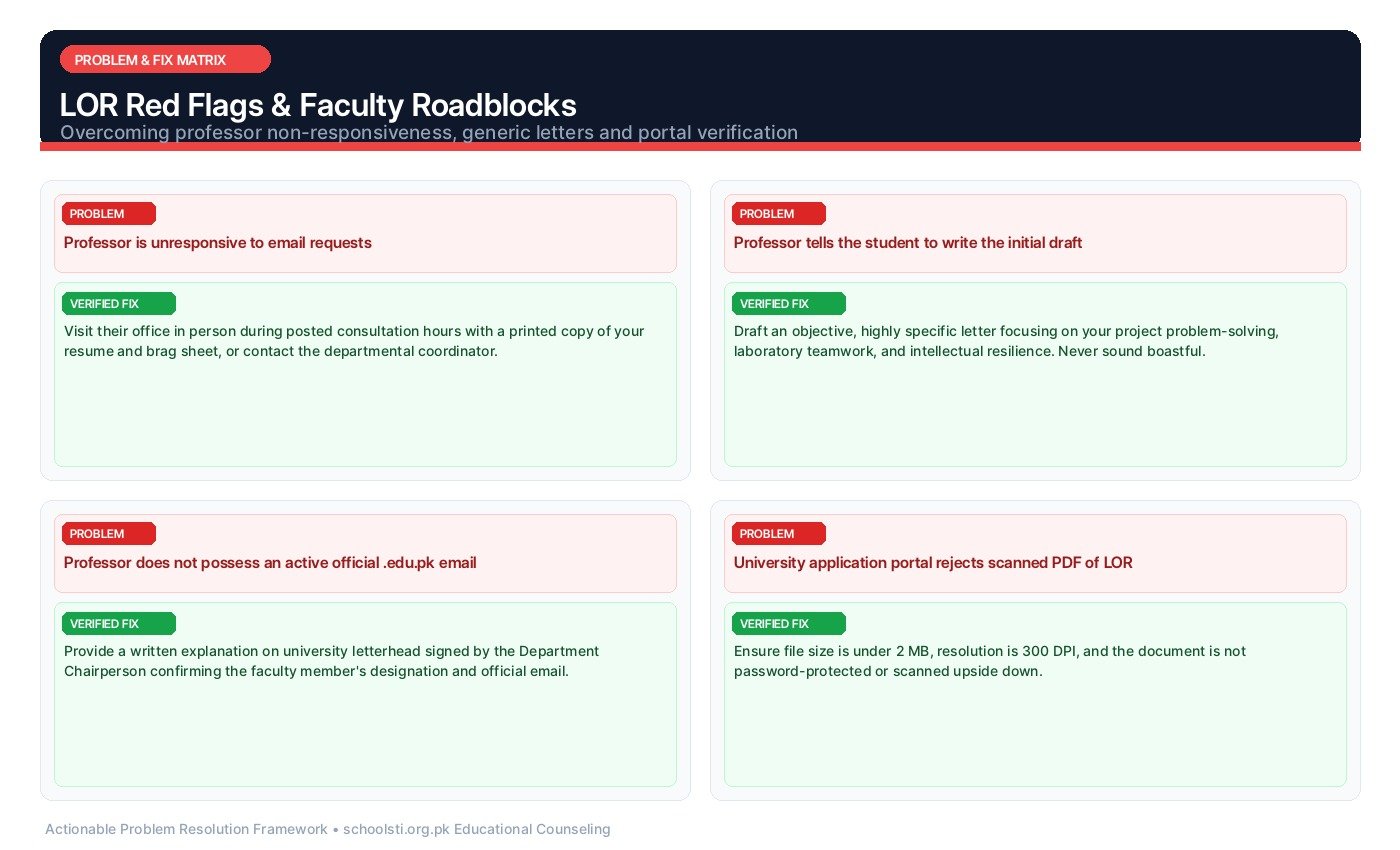
⚠️ Problem: My professor has not replied to my email.
✅ Verified Solution: Wait 7-10 working days first — professors receive hundreds of emails. Then send one polite follow-up with a clear subject line mentioning the deadline. If a second nudge also goes unanswered, try visiting during office hours or ask the department office for the best contact method. Do not keep waiting past three weeks before a deadline; switch to a backup recommender.
⚠️ Problem: My professor politely declined my request.
✅ Verified Solution: Do not argue or guilt-trip them — thank them for the honest answer. A declined request is far better than a lukewarm letter. Ask whether they can suggest another faculty member who knows your work, then approach that person immediately with your full packet ready.
⚠️ Problem: My professor asked me to draft the letter myself.
✅ Verified Solution: This happens often, but a self-written letter usually sounds like your own SOP and committees can tell. Instead, send detailed bullet points: four or five specific achievements, grades, and anecdotes from their course, and ask them to write the final letter in their own words. Never submit a letter the recommender has not read and approved.
⚠️ Problem: My deadline is less than two weeks away.
✅ Verified Solution: Be honest in your first email that the timeline is tight, and apologise for the rush. Send everything in one complete packet so no back-and-forth is needed, and ask directly whether the deadline is feasible. If it is not, switch to a recommender who can move fast — and next time, ask four to six weeks ahead.
⚠️ Problem: My professor retired or left the university.
✅ Verified Solution: Retired professors can still write strong letters — their title and memory of your work matter, not their office. Email their last known university address, or ask the department office to forward your request. As a last resort, a professional contact message can work. Because more time has passed, give them extra reminders of your coursework and achievements.
⚠️ Problem: My professor's English is weak and I fear the letter will read poorly.
✅ Verified Solution: Never rewrite their letter yourself. The best help comes earlier: give them a well-organised one-page note of facts, figures, and short example sentences they can adapt. You may politely ask whether they would like a colleague to proofread the final draft — many professors appreciate the offer. Committees care about content and credibility far more than perfect grammar.
Frequently Asked Questions (FAQ)
Clear, direct answers to common questions about How to Request an Academic Recommendation Letter (LOR) from Professors (Email Templates Included):