How Tuition-Free Really Works in Europe
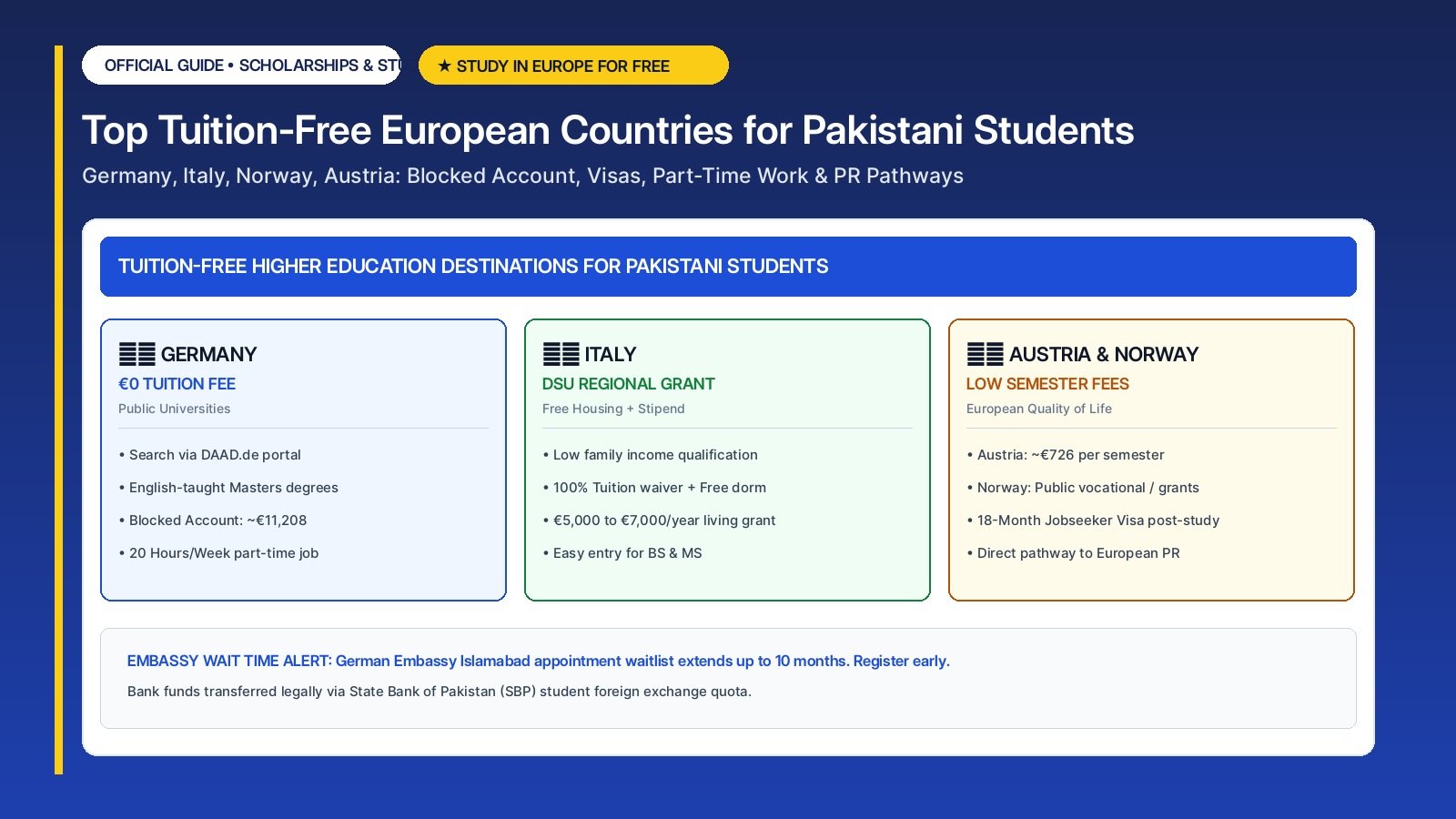
When people say studying in Europe is free, they mean something specific: public universities in several European countries charge no tuition fees, because higher education is funded by taxpayers. As an international student from Pakistan, you can enrol at these public universities and pay zero tuition — but that is where free ends and real costs begin.
Nearly every tuition-free university still charges a semester contribution — typically a few hundred euros per semester, covering student services and often a public transport pass. Verify the current official figure for your chosen university, reviewed October 2026. You must also fund your own living costs: rent, food, health insurance, and transport, which realistically run several hundred to over a thousand euros per month depending on the country and city.
There are important exceptions to know. Tuition-free places are mostly for degrees taught in the local language — particularly at Bachelor's level. English-taught programs, especially Bachelor's degrees, often charge tuition even at public universities, and some regions charge non-EU students tuition regardless. Private universities always charge full fees. So the honest formula is: free tuition is real, but only at the right universities, in the right programs — and living costs are never free.
Country-by-Country Comparison for Pakistani Students
The table below compares the most realistic tuition-free or very-low-cost options. Every cost figure is approximate — exchange rates, cities, and official requirements change, so verify the current official figure for your situation; reviewed October 2026.
| Country | Tuition status at public universities | Language reality | Estimated living cost per month | Proof of funds note |
|---|---|---|---|---|
| Germany | No tuition at most public universities; some states and programs charge non-EU students — verify current official requirement. | Many English-taught Master's; Bachelor's mostly German-taught. | Approximately EUR 900-1,100. | Blocked account: approximately EUR 992 per month, roughly EUR 11,900 per year. |
| Norway | No tuition at public universities, including for non-EU students. | English-taught Master's common; Bachelor's mostly Norwegian. | Approximately EUR 1,100-1,400. | Proof of funds required for the residence permit; the threshold is high. |
| Finland | Non-EU students typically pay tuition; generous scholarships are widely available. | Many English-taught Bachelor's and Master's programs. | Approximately EUR 800-1,100. | Proof of sufficient funds required for the residence permit. |
| Austria | Very low tuition for non-EU students — typically a few hundred euros per semester (approximate). | Mostly German-taught; a growing number of English Master's. | Approximately EUR 900-1,100. | Proof of funds required for the residence permit. |
| Czech Republic | Free if you study in Czech; English-taught programs charge tuition fees. | Czech for free programs; English programs are paid. | Approximately EUR 600-800. | Proof of funds required for the long-stay student visa. |
| France | Very low fees at public universities — typically a few hundred euros per year (approximate). | Mostly French-taught; growing English-taught Master's options. | Approximately EUR 800-1,200; Paris is higher. | Proof of funds required for the student visa. |
| Poland | Low tuition at public universities for non-EU students — typically EUR 2,000-4,000 per year (approximate). | Many English-taught programs available. | Approximately EUR 500-700. | Proof of funds required for the national student visa. |
Germany Blocked Account: Step-by-Step Process
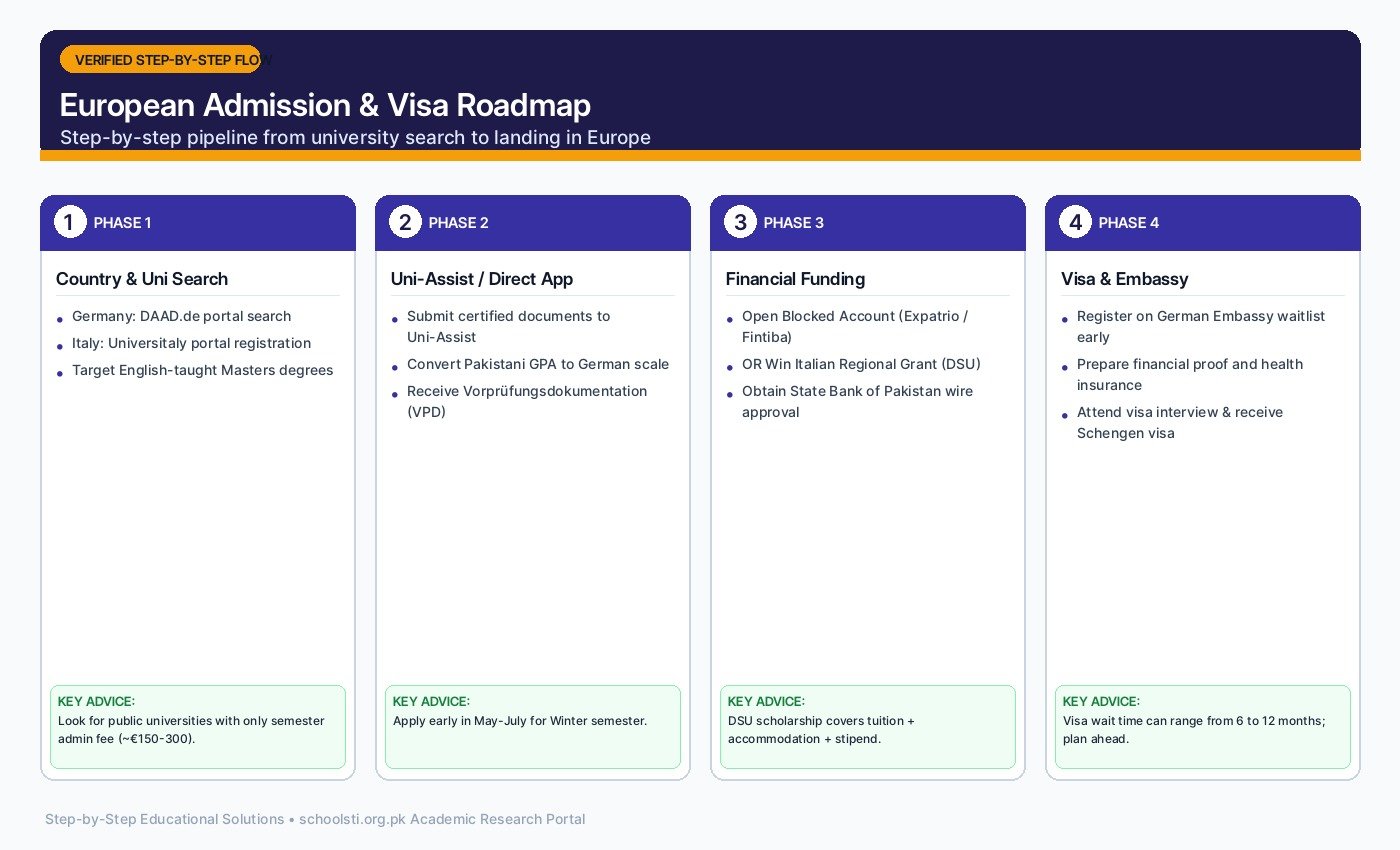
The blocked account (Sperrkonto) is how Germany verifies you can support yourself. You deposit roughly one year of living costs into a special account, and the money is released to you in monthly instalments after you arrive. Here is the process from Pakistan, step by step.
- Choose a blocked account provider Several licensed providers offer blocked accounts designed for international students. Compare setup fees, monthly charges, transfer times, and customer support quality. Choose a provider recognised by German missions, since you will submit their confirmation document at your visa interview.
- Open the account and receive your IBAN Apply online with your passport and your admission letter — many providers also accept conditional admission at this stage. Verification usually takes a few working days, after which you receive your account details and IBAN for the transfer.
- Transfer the required funds from Pakistan Transfer approximately one full year's amount — roughly EUR 11,900, though you must verify the current official requirement before sending, reviewed October 2026. Use a proper bank transfer from your own or your sponsor's account and keep every remittance receipt. International transfers from Pakistan typically take one to three weeks, so send the money early.
- Receive your blocking confirmation Once the funds arrive, the provider issues your official blocking confirmation. This document proves to the embassy that the required amount is secured. Download it, print it, and keep a digital backup — it is one of the most important papers in your visa file.
- Book and attend your visa appointment Book your appointment at the German mission in Pakistan as early as slots allow. Bring the blocking confirmation together with your admission letter, passport, photos, health insurance, academic documents, and language certificates. Answer questions about your study plans honestly and specifically.
- Activate the account after arrival and receive monthly payouts Once in Germany, complete your local address registration and activate the account with the provider. The blocked amount is then released to your regular German bank account in monthly instalments — approximately EUR 992 per month (verify the current official figure). Budget carefully: the instalment is designed to cover basic living costs, not luxuries.
Student Visa Requirements Checklist
Requirements vary slightly between countries, but the core checklist below covers what European missions in Pakistan typically ask from student applicants. Prepare originals plus photocopies of everything, and check your specific mission's website for its current list before your appointment.
| Document | What to prepare |
|---|---|
| Admission letter | Unconditional admission, or conditional admission where the mission accepts it, from a recognised university. |
| Financial proof | Blocked account confirmation, scholarship award letter, or other accepted proof covering one year of living costs. |
| Health insurance | Valid health insurance covering the visa period; most students switch to local statutory insurance after enrolment. |
| Accommodation proof | Rental agreement, dormitory confirmation, or a credible written plan for where you will live. |
| Language proof | Whatever your program requires — for example IELTS or TOEFL for English-taught programs, or a German certificate for German-taught ones. |
| Passport and photographs | Passport valid well beyond your planned stay, plus biometric photographs meeting the mission's specifications. |
| Academic documents | Degrees and transcripts, attested as required. HEC and IBCC attestation in Pakistan can take weeks — start early. |
Troubleshooting: Common Student Problems & Verified Solutions
Real-world issues reported by Pakistani applicants and students, with actionable step-by-step solutions:
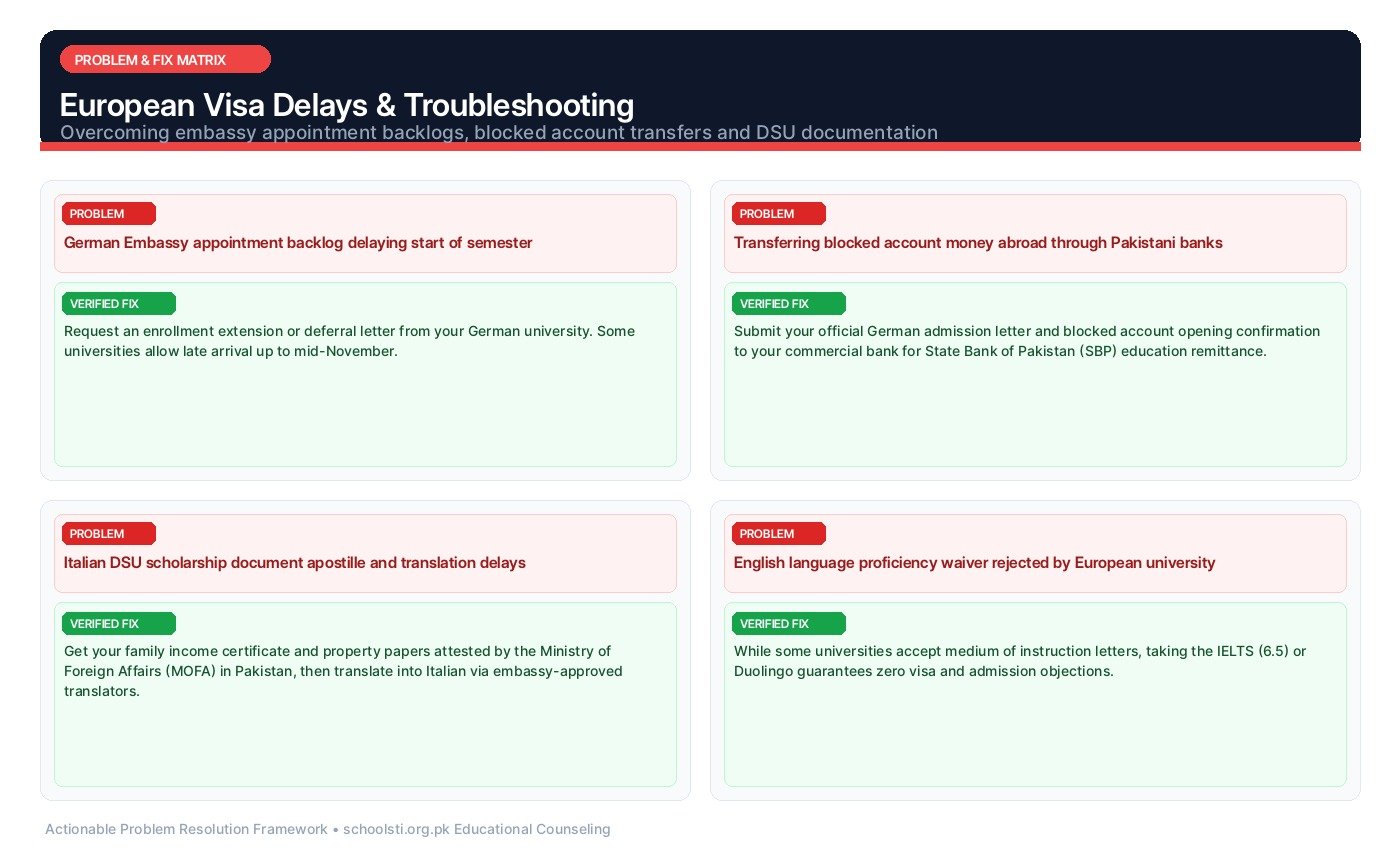
⚠️ Problem: My blocked account transfer is delayed.
✅ Verified Solution: Bank transfers from Pakistan commonly take one to three weeks, so send funds well ahead of your visa appointment. Keep all remittance receipts and ask your provider whether they can issue a provisional confirmation letter. Never route the money through informal channels — embassies reject funds whose source cannot be documented.
⚠️ Problem: There are no free visa appointment slots.
✅ Verified Solution: Mission booking systems release slots in batches, so check frequently — including early mornings. Use the waiting time productively by perfecting your document file. If no slot appears before your program starts, ask the university about deferring to the next intake rather than travelling on the wrong visa type.
⚠️ Problem: My student visa was rejected.
✅ Verified Solution: Read the rejection letter carefully: the most common reasons are weak financial proof, an unclear study motivation, or doubtful documents. You can usually reapply with stronger evidence, or file a formal remonstrance or appeal within the stated deadline. Many Pakistani students succeed on their second attempt — fix the specific weakness named in the letter instead of resubmitting the same file.
⚠️ Problem: My admission letter arrived late.
✅ Verified Solution: Contact the university's international office immediately and ask for an expedited or conditional admission letter — some missions accept conditional letters for the visa interview. Keep written proof of all correspondence, and ask whether late enrolment or a deferred start date is possible if the visa runs past orientation week.
⚠️ Problem: I am confused about health insurance requirements.
✅ Verified Solution: You typically need travel health insurance covering the visa application period, then switch to the destination country's statutory student health insurance after enrolment (in Germany this costs roughly EUR 120 or more per month — verify the current official figure). Your university's international office can confirm exactly which policy to buy and when to switch.
⚠️ Problem: My proof of funds falls short of the requirement.
✅ Verified Solution: The shortfall must be closed before your interview — partial funds almost always lead to refusal. Options include a top-up transfer to the blocked account, a formal scholarship award letter, or a sponsor's undertaking where the mission accepts one. Do not borrow money that you must return immediately after the visa; missions can ask for updated statements.
Frequently Asked Questions (FAQ)
Clear, direct answers to common questions about Top Tuition-Free European Countries for Pakistani Students: Blocked Account & Visa Requirements: