What Is ECAT and Who Conducts It
ECAT — the Engineering College Admission Test — is the combined entry test conducted by the University of Engineering and Technology (UET) Lahore for admission to undergraduate engineering programs at public-sector engineering universities in Punjab. If you want a BSc Engineering seat at UET Lahore, UET Taxila or other participating public engineering institutes in the province, ECAT is the doorway you must walk through.
One important clarification: ECAT is a Punjab test — engineering universities in other provinces announce their own admission tests each year. Confirm which test applies to your target university in its latest official admission notification. Eligibility normally requires FSc (Pre-Engineering) or an equivalent such as ICS with Mathematics, with a minimum marks requirement — always verify the exact figure on the official website before applying.
ECAT Test Pattern and Syllabus
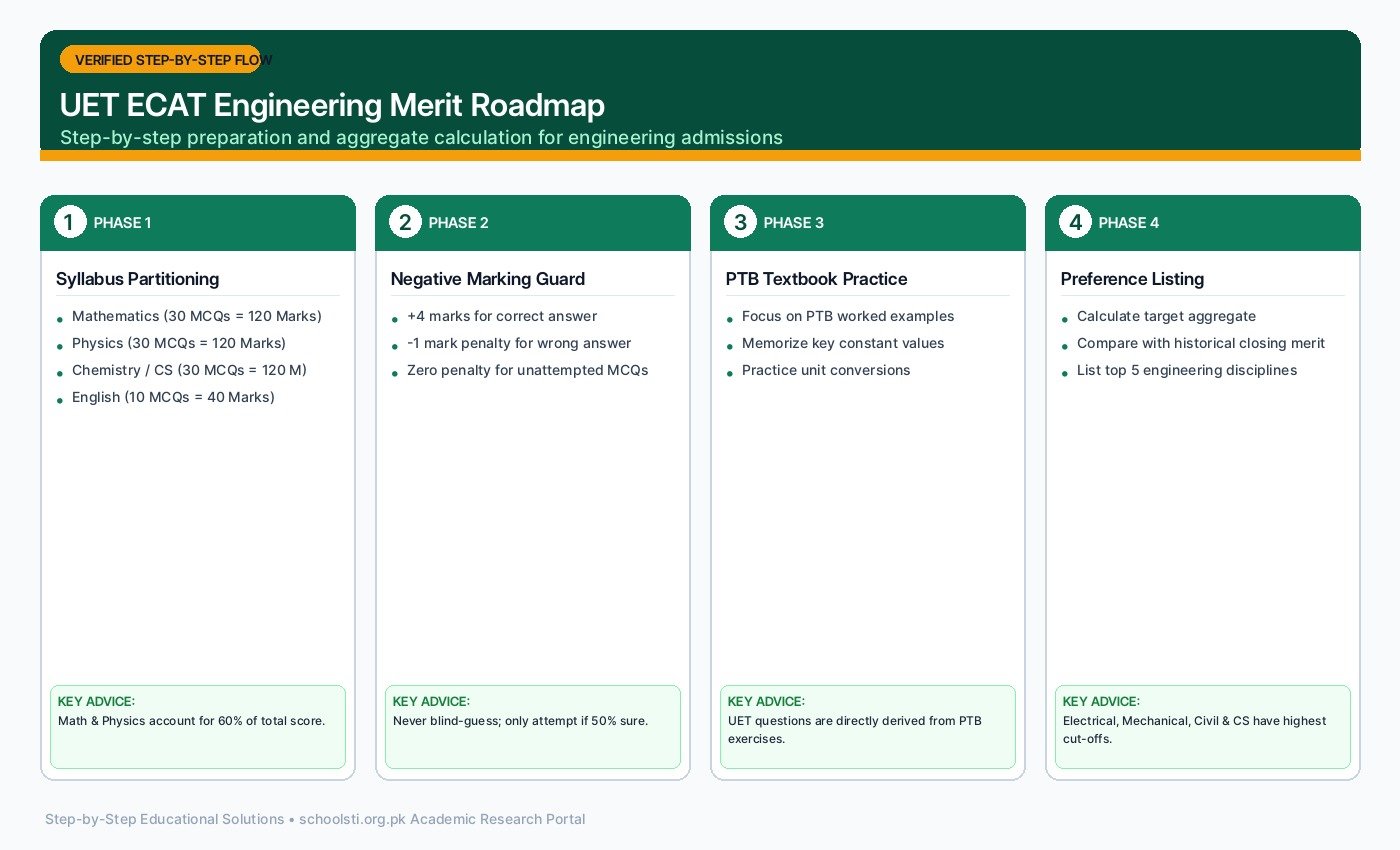
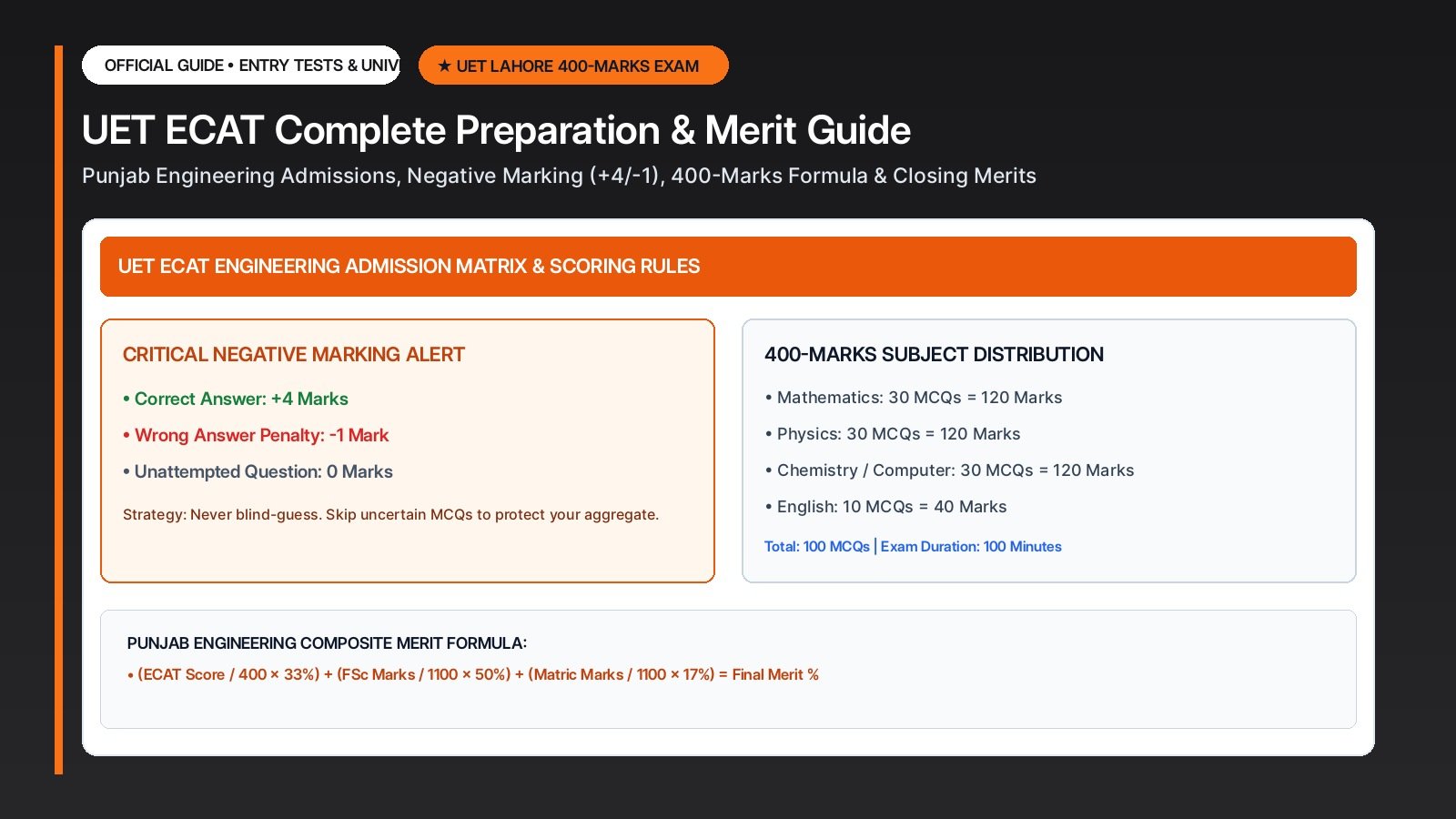
The ECAT paper tests the four core subjects of your intermediate studies. Pre-engineering students answer Mathematics, Physics, Chemistry and English, while ICS students answer Computer Science instead of Chemistry. The pattern below follows the latest published UET policy — treat it as your working guide, but verify the exact number of MCQs, total marks and time duration on the official website, reviewed October 2026.
Every correct answer carries equal marks, and recent published policy has no negative marking — confirm this in the current year's instructions, as rules can change. The paper is time-pressured, so timed full-length practice matters far more than rereading theory.
| Subject | MCQs | Syllabus Focus |
|---|---|---|
| Mathematics | 30 | FSc Part I and II mathematics: functions, limits, derivatives, integration, vectors, complex numbers, trigonometry |
| Physics | 30 | FSc Part I and II physics: mechanics, thermodynamics, waves and oscillations, electromagnetism, modern physics |
| Chemistry (Pre-Engineering) or Computer Science (ICS) | 30 | Chemistry: organic reactions, chemical bonding, acids and bases, periodic trends; CS: programming basics, loops, arrays, data structures, databases |
| English | 10 | Grammar, prepositions, articles, subject-verb agreement, vocabulary and basic comprehension |
How the UET Aggregate Is Calculated
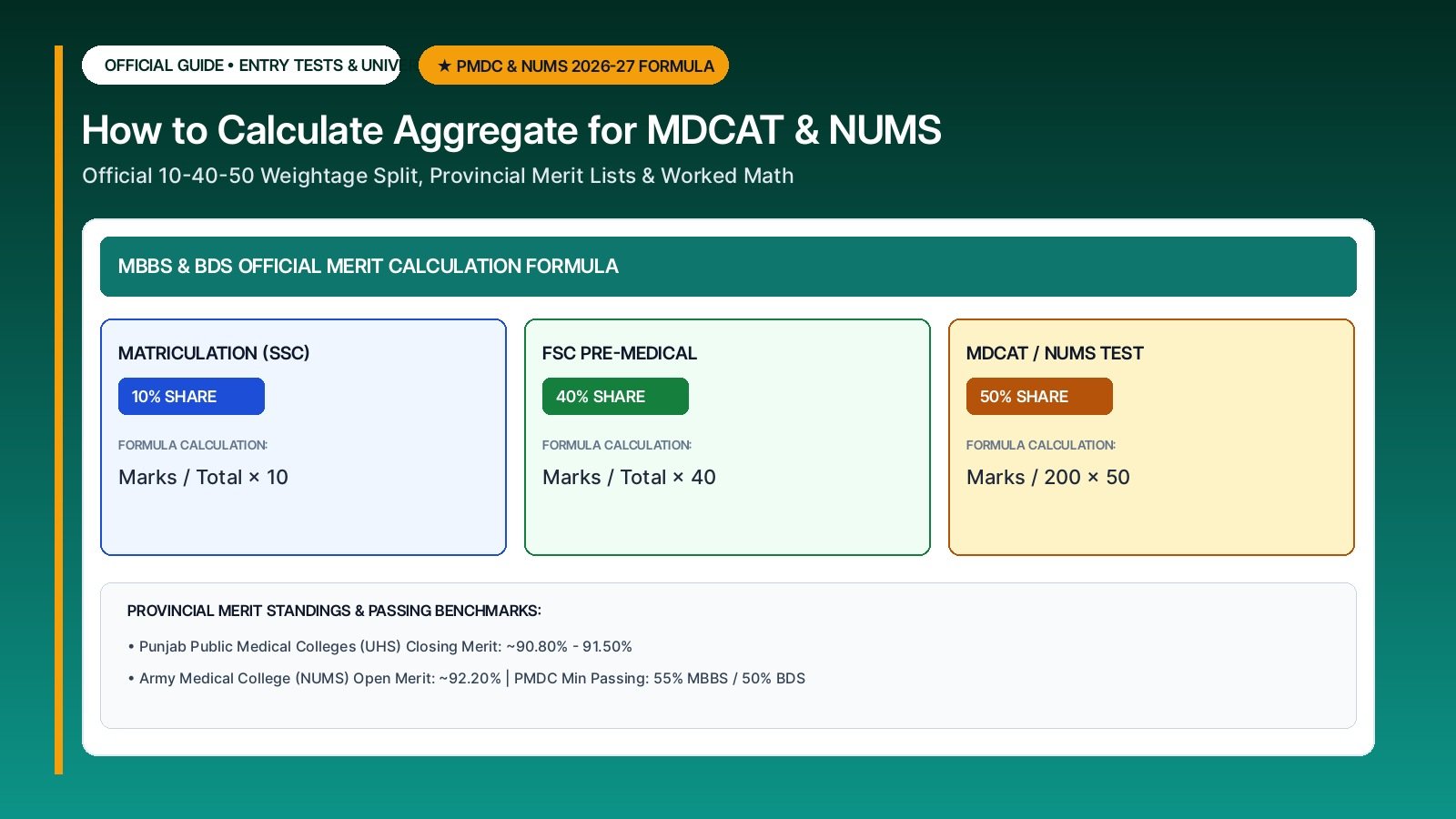
Your admission merit — the aggregate — combines three components: your ECAT score, your FSc (intermediate) marks and your matric marks, each given a fixed weightage. The exact weightages are set by UET policy for each admission cycle, so do not rely on memory or old blog posts: verify the current weightages on the official website, reviewed October 2026. The steps below show how the calculation works once you know the official weightages.
Below the steps you will find a worked example. It is an illustrative example only, built with official academic benchmarks and example weightages, so you can see the arithmetic. When you calculate your own aggregate, plug in your real marks and the real published weightages.
- Collect your three marks Note your ECAT score out of the total test marks, your FSc obtained marks out of 1100, and your matric obtained marks out of 1100.
- Convert each to a percentage Divide obtained marks by total marks and multiply by 100 for each of the three components separately.
- Apply the official weightages Multiply each component percentage by its official weightage taken from the current admission notification.
- Add the three weighted values The sum is your aggregate percentage — the single number every engineering merit list is built on.
- Compare with closing merits Match your aggregate against the closing merits of your target disciplines from recent years, remembering that past merits are only a guide, never a guarantee.
| Scoring Scenario | Correct Answers | Wrong Answers | Negative Penalty | Net Score | Estimated Engineering Merit |
|---|---|---|---|---|---|
| Scenario A: High Accuracy (Disciplined) | 75 Correct (+300) | 10 Wrong (-10) | -10 Marks | 290 / 400 | Top 5% UET Lahore Merit |
| Scenario B: Excessive Guessing (Blind) | 75 Correct (+300) | 25 Wrong (-25) | -25 Marks | 275 / 400 | Loss of 15 net marks (~3.7% aggregate drop) |
| Scenario C: Conservative Attempt | 65 Correct (+260) | 2 Wrong (-2) | -2 Marks | 258 / 400 | Secures admission in core engineering |
| Scenario D: High Risk Wild Guessing | 50 Correct (+200) | 45 Wrong (-45) | -45 Marks | 155 / 400 | Disqualified from main campus merit |
Subject-Wise Preparation Strategy
Mathematics: This is the highest-scoring opportunity for most students because the questions are formula-driven. Master differentiation, integration, limits, vectors and complex numbers from both FSc years, and revise a personal formula sheet daily. In an MCQ paper, short textbook methods beat long derivations — aim for 50 practice MCQs a day in the final month.
Physics: Physics rewards conceptual clarity over memorization. Focus on mechanics, electromagnetism and modern physics, and eliminate wrong options fast using units and dimensions. Timed numerical practice is essential — calculation speed decides this section.
Chemistry or Computer Science: Pre-engineering students should revise organic reactions, chemical bonding and periodic trends thoroughly — these return year after year. ICS students must be fluent in programming fundamentals: loops, arrays, basic data structures and database concepts from their FSc books.
English: Ten questions may look small, but they decide close merit fights. Cover prepositions, articles, subject-verb agreement, synonyms and antonyms, and read one comprehension passage daily in the last two weeks.
Preparation Timeline and Test-Day Strategy
A calm, phased plan beats last-minute panic every time. The timeline below assumes roughly three months of serious preparation — compress or stretch it to fit your own schedule, but keep the order: syllabus first, then topic-wise practice, then full papers, then revision only.
On test day itself, remember that ECAT rewards steady pace and clear thinking, not heroics. Attempt your strongest subject first to build confidence, keep an eye on the clock, and never leave a question blank if the current policy has no negative marking.
- Three months before: finish the syllabus Complete a first full reading of all four subjects from your FSc textbooks and mark every weak topic honestly.
- Two months before: topic-wise MCQs Solve topic-wise MCQs every day, update your error notebook, and revisit weak topics until they stop appearing in it.
- One month before: full-length timed papers Attempt complete ECAT-pattern papers under strict timed conditions at least twice a week, then analyze every single wrong answer.
- Final week: revise, do not start new topics Revise only your formula sheets and error notebook. Sleep properly — a tired mind drops easy marks.
- Test day: execute the plan Reach the center early with your documents, attempt easy questions on the first pass, mark the long ones for later, and use the last minutes to fill any skipped answers.
Common ECAT Mistakes and How to Avoid Them
Most ECAT marks are lost to avoidable mistakes, not to difficult questions. The first mistake is preparing from the wrong syllabus — students revise general FSc notes instead of the syllabus actually published for their test cycle. Download the current syllabus from the official UET admission portal and tick off every topic yourself; in the final weeks, anything outside it is a distraction, not extra preparation.
The second mistake is memorising formulas without practising their use. ECAT MCQs test whether you can apply a formula under time pressure, so follow every formula you learn with at least ten mixed MCQs until using it feels automatic. The third mistake is ignoring the English section. Many engineering students treat it as free marks and then drop easy points on vocabulary and grammar that a few weeks of steady daily work would have secured.
The fourth mistake is logistical: reaching the test centre without a printed roll number slip or a valid ID. Every year, candidates are turned away at the gate for exactly this reason. Keep your slip, CNIC or B-form, and stationery ready the night before, and confirm the latest centre instructions on the official website — this guide was reviewed in October 2026, but centre rules are announced fresh each cycle.
A fifth mistake is treating coaching notes as the syllabus itself. Notes from academies and seniors are useful revision tools, but they are summaries of someone else's reading of the syllabus, not the syllabus itself. Cross-check every topic against the official UET document once, and you will never waste weeks preparing material that was never going to be tested.
Troubleshooting: Common Student Problems & Verified Solutions
Real-world issues reported by Pakistani applicants and students, with actionable step-by-step solutions:
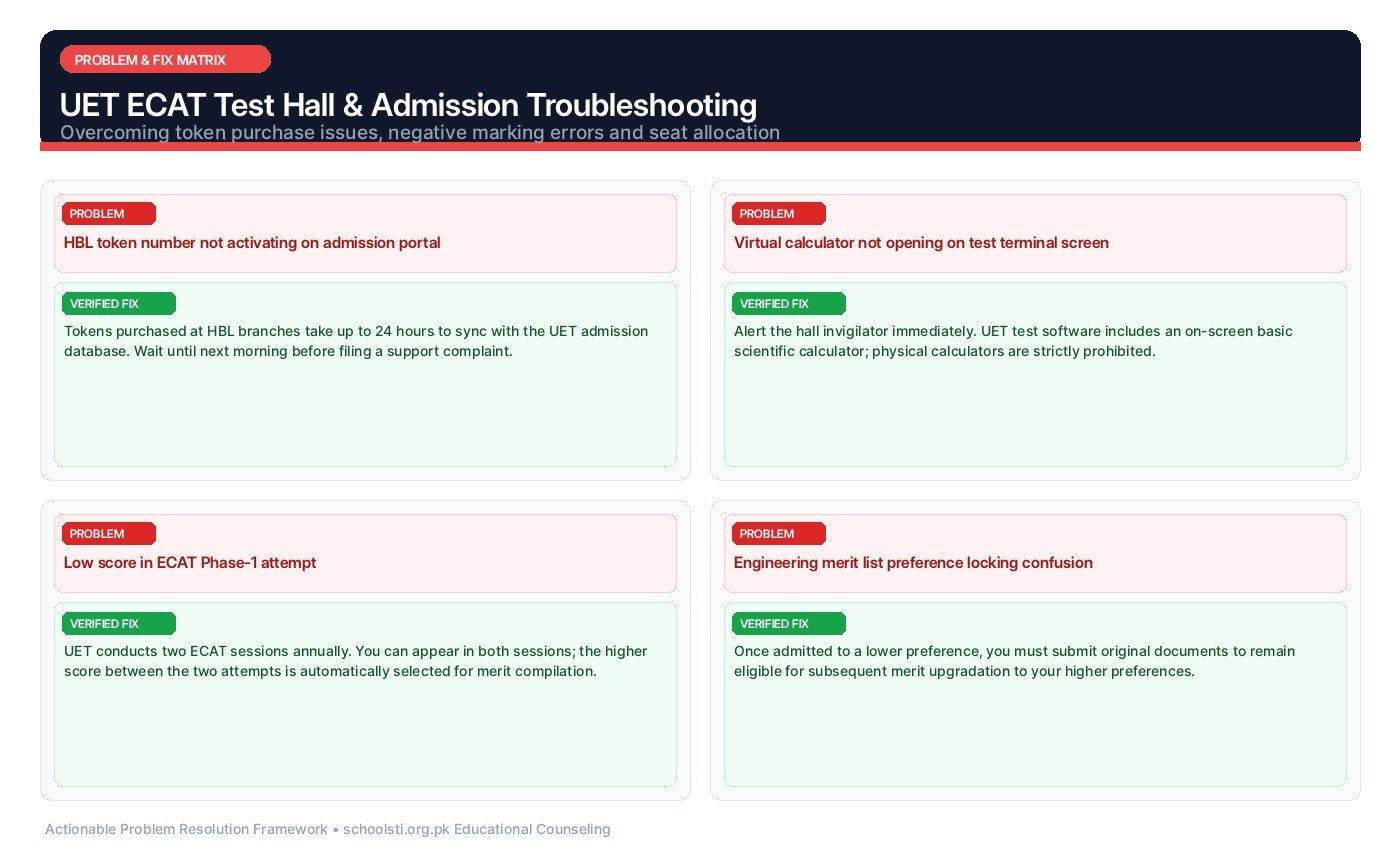
⚠️ Problem: My FSc marks are low — can a good ECAT score still save me?
✅ Verified Solution: Yes, partially. ECAT carries its own weightage, so a strong test score genuinely lifts students with average board marks — but it cannot fully erase a very weak FSc. Calculate your realistic aggregate honestly and keep backup options with lower closing merits.
⚠️ Problem: I am an ICS student — do I need to prepare Chemistry too?
✅ Verified Solution: No. ICS students answer Computer Science instead of Chemistry in ECAT. Prepare your FSc computer science syllabus thoroughly and do not waste weeks on chemistry you will never be tested on.
⚠️ Problem: I missed the ECAT registration deadline.
✅ Verified Solution: Registration windows are announced on the official UET admission portal each year and close strictly. Mark the announced dates the day they are published, set two reminders, and apply in the first week — late applications are not accepted.
⚠️ Problem: I panic and run out of time in MCQ papers.
✅ Verified Solution: This is a practice problem, not a knowledge problem. Do at least ten full timed papers before the test, skip long numericals on the first pass and return to them at the end. Speed comes from repetition, not from rushing on the day.
⚠️ Problem: My aggregate falls short of my dream discipline.
✅ Verified Solution: Consider a related discipline with a lower closing merit at the same university, or apply to other public engineering universities as a backup. One discipline does not define your career — many successful engineers started in their second choice.
Frequently Asked Questions (FAQ)
Clear, direct answers to common questions about UET ECAT Complete Preparation Guide: Syllabus, Aggregate Formula & Engineering Merit: