The 2026 BISE Matric & Intermediate Grading System
The 2026 BISE Matric & Intermediate Grading System Explained (No More 33% Pass Rule!)
A few days ago, my younger cousin came to me completely stressed out. He had just heard a rumor on social media that if you don’t score a 95% in your Matric exams, you won’t get an A-grade anymore. As someone who has spent years in the tech and education blogging space—building educational tools, analyzing board results, and trying to build sense of government policies for students—I knew I had to dig into this.
I sat down with him, opened up my laptop, and went straight to the official sources. What I found was a massive shift in how our education structure works. Starting from the 2026 annual exams, the Inter Boards Coordination Commission (IBCC) and various BISE boards across Pakistan are completely overhauling the grading framework for SSC (Matric) and HSSC (Intermediate).
If you are a pupil, a parent, or a teacher, you need to pay near attention because the former days of scraping by with 33% marks are officially over. Let me break down exactly what this means, spread some real-world implications, and reveal you how to navigate this alter without panicking.
The End of the Marks Rat Race
For decades, we have been obsessed with exact numbers. If a student scored 1045 and another scored 1044, they were treated entirely differently for college admissions. It was an unhealthy rat race. I remember my own exam days; the pressure to squeeze out just one more mark to beat a friend’s total was immense and, honestly, quite toxic. It led to rote memorization rather than actual learning.
The new grading system is designed to fix this fundamental flaw in our education sector. By shifting from a strict numerical framework to a 10-point grading structure, the authorities aim to reduce the psychological pressure on students. Instead of obsessing over a single mark, students will be placed in broader grade bands. This is a model closely aligned with international standards like the Cambridge setup (O/A Levels), making Pakistani educational certificates more easily recognizable globally.
It is a massive leap forward. However as with any major tech or policy rollout, the transition phase is where the bugs happen. You need to realize exactly how your papers will be evaluated so you don’t obtain caught off guard when you check your result online next twelve months.
Breaking Down the New 10-Point Grading System
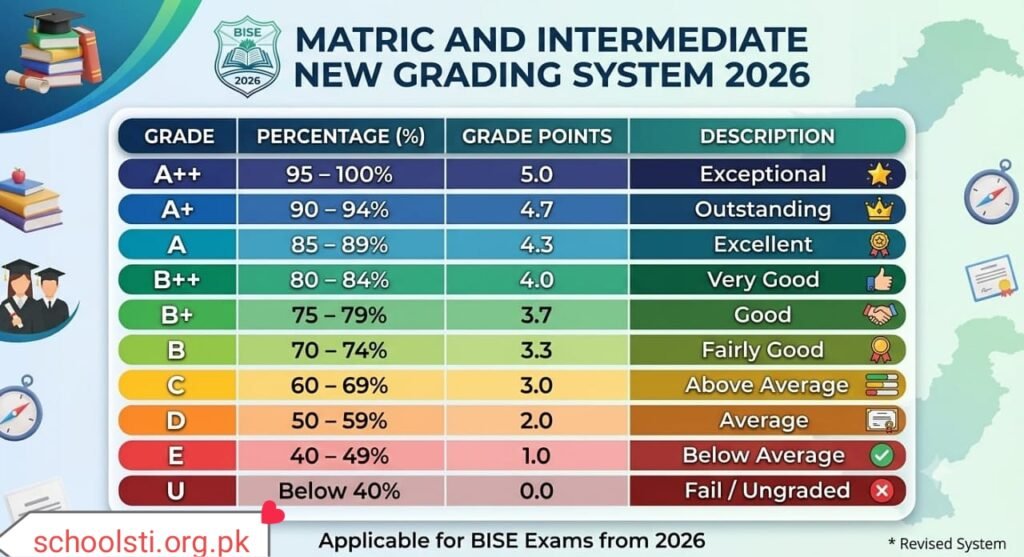
There has been a lot of fake news circulating on Facebook and WhatsApp groups around the exact percentage brackets. To clear the air, I am directly referencing the official notification image, specifically the file named IMG-20260716-WA0001.jpg, which outlines the exact BISE Matric and Intermediate fresh grading setup for 2026.
Let’s look at the actual data. Below is the exact breakdown of how your percentages will translate into grades and grade points under the recent policy.
| Grade | Percentage (%) | Grade Points | Description |
|---|---|---|---|
| A++ | 95 – 100% | 5.0 | Exceptional |
| A+ | 90 – 94% | 4.7 | Outstanding |
| A | 85 – 89% | 4.3 | Excellent |
| B++ | 80 – 84% | 4.0 | Very Good |
| B+ | 75 – 79% | 3.7 | Good |
| B | 70 – 74% | 3.3 | Fairly Good |
| C | 60 – 69% | 3.0 | Above Average |
| D | 50 – 59% | 2.0 | Average |
| E | 40 – 49% | 1.0 | Below Average |
| U | Below 40% | 0.0 | Fail / Ungraded |
As you can see from the table, the old structure where an 80% guaranteed you the top tier A-1 grade is completely gone. Now, to obtain the absolute top tier (A++), you need to hit the 95% mark. Still, don’t let this scare you. The introduction of intermediate grades like B++ and B+ means that your efforts are recognized more accurately, rather than just lumping a massive range of students into a single “B” or “C” grade. It provides a considerable more granular look at a student’s actual capability.
The Biggest Shock: 40% is the New 33%
This is the part that is catching a lot of students by surprise, and frankly, it is the most significant change in the entire policy. When I was in academy, getting 33 out of 100 meant you survived. You lived to fight another day.
Not anymore. From 2026 onwards, the minimum passing threshold has been explicitly raised to 40%. If you score a 39%, you do not get a passing grade. You gain a “U”, which stands for Ungraded (essentially a fail).
Why did they do this? I have spoken to several educators while researching for my tech blogs, and the consensus is evident: the 33% benchmark was producing students who simply lacked the foundational knowledge required for higher education. By raising the bar to 40%, the boards are forcing a higher standard of basic competency. It’s tough love, however it’s entirely necessary if we prefer our degrees to hold any genuine value in the modern, highly competitive job market.
Navigating the “U” Grade (Ungraded)
Let’s talk regarding the dreaded “U”. Previously, if you failed a subject, your outcome card boldly declared “FAIL” in red ink. The recent policy shifts the terminology to “Ungraded”.
While it functionally means the exact same thing—you have to reappear for that precise exam—the language is deliberately less harsh. It means your performance wasn’t at a standard that could be graded on the standard scale. If you end up with a U in a subject, my practical advice is to immediately check your board’s supplementary exam schedule. Don’t wait around feeling negative concerning it. Action is your optimal friend here.
For reliable resources, past papers, and study materials that align with these recent passing standards, you should definitely check out the comprehensive study guides over at schoolsti.org.pk. Having a solid online resource is crucial when the rules of the game modify so drastically, and you want updated materials to hit that 40% mark safely.
How This Affects University Admissions and Entry Tests
This is where things get slightly complicated, and it’s a scenario I’ve seen play out numerous times in the education tech sector when rolling out new software. Universities rely heavily on exact marks to calculate merit for highly competitive fields like medicine (MDCAT), engineering (ECAT), and IT.
With the shift to a GPA-style 10-point framework, universities will have to fundamentally adapt their merit calculation formulas. According to the Inter Boards Coordination Commission (IBCC), there has been a lot of back-and-forth regarding how universities will process these grade points. In the initial phases, boards will likely supply a conversion formula or continue to quietly supply exact marks to universities behind the scenes so that merit lists don’t descend into complete chaos.
If you are planning to apply for university in the coming years, keep a extremely close eye on the admission policies of the Higher Education Commission (HEC). They will be the ones setting the standard for how an A++ or a B+ translates into a university seat. The transition will be rocky, however staying informed gives you a massive advantage.
Step-by-Step Guide: Adapting to the 2026 System
Whenever a major tech update or policy adjust happens, the individuals who thrive are the ones who adapt quickly. Here is a practical, step-by-step approach to adjusting your study habits for the recent grading era:
- Target the 40% Baseline Immediately
If you have historically struggled with certain subjects (like Math, Physics, or English), you can no longer aim for the bare minimum of 33. Adjust your study schedule to ensure you have a comfortable buffer. Aim for at least 50% in your weakest subjects to avoid the “U” grade trap. - Stop Counting Individual Marks
It used to produce sense to spend days crying over a 2-mark deduction in a chemistry practical. Now, unless those 2 marks drop you from an 85% (A) to an 84% (B++), they don’t matter as considerable. Focus on securing the grade bracket rather than arguing with your educator over a single point. - Leverage Online GPA Calculators
As the new system rolls out, developers in the tech community will be pushing out mobile and web apps that let you input your expected performance and see your Grade Points instantly. Utilize these digital tools to track your progress rather than doing manual percentage math on a piece of paper. - Monitor Your Specific Board’s Portal
While the IBCC sets the national standard, implementation can sometimes vary slightly in timing between the Federal Board, Punjab Boards, Sindh Boards, and KPK boards. Always cross-reference the national news with your specific BISE website. Major news outlets like Dawn News Pakistan are great for keeping up with high-standard policy announcements, but your local board’s official portal is your ultimate source of truth.
[Apply Online]
Real Tools and Platforms You Will Need
As a tech blogger, I consistently look for digital solutions to genuine-planet problems. With this recent grading setup, you can’t just rely on a printed syllabus book and old guess papers anymore. You need to leverage technology to stay ahead of the curve.
- Official Board Mobile Apps: Many BISE boards are launching their own dedicated mobile apps. Download yours. It’s the fastest method to gain push notifications around exact implementation dates, roll number slips, and outcome announcements for the recent grading framework in your district.
- Interactive Educational Portals: Websites that offer chapter-wise MCQs, automated grading, and video lectures are your best friends now. Since the passing mark is higher, practicing objective questions online can provide you that essential push over the 40% line.
- Result Checking Websites: Familiarize yourself with the modern effect card layouts online. The old exact marks columns will eventually be replaced by Grade Point columns and alphabetical grades.
The Psychological Shift for Parents and Teachers
We require to address the elephant in the room: Pakistani parents. For generations, parents have compared their children’s exact marks. “My son got 1020, how much did yours get?”
This system forces a psychological shift. Teachers will demand to train parents during parent-teacher meetings to grasp that a 4.7 Grade Point (A+) is phenomenal, even if it doesn’t come with the bragging rights of an exact 1050 score. Teachers themselves have to adjust how they mark mock exams. They must stop giving pity marks to push a student to 33 and instead focus on genuine feedback so the student can actually cross the 40% threshold based on merit.
Common Mistakes and Misconceptions
I’ve been monitoring pupil forums and WhatsApp study groups, and the amount of misinformation is staggering. Here are the biggest mistakes you absolutely require to avoid:
- Believing the framework applies retroactively: If you gave your Matric exams in 2024 or 2025, your results are not suddenly going to be magically converted to this recent 10-point scale on your previous certificates. This applies strictly from the 2026 annual exams onwards. Your past scores remain as they are.
- Thinking the syllabus has changed: The grading framework is purely a method of assessment; it is not a curriculum change. You are still studying the equivalent textbooks, the identical chapters, and the same concepts. Don’t go buying “New Grading System Textbooks” if a shady publisher tries to scam you—they do not exist.
- Panicking over the A++ bracket: Yes, 95-100% is incredibly challenging to achieve. Yet remember, it’s difficult for everyone. University merit lists will naturally adjust downward. If nobody is getting 1050 marks anymore, the closing merit for highest medical and engineering universities won’t be 98% either. It will balance out organically.
Frequently Asked Questions (FAQs)
Will the 2026 grading system apply to both 9th and 10th grades at the identical period?
Yes, the phased rollout starting in 2026 will apply to the fresh batch appearing for their annual exams. It is designed to eventually encompass both SSC (Matric) and HSSC (Intermediate) entirely across all boards.
What happens if I score exactly 40% in a subject?
Take a deep breath, you passed! According to the new breakdown, scoring 40-49% places you in the “E” grade (Below Average, 1.0 Grade Point). It might be the lowest tier, however it is a passing grade. You have successfully avoided the “U”.
Is there still a distinction between science and arts subjects in the grading formula?
No, the grading formula itself is completely uniform across all subject groups. A 75% in a core science subject like Computer Science and a 75% in a humanities subject like Islamic Studies both yield exactly the similar B+ grade.
Will exact marks still be shown on the official board effect card?
Eventually, the long-term goal of the IBCC is to completely phase out exact marks and only reveal letter grades and GPAs. Still, during the initial transition phase, some provincial boards might still reveal both to assist students and universities adapt without panic.
Are practical exams graded separately under this recent policy?
Practical exams are usually assessed as part of the subject, yet the final grade for a subject is typically a composite of your theory and practical performance, mapped onto the recent percentage brackets shown in the official table.
Final Thoughts
Change is always intimidating, especially when it involves something as crucial as your academic forthcoming and career path. When I earliest saw the image IMG-20260716-WA0001.jpg detailing the massive scale from A++ to U, I admit, it looked complicated. But after deeply analyzing it and looking at how modern education systems operate globally, I firmly believe this is a highly positive step.
We are finally moving away from an outdated framework that treats students like uncomplicated memory storage drives, heavily penalizing minor mistakes, and towards a progressive structure that rewards overall comprehension, consistency, and actual learning. It will undoubtedly take a twelve months or two for the dust to settle, for universities to adjust their strict entry requirements, and for parents to stop asking about exact total marks.
My advice? Focus on genuinely understanding your subjects rather than relying on rote memorization just to pass a test. Keep a close eye on official board announcements, use the tech tools and online resources obtainable to you, and don’t let the social media rumors stress you out. You’ve got this.
If you found this detailed breakdown helpful and want to stay updated on educational materials, tech tools, and study tips, make sure to bookmark my site and circulate this guide with your classmates who might be panicking over the modern 40% rule! Your upcoming is bright, just adapt to the recent rules of the game.