MBBS & BDS Seats Allocation in Govt Medical & Dental Colleges of Punjab Session 2026-27
MBBS & BDS Seats Allocation in Govt Medical & Dental Colleges of Punjab Session 2026-27
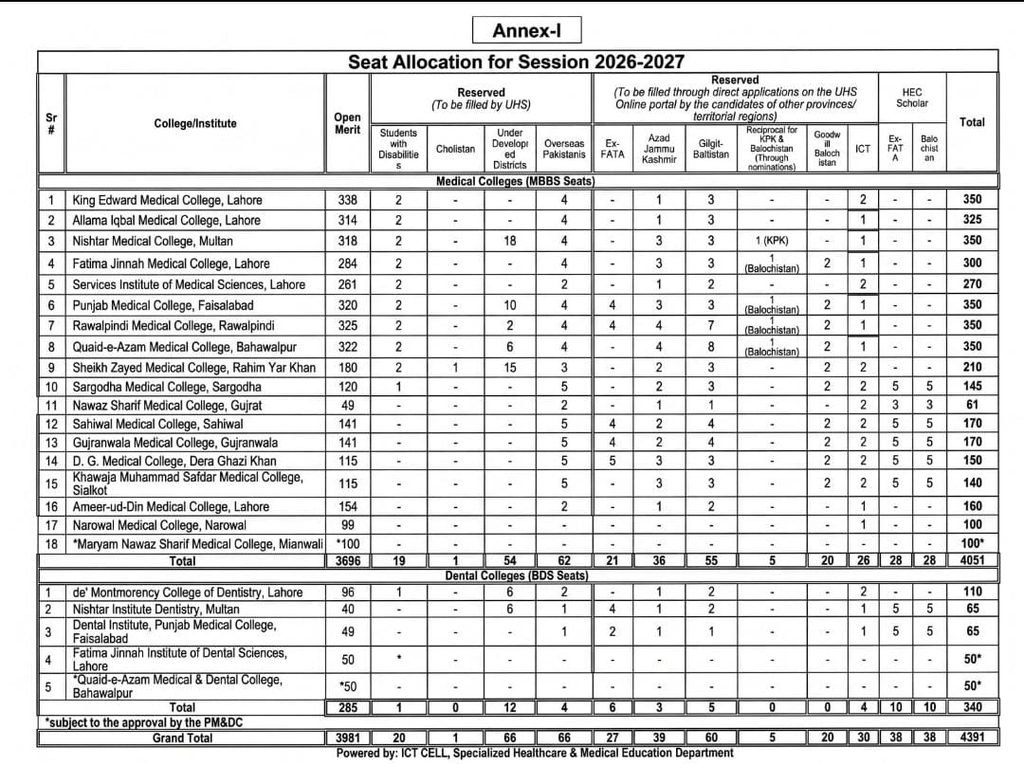
Securing admission to a general sector medical or dental college in Punjab is among the most competitive academic pursuits in Pakistan. Every twelve months, tens of thousands of pre-medical candidates appear for the Medical and Dental College Admission Test (MDCAT), vying for a coveted seat. For the academic session 2026-2027, the Specialized Healthcare & Medical Education Department (SHC&MED), Government of the Punjab, via its official ICT Cell notification (Annex-I), released the comprehensive seat matrix governing admissions across the province.
The centralized admission method is administered by the University of Health Sciences (UHS) Lahore, strictly abiding by the statutory regulatory framework enforced by the Pakistan Medical & Dental Council (PM&DC). This guide provides an in-depth, authoritative breakdown of the general sector MBBS and BDS seat allocation for Session 2026-27, detailing accessible merit distribution, quota categories, college-wise seat counts, comparative institutional dynamics, and practical strategic insights for applicants.
Executive Overview: Punjab Medical & Dental Seat Matrix 2026-2027
For Session 2026–27, Punjab’s open medical education network comprises 18 medical colleges offering MBBS programs and 5 dental colleges/institutes offering BDS programs. The total capacity stands at 4,391 seats, reflecting the ongoing expansion of healthcare training infrastructure across both central and peripheral districts.
Key Macro Figures at a Glance
- Grand Total Medical & Dental Seats: 4,391 seats
- Total MBBS Seats: 4,051 seats across 18 general medical colleges
- Open Merit MBBS: 3,696 seats (91.24% of total MBBS intake)
- Reserved Quota MBBS: 355 seats (comprising provincial quotas, reciprocal allocations, underdeveloped districts, and HEC scholarship programs)
- Total BDS Seats: 340 seats across 5 public dental institutions
- Open Merit BDS: 285 seats (83.82% of total BDS intake)
- Reserved Quota BDS: 55 seats
- Provincial Open Merit Pool (MBBS + BDS Combined): 3,981 seats
- Total Reserved Quota Pool (MBBS + BDS Combined): 410 seats
Candidates tracking merit cutoffs, aggregate calculations, and admission timelines can review our detailed Punjab MDCAT admissions portal on schoolsti.org.pk to evaluate historical closing merits and quota eligibility rules.
Complete College-Wise MBBS Seat Allocation 2026-2027
Public medical institutions in Punjab are categorized under provincial open merit and precise quota classifications. Seats designated under reserved categories ensure regional equity, socio-economic inclusion, and inter-provincial harmony.
Quota Classification Scheme
- UHS-Administered Reserved Quotas:
- Disabled Students: Verified candidates with physical impairments evaluated by a designated medical board.
- Cholistan: Reserved for candidates with verified domicile and schooling within the Cholistan desert expanse.
- Underdeveloped Districts (UDD): Specific seats earmarked for backward districts, primarily Dera Ghazi Khan, Rajanpur, Layyah, Lodhran, Bhakkar, and Muzaffargarh.
- Overseas Pakistanis / Dual Nationals: Reserved for children of Pakistani expatriates and dual-nationality holders meeting UHS eligibility criteria.
- Direct Online Application Portal Quotas (Inter-Provincial / Regional):
- Candidates from Ex-FATA, Azad Jammu & Kashmir (AJK), Gilgit-Baltistan (GB), and the Islamabad Capital Territory (ICT).
- Reciprocal Seats: Reciprocal institutional exchange seats for Khyber Pakhtunkhwa (KPK) and Balochistan nominees.
- Goodwill Balochistan: Special seats reserved by the Government of Punjab for Balochistan candidates to foster national cohesion.
- HEC Scholarship Programs:
- Higher Education Commission (HEC) managed scholarship allocations dedicated to students from Ex-FATA and Balochistan.
Master Table: Public Sector MBBS Seat Distribution (Session 2026–27)
| Sr # | Medical College / Institute | Open Merit | Disabled | Cholistan | Underdeveloped Districts | Overseas Pak. | Ex-FATA | AJK | GB | Reciprocal (KPK/Bal.) | Goodwill Balochistan | ICT | HEC Ex-FATA | HEC Balochistan | Total Seats |
|---|---|---|---|---|---|---|---|---|---|---|---|---|---|---|---|
| 1 | King Edward Medical University (KEMC), Lahore | 338 | 2 | — | — | 4 | — | 1 | 3 | — | — | 2 | — | — | 350 |
| 2 | Allama Iqbal Medical College (AIMC), Lahore | 314 | 2 | — | — | 4 | — | 1 | 3 | — | — | 1 | — | — | 325 |
| 3 | Nishtar Medical College (NMC), Multan | 318 | 2 | — | 18 | 4 | — | 3 | 3 | 1 (KPK) | — | 1 | — | — | 350 |
| 4 | Fatima Jinnah Medical College (FJMC), Lahore | 284 | 2 | — | — | 4 | — | 3 | 3 | 1 (Bal.) | 2 | 1 | — | — | 300 |
| 5 | Services Institute of Medical Sciences (SIMS), Lahore | 261 | 2 | — | — | 2 | — | 1 | 2 | — | — | 2 | — | — | 270 |
| 6 | Punjab Medical College (PMC), Faisalabad | 320 | 2 | — | 10 | 4 | 4 | 3 | 3 | 1 (Bal.) | 2 | 1 | — | — | 350 |
| 7 | Rawalpindi Medical College (RMC), Rawalpindi | 325 | 2 | — | 2 | 4 | 4 | 4 | 7 | 1 (Bal.) | — | 1 | — | — | 350 |
| 8 | Quaid-e-Azam Medical College (QAMC), Bahawalpur | 322 | 2 | — | 6 | 4 | — | 4 | 8 | 1 (Bal.) | 2 | 1 | — | — | 350 |
| 9 | Sheikh Zayed Medical College (SZMC), Rahim Yar Khan | 180 | 2 | 1 | 15 | 3 | — | 2 | 3 | — | 2 | 2 | — | — | 210 |
| 10 | Sargodha Medical College (SMC), Sargodha | 120 | 1 | — | — | 5 | — | 2 | 3 | — | 2 | 2 | 5 | 5 | 145 |
| 11 | Nawaz Sharif Medical College (NSMC), Gujrat | 49 | — | — | — | 2 | — | 1 | 1 | — | — | 2 | 3 | 3 | 61 |
| 12 | Sahiwal Medical College (SLMC), Sahiwal | 141 | — | — | — | 5 | 4 | 2 | 4 | — | 2 | 2 | 5 | 5 | 170 |
| 13 | Gujranwala Medical College (GMC), Gujranwala | 141 | — | — | — | 5 | 4 | 2 | 4 | — | 2 | 2 | 5 | 5 | 170 |
| 14 | D. G. Khan Medical College (DGMC), D. G. Khan | 115 | — | — | — | 5 | 5 | 3 | 3 | — | 2 | 2 | 5 | 5 | 150 |
| 15 | K. M. Safdar Medical College (KMSMC), Sialkot | 115 | — | — | — | 5 | — | 3 | 3 | — | 2 | 2 | 5 | 5 | 140 |
| 16 | Ameer-ud-Din Medical College (AMC), Lahore | 154 | — | — | — | 2 | — | 1 | 2 | — | — | 1 | — | — | 160 |
| 17 | Narowal Medical College (NMC), Narowal | 99 | — | — | — | — | — | — | — | — | — | 1 | — | — | 100 |
| 18 | *Maryam Nawaz Sharif Medical College, Mianwali | *100 | — | — | — | — | — | — | — | — | — | — | — | — | *100 |
| — | MBBS Subtotal | 3,696 | 19 | 1 | 54 | 62 | 21 | 36 | 55 | 5 | 20 | 26 | 28 | 28 | 4,051 |
*Note: Allocation for Maryam Nawaz Sharif Medical College, Mianwali, remains subject to formal recognition and seat inspection approval by the PM&DC.
College-Wise BDS Seat Allocation 2026-2027
Dental education in Punjab features specialized institutes affiliated with premier medical colleges as well as independent dental colleges. For the 2026-2027 academic session, 340 seats are allocated across 5 dental institutes.
Master Table: Public Sector BDS Seat Distribution (Session 2026–27)
| Sr # | Dental College / Institute | Open Merit | Disabled | Cholistan | Underdeveloped Districts | Overseas Pak. | Ex-FATA | AJK | GB | Reciprocal | Goodwill Balochistan | ICT | HEC Ex-FATA | HEC Balochistan | Total Seats |
|---|---|---|---|---|---|---|---|---|---|---|---|---|---|---|---|
| 1 | de’ Montmorency College of Dentistry (DCD), Lahore | 96 | 1 | — | 6 | 2 | — | 1 | 2 | — | — | 2 | — | — | 110 |
| 2 | Nishtar Institute of Dentistry (NID), Multan | 40 | — | — | 6 | 1 | 4 | 1 | 2 | — | — | 1 | 5 | 5 | 65 |
| 3 | Dental Institute, Punjab Medical College, Faisalabad | 49 | — | — | — | 1 | 2 | 1 | 1 | — | — | 1 | 5 | 5 | 65 |
| 4 | Fatima Jinnah Institute of Dental Sciences, Lahore | 50 | — | — | — | — | — | — | — | — | — | — | — | — | 50 |
| 5 | *Dental Section, Quaid-e-Azam Medical College, Bahawalpur | *50 | — | — | — | — | — | — | — | — | — | — | — | — | *50 |
| — | BDS Subtotal | 285 | 1 | 0 | 12 | 4 | 6 | 3 | 5 | 0 | 0 | 4 | 10 | 10 | 340 |
*Note: Admissions for the Dental Section of Quaid-e-Azam Medical College, Bahawalpur, remain subject to formal inspection and accreditation approval by the PM&DC.
Grand Summary: Aggregate Seat Distribution
Consolidating both medical and dental faculties under the Specialized Healthcare & Medical Education Department (SHC&MED) provides a obvious picture of how educational opportunities are distributed:
+-----------------------------------------------------------------------------------------+
|                  PUNJAB OPEN MEDICAL & DENTAL SEAT COMPOSITION 2026-27                |
+=============================================+===========+==========+====================+
| Category                                    | MBBS      | BDS      | Total Seats        |
+---------------------------------------------+-----------+----------+--------------------+
| Open Merit (Punjab Domicile)                | 3,696     | 285      | 3,981              |
| Students with Disabilities                  | 19        | 1        | 20                 |
| Cholistan Desert Quota                      | 1         | 0        | 1                  |
| Underdeveloped Districts (UDD)              | 54        | 12       | 66                 |
| Overseas Pakistanis / Dual Nationals        | 62        | 4        | 66                 |
| Ex-FATA (Direct UHS Portal)                 | 21        | 6        | 27                 |
| Azad Jammu & Kashmir (AJK)                  | 36        | 3        | 39                 |
| Gilgit-Baltistan (GB)                       | 55        | 5        | 60                 |
| Reciprocal Quota (KPK & Balochistan)        | 5         | 0        | 5                  |
| Goodwill Balochistan                        | 20        | 0        | 20                 |
| Islamabad Capital Territory (ICT)           | 26        | 4        | 30                 |
| HEC Scholarship (Ex-FATA)                   | 28        | 10       | 38                 |
| HEC Scholarship (Balochistan)               | 28        | 10       | 38                 |
+---------------------------------------------+-----------+----------+--------------------+
| GRAND TOTAL                                 | 4,051     | 340      | 4,391              |
+---------------------------------------------+-----------+----------+--------------------+
Comparative Analysis: Institutional Tiers and Quota Dynamics
Understanding the structure of the seat matrix helps candidates assess competition levels and formulate effective preference lists.
1. Established Tier-1 Hubs vs. Peripheral Colleges
Punjab’s medical colleges exhibit clear operational and historical stratification:
- Central Tier-1 Giants (Lahore, Multan, Faisalabad, Rawalpindi): King Edward Medical University (350 seats), Allama Iqbal Medical College (325 seats), Nishtar Medical College (350 seats), Services Institute of Medical Sciences (270 seats), Punjab Medical College (350 seats), and Rawalpindi Medical College (350 seats) account for over 50% of the total open merit seats. These legacy institutions carry the highest aggregate cutoffs due to well-established teaching hospitals, renowned clinical faculty, and central urban locations.
- Southern & Regional Established Centers: Quaid-e-Azam Medical College, Bahawalpur (350 seats) and Sheikh Zayed Medical College, Rahim Yar Khan (210 seats) serve extensive regional populations and absorb the majority of South Punjab’s specialized quota allotments.
- Second-Generation & Peripheral Colleges: Colleges such as Gujranwala Medical College (170 seats), Sahiwal Medical College (170 seats), D.G. Khan Medical College (150 seats), Khawaja Safdar Medical College Sialkot (140 seats), and Sargodha Medical College (145 seats) offer significant unrestricted-merit volume while presenting slightly more accessible aggregate thresholds for candidates ranking outside the foremost 1,500 provincial merit positions.
- Emerging Institutions: Narowal Medical College (100 seats) and the newly proposed Maryam Nawaz Sharif Medical College in Mianwali (100 seats) provide decentralized access to medical education in previously underserved border and western regions.
2. MBBS vs. BDS Intake Disparity
A major structural takeaway is the sharp numerical contrast between medical and dental training capacities. With 4,051 MBBS seats compared to only 340 BDS seats, the ratio stands at approximately 12:1.
As dental colleges are limited to five centers—primarily de’ Montmorency (Lahore), Nishtar Institute of Dentistry (Multan), Dental Institute Faisalabad, Fatima Jinnah Institute of Dental Sciences (Lahore), and the proposed Quaid-e-Azam Dental Section (Bahawalpur)—closing aggregates for general BDS frequently overlap with or surpass the closing aggregates of peripheral MBBS colleges.
3. Unrestricted Merit vs. Reserved Policy Balancing
The Government of Punjab allocates 90.66% of all combined medical and dental seats (3,981 of 4,391) to accessible merit. The remaining 410 seats are strategically distributed to maintain federal integration:
- Providing direct opportunities to candidates from Gilgit-Baltistan (60 seats) and Azad Jammu & Kashmir (39 seats).
- Supporting the integration of merged tribal districts (Ex-FATA) through 27 direct portal seats and 38 HEC scholarship slots.
- Enhancing national solidarity through 20 Goodwill Balochistan seats, 5 reciprocal exchange seats, and 38 HEC Balochistan scholarship positions.
For candidate-exact eligibility requirements across regional and sports quotas, refer to the medical college merit calculation guide at schoolsti.org.pk for detailed documentation checklists and scoring rubrics.
Frequently Asked Questions (FAQs)
What is the total number of communal MBBS and BDS seats in Punjab for Session 2026-27?
Punjab has allocated a total of 4,391 public seats, comprising 4,051 MBBS seats across 18 medical colleges and 340 BDS seats across 5 dental institutes.
How numerous seats are strictly obtainable on Open Merit for Punjab domicile holders?
There are 3,696 Open Merit MBBS seats and 285 Open Merit BDS seats, resulting in a cumulative open merit pool of 3,981 seats.
Which medical college in Punjab has the largest seat intake?
King Edward Medical University (Lahore), Nishtar Medical College (Multan), Punjab Medical College (Faisalabad), Rawalpindi Medical College (Rawalpindi), and Quaid-e-Azam Medical College (Bahawalpur) share the highest single-institution capacity, each with 350 total seats.
What does the asterisk (*) next to Mianwali and Bahawalpur dental seats mean?
The asterisk indicates that the 100 MBBS seats at Maryam Nawaz Sharif Medical College, Mianwali, and the 50 BDS seats at the Dental Section of Quaid-e-Azam Medical College, Bahawalpur, are subject to final inspection and accreditation approval by the PM&DC. Induction on these seats is contingent upon formal regulatory clearance prior to merit list finalization.
How are Overseas Pakistanis seats processed in Punjab general colleges?
There are 62 MBBS seats and 4 BDS seats reserved for Overseas Pakistanis/Dual Nationality holders. Admissions are administered centrally by UHS. Applicants must meet PM&DC equivalence requirements, supply valid proof of overseas residency/citizenship, and submit their applications through the UHS online admission portal.
Which colleges offer seats for candidates from Underdeveloped Districts (UDD)?
UDD seats are concentrated in institutions serving or adjacent to underdeveloped regions: Nishtar Medical College (18 MBBS, 6 BDS), Sheikh Zayed Medical College (15 MBBS), Punjab Medical College (10 MBBS), Quaid-e-Azam Medical College (6 MBBS), Rawalpindi Medical College (2 MBBS), and de’ Montmorency College of Dentistry (6 BDS), providing a total of 66 seats across Punjab.
Analysis: Key Takeaways from the 2026-27 Allocation
A detailed examination of the 2026-27 seat allocation document reveals several distinct administrative priorities and operational shifts:
- Strategic Decentralization of Medical Education: The inclusion of Maryam Nawaz Sharif Medical College in Mianwali (100 seats) and Narowal Medical College (100 seats) illustrates Punjab’s policy of expanding clinical training facilities into rural and remote districts. This approach broadens regional tertiary healthcare infrastructure while adding capacity to the provincial accessible merit pool.
- Strengthening Dental Infrastructure: Adding 50 seats at Fatima Jinnah Institute of Dental Sciences in Lahore and planning 50 seats at the Dental Section of QAMC Bahawalpur expands open dental training capacity to 340 seats, helping alleviate the bottleneck in authority dental education.
- Preservation of Core Open Merit Dominance: Despite multiple specialized quotas, the policy preserves more than 90% of seats for provincial accessible merit. This protects high-achieving candidates competing under Punjab’s rigorous aggregate formula.
- Targeted Affirmative Action for Southern Punjab: The concentration of Underdeveloped District (UDD) seats (54 in MBBS, 12 in BDS) and the Cholistan seat specifically distributed across Nishtar Medical College, Sheikh Zayed Medical College, and Quaid-e-Azam Medical College addresses historical educational disparities in southern Punjab without diluting accessible merit competition in northern and central hubs.
Opinion: Expert Admission Verdict & Strategic Advice
The 2026–2027 seat matrix provides welcome structural stability for medical aspirants in Punjab. The net addition of capacity in Mianwali and Bahawalpur offers marginal relief against growing applicant numbers, however it will not meaningfully lower closing merit thresholds.
Given that medical admissions in Punjab operate on a fraction-of-a-percent margin, candidates and parents should approach the preference-setting phase with evident analytical discipline:
- Prioritize Institutional Fit Over Geographic Convenience Alone: While Lahore-based institutes (KEMU, AIMC, SIMS, AMC) will continue to demand closing aggregates above 91.5%–93.5%, candidates hovering between 90.0% and 91.2% must construct realistic college preference orders. Placing well-established regional centers like Rawalpindi Medical College, Nishtar, and PMC Faisalabad ahead of newly founded peripheral facilities ensures stronger clinical exposure during house jobs and residency training.
- Diligent Regulatory Tracking for Asterisk-Marked Seats: Aspirants listing Maryam Nawaz Sharif Medical College (Mianwali) or the Dental Section of QAMC Bahawalpur must closely track PM&DC inspection notifications. While UHS includes these seats in provisional allocation frameworks, any regulatory delay can shift admissions mid-cycle, making contingency preferences essential.
- Prudent BDS Preference Placement: Given that BDS seats total just 340 across the entire province, candidates often mistakenly assume dental cutoffs will fall well below peripheral MBBS cutoffs. In practice, closing aggregates for de’ Montmorency and Nishtar Institute of Dentistry regularly exceed those of the lowest-ranked district MBBS colleges.
Ultimately, the Session 2026–27 seat matrix balances provincial unrestricted competition with regional representation. Careful preparation, realistic preference selection, and thorough documentation remain key to securing admission in this competitive cycle.
Conclusion
The MBBS and BDS seat allocation for Session 2026-27 in Punjab’s communal medical and dental colleges demonstrates a balanced distribution model designed to uphold academic merit while supporting regional equity. With 3,981 Open Merit seats and 410 Reserved seats across 23 medical and dental institutions, the framework provides clear pathways for candidates across all administrative divisions of Punjab, Azad Jammu & Kashmir, Gilgit-Baltistan, and allied regions.
Prospective students are advised to maintain verified documentation for both accessible merit and quota applications, review institutional performance metrics, and submit preference lists through the official UHS portal within designated deadlines.