How to Claim M.Phil Allowance in Pakistan
How to Claim M.Phil Allowance in Pakistan: Are MS and M.Phil Equivalent?
Quick Summary
- The Ministry of Finance has officially clarified that MS and M.Phil degrees are equivalent postgraduate qualifications.
- Government employees holding an MS degree are fully entitled to the M.Phil allowance.
- The distinction between MS and M.Phil is strictly a matter of nomenclature, not academic degree.
- The current M.Phil allowance rate is Rs. 2,500 per period of weeks, granted upon fulfilling prescribed terms.
- Proper departmental routing and HEC degree verification remain mandatory steps for approval.
To claim the M.Phil allowance in Pakistan, you must submit a formal application through your departmental proper channel, attaching your HEC-verified MS or M.Phil degree, transcripts, and the departmental NOC. Once your department issues an Office Memorandum (OM) sanctioning the allowance, the local Accounts Office (AGPR or District Accounts) updates your payroll to comprise the Rs. 2,500 monthly addition.
What is the latest Ministry of Finance update on the MS and M.Phil allowance?
Navigating the administrative corridors of government departments to claim an educational allowance can commonly feel like an endless loop of paperwork. If you have ever tried to get a qualification pay added to your monthly salary slip, you already understand the drill. Recently, a quite particular and highly essential notification surfaced that resolves a massive headache for hundreds of administration employees across various ministries and provincial departments.
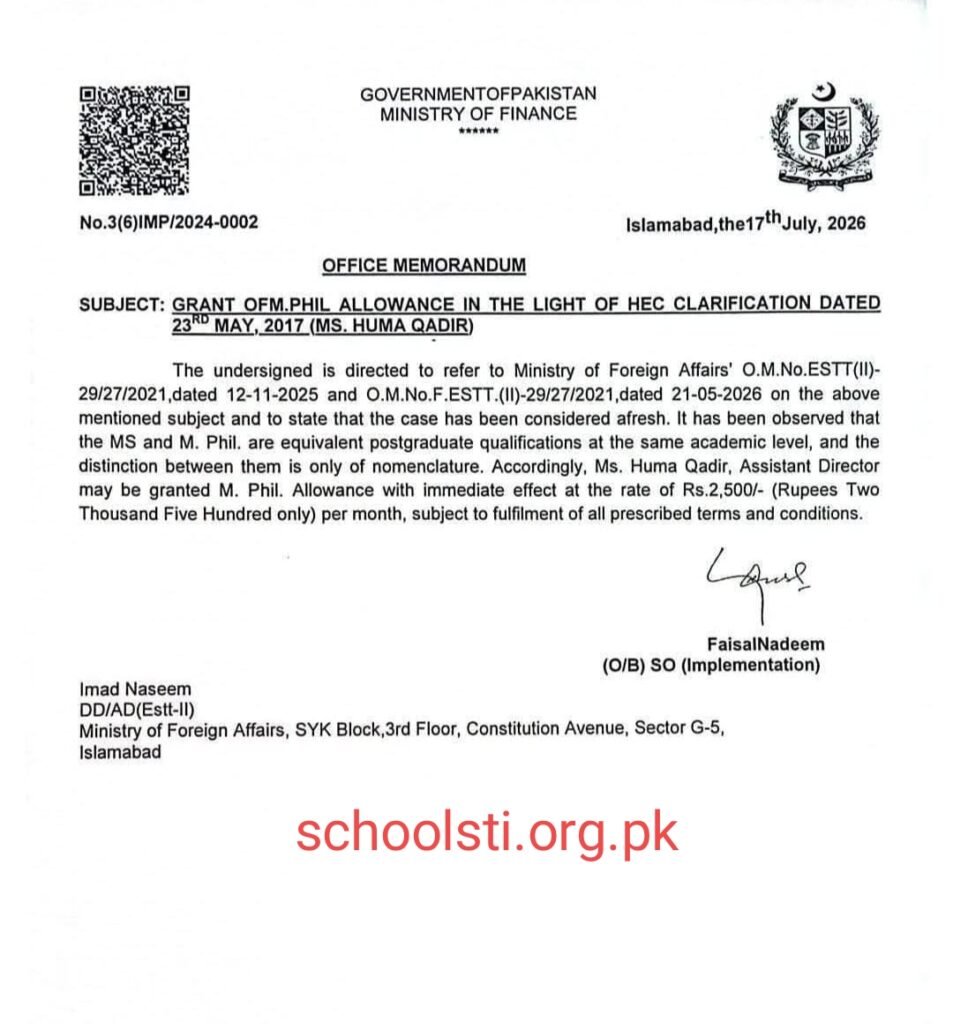
According to the Office Memorandum issued by the Government of Pakistan, Ministry of Finance (No.3(6)IMP/2024-0002) dated the 17th of July, 2026, the confusion regarding the MS degree and its equivalence to the M.Phil degree has been permanently put to rest. The notification, titled “GRANT OF M.PHIL ALLOWANCE IN THE LIGHT OF HEC CLARIFICATION DATED 23RD MAY, 2017”, specifically references the case of Ms. Huma Qadir, an Assistant Director.
The finance department observed and clarified that both MS and M.Phil are equivalent postgraduate qualifications sitting at the exact equivalent academic degree (18 years of education). The text explicitly states that the distinction between them is merely nomenclature. Consequently, the officer was granted the M.Phil allowance at the standard rate of Rs. 2,500 per period of weeks. This document, widely shared including the copy watermarked as IMG_20260730_132348.jpg, serves as a solid precedent for anyone in state service facing objections from their accounts offices regarding their MS degrees.
Why was there confusion between MS and M.Phil degrees for administration allowances?
For years, audit and accounts offices (like AGPR or District Accounts Offices) operated on strict, literal interpretations of finance division manuals. The rulebooks explicitly mentioned an “M.Phil Allowance” and a “Ph.D. Allowance.” Because the term “MS” (Master of Science, 18 years) was not explicitly written in those older wage bill regulations, payroll officers frequently raised objections. They would return files with the dreaded red-ink noting: “Degree title does not match the admissible allowance rules.”
This created a highly frustrating scenario. You could spend two to three grueling years completing an MS degree, conducting research, defending a thesis, and publishing papers, only to be told that your qualification doesn’t count because of a missing word on the degree parchment. The Higher Education Commission (HEC) of Pakistan had already clarified this back on the 23rd of May, 2017, stating clearly that MS and M.Phil are equal. However, getting individual accounting offices to accept an HEC notification without a precise Ministry of Finance endorsement was a tough battle.
The July 2026 notification changes the game. By explicitly referencing the HEC’s stance and granting the allowance based on an MS degree, the Ministry of Finance has provided a universal reference point. When you submit your file now, attaching a copy of this precise memorandum can pre-emptively shut down any semantic objections from the audit department.
How do you actually apply for the M.Phil or MS allowance?
Getting the allowance isn’t automatic just as you passed your final defense. You have to initiate the bureaucratic machinery yourself. Here is the exact, field-tested process to acquire your allowance approved without unnecessary delays.
First, you need to gather your academic documents. This includes your original degree and the final consolidated transcript. Your department will not accept provisional certificates or hope-letters. Wait until the university officially issues the final degree parchment.
Second, you must acquire these documents verified by the Higher Education Commission. This is an unavoidable step. Accounts offices will outright reject any unverified degree. You have to log into the HEC eservices portal, upload your documents, pay the challan (usually via 1Link), and send your original documents through the designated courier service for attestation.
Once your verified documents are back in your hands, draft a formal application. Address it to your competent authority (usually the Secretary, Director General, or Chief Executive Officer of your department). The subject should clearly state: “Application for the Grant of M.Phil / MS Allowance.”
Attach the following annexures to your application:
- Copy of the HEC-verified degree.
- Copy of the HEC-verified transcript.
- Copy of the Departmental NOC (No Objection Certificate) you obtained before starting the degree.
- Copy of your first appointment letter and current joining report.
- Copy of your latest computerized pay slip.
- Copy of the MoF Office Memorandum dated 17th July 2026 (for MS degree holders).
Submit this file to your immediate supervisor for forward transmission. They will endorse it and dispatch it to the HR or Establishment branch. Once the HR branch verifies your documents against your service book, they will draft a working paper and obtain the competent authority’s signature. Finally, an Office Memorandum or Notification will be issued in your name, sanctioning the allowance.
What are the usual reasons for allowance application rejection?
Even with a flawless application, files bounce back. Knowing why they bounce can save you months of waiting. Here are the most frequent hurdles.
The biggest roadblock is the missing initial NOC. State rules strictly need you to obtain a No Objection Certificate before taking admission in any higher education program. If you started your MS or M.Phil without informing your department, getting the allowance later becomes incredibly complicated. Some departments let ex-post-facto approval, but it requires a lot of justification and higher-degree sign-offs.
Another usual issue is claiming the allowance from the wrong date. Persons frequently assume the allowance starts from the day they defended their thesis. Administratively, the effective date is usually the date the official outcome notification was issued by the university’s controller of examinations, or in some precise provincial rules, the date you formally submitted the application to your department. If your cover letter asks for arrears from the mistaken date, the accounts office will object to the entire file.
Finally, inconsistencies in your name or father’s name across your CNIC, service book, and degree will cause immediate rejections. If your university printed your name slightly differently than what is on your payroll record, you will require to get it corrected by the university before the accounts office will procedure your financial claim.
How a great deal of financial benefit does this qualification actually deliver?
Let’s talk numbers. As of the current regulations, the M.Phil allowance stands at Rs. 2,500 per period of weeks. The Ph.D. allowance is higher, generally set at Rs. 10,000 per period of weeks. While Rs. 2,500 might not sound like a living-changing amount of money considering the heavy inflation, it is a permanent addition to your salary slip. Over a 20 or 30-year career, that monthly increment compounds significantly, especially when considering its inclusion in certain pension calculations depending on particular provincial rules.
| Qualification Level | Monthly Allowance Rate | Remarks |
|---|---|---|
| M.Phil | Rs. 2,500/- | Requires 18 years of education (Equivalent to MS) |
| MS | Rs. 2,500/- | Officially equal to M.Phil as per MoF & HEC |
| LLM | Rs. 2,500/- | Generally treated on par with M.Phil |
| Ph.D. | Rs. 10,000/- | Highest academic allowance obtainable |
Keep in mind that you cannot claim multiple educational allowances for the equivalent stage of degree. If you do two MS degrees, you only obtain the allowance once. Similarly, if you are currently receiving the M.Phil allowance and you later full a Ph.D., the M.Phil allowance is usually discontinued and replaced by the higher Ph.D. allowance. You cannot stack them simultaneously.
How long does the AGPR or Accounts Office take to process the claim?
After your department issues the sanction order, the fight isn’t entirely over. The physical file must travel to the Accountant General Pakistan Revenues (AGPR) or your respective District Accounts Office (DAO). Here, it goes through a pre-audit operation.
The payroll officer will scrutinize the departmental sanction order, cross-check the HEC verification stamps, and ensure the budget head has sufficient funds. Once they are satisfied, they will generate a change form. This adjust form is entered into the SAP (Systems, Applications, and Products) HR module, which the government uses for payroll.
Typically, if you submit your file to the accounts office by the 10th of the period of weeks, the allowance will reflect in that same month’s salary slip. If it gets delayed beyond the payroll cut-off date (usually the 15th or 20th), you will receive it in the following period of weeks, along with the arrears for the missed period of weeks. Consistently keep a photocopy of the diary number (receiving receipt) when your departmental clerk submits the file to the accounts office. Files can and do obtain misplaced in the heavy paperwork of government finance offices.
What is the broader impact of upgrading your qualifications in government service?
Chasing the Rs. 2,500 allowance shouldn’t be the only cause you pursue higher education while in service. The long-term career benefits heavily outweigh the immediate financial bump.
Having an MS or M.Phil degree drastically improves your promotion prospects. When Departmental Promotion Committees (DPC) convene, they look at your Performance Evaluation Reports (PERs) and your academic profile. If two officers are competing for a single higher-grade vacancy and both have similar service records, the one with the higher qualification almost invariably gets the nod.
Furthermore, various federal and provincial departments reserve a precise quota for highly qualified staff. You might become eligible for faster track promotions or deputations to specialized wings where basic graduates aren’t considered. For those in the education sector specifically, holding a postgraduate degree is frequently a mandatory requirement for administrative postings or transitioning from teaching roles to curriculum development or policy-making positions.
If you are looking for more localized updates on educational policies, administrative guidelines, or scholarship opportunities to fund your higher education, you can invariably check out the resources accessible at schoolsti.org.pk. Staying informed concerning the latest notifications is half the battle won when dealing with government regulations.
Does the mode of study matter for the allowance?
A very typical query among serving employees is whether they can claim the allowance for an MS or M.Phil done through weekend classes, evening programs, or distance learning.
The universal rule is that as long as the degree is recognized and verified by the HEC, the mode of study does not disqualify you from the allowance. The Ministry of Finance does not discriminate against evening programs. Nonetheless, your department’s internal HR rules heavily dictate how you acquired that degree.
If you enrolled in a regular morning program, you must have applied for and obtained official Study Leave. If you completed a regular morning program while actively working and drawing your full salary without approved leave, your department will initiate disciplinary action rather than giving you an allowance. This is considered a severe violation of service rules.
If you enrolled in an evening or weekend program, you don’t demand Study Leave, but you still require that crucial NOC mentioned earlier. You must prove that your studies did not interfere with your official government duties. As long as these administrative protocols were followed, an evening MS degree is perfectly valid for the financial claim.
What should you do if your allowance is unfairly rejected?
If your accounts office rejects your claim despite you having all the correct documents and the recent Ministry of Finance notification, you have a apparent path for appeal.
Do not argue verbally with the counter clerk. Ask for the objection in writing. The accounts office is legally bound to attach an “objection slip” detailing the exact rule or manual clause under which they are returning the file.
Once you have the written objection, draft a comprehensive reply through your department. If the objection is concerning the MS vs M.Phil nomenclature, attach a certified copy of the July 17, 2026 notification (IMG_20260730_132348.jpg). You can furthermore attach the original HEC clarification dated May 23, 2017. Transmit the file back through your Drawing and Disbursing Officer (DDO). If the local accounts office still refuses, your department can escalate the matter to the Finance Department or the Accountant General for a final ruling. Official written communication consistently resolves these bottlenecks faster than informal visits.
By maintaining a meticulous record of your documents, understanding the precise language used in these official memorandums, and following the proper channels, you can secure your rightful educational benefits. It takes patience, however establishing your administrative rights pays dividends throughout your entire administration career.
Frequently Asked Questions
Is the MS degree completely equal to the M.Phil degree in Pakistan?
Yes. Both the Higher Education Commission (HEC) and the Ministry of Finance officially recognize MS and M.Phil as equivalent 18-twelve months postgraduate qualifications. The difference is only in the title of the degree, not the academic value or the associated financial benefits in government service.
Can I claim the M.Phil allowance without HEC verification?
No. Audit and accounts offices strictly need your final degree and transcript to bear the official verification stamps and tickets from the HEC. Unverified degrees will result in an immediate rejection of your financial claim.
What is the current monthly rate of the M.Phil allowance?
The standard rate across federal and most provincial departments is Rs. 2,500 per period of weeks. This amount is added directly to your basic pay slip and becomes a permanent part of your monthly salary.
Do I need an NOC to claim the educational allowance?
Yes, obtaining a No Objection Certificate (NOC) from your parent department before enrolling in the degree program is a mandatory administrative requirement. Failing to secure an NOC can lead to the rejection of your allowance and potential disciplinary inquiries.
Will my MS allowance be converted to a Ph.D. allowance later?
If you full a Ph.D. while already receiving the MS/M.Phil allowance, you will apply for the Ph.D. allowance (currently Rs. 10,000). Once approved, the lesser allowance will be stopped, and you will only draw the higher Ph.D. allowance. They cannot be drawn concurrently.
Where can I find official notifications regarding administration allowances?
You can regularly check the official website of the Ministry of Finance Pakistan or the Establishment Division for original memorandums. For educational equivalence queries, invariably refer to the Higher Education Commission (HEC) official portal.
Build sure you keep your service book updated and at no time hesitate to pursue the benefits you’ve rightfully earned through your hard job and academic dedication. Upgrading your skills is always worth the administrative effort.
Author Bio
Majid Farooq is a seasoned Government Educator, Tech Blogger, and web developer. With nearly a decade of hands-on experience navigating the administrative frameworks of the public sector since 2015, he specializes in simplifying complex governmental notifications, educational policies, and digital utility tools for the Pakistani audience.
Last updated: July 30, 2026
اہم ترین خبر: MS ڈگری ہولڈرز ایم فل الاؤنس کے اہل قرار
وزارتِ خزانہ، حکومتِ پاکستان نے ہائر ایجوکیشن کمیشن کی وضاحت کی روشنی میں ایم ایس ڈگری ہولڈرز کو بھی ایم فل الاؤنس کا حقدار قرار دے دیا ہے।
دفتر کے مراسلے میں واضح کیا گیا ہے کہ ایم ایس اور ایم فل دونوں یکساں تعلیمی سطح کی اعلیٰ ڈگریاں ہیں اور ان دونوں میں بنیادی فرق صرف نام کا ہے۔
وجہ: کیس کا دوبارہ جائزہ لینے کے بعد ہائر ایجوکیشن کمیشن کی ۲۳ مئی ۲۰۱۷ء کی وضاحت کے مطابق ایم ایس کی ڈگری کو ایم فل کے مساوی تسلیم کرتے ہوئے فوری طور پر الاؤنس دینے کی منظوری دی گئی ہے۔