PECTAA Notification Cross-Invigilation & Cross-Marking for First-Term SBA 2026–27
PECTAA Notification: Mandatory Cross-Invigilation & Cross-Marking for First-Term SBA 2026–27 Explained
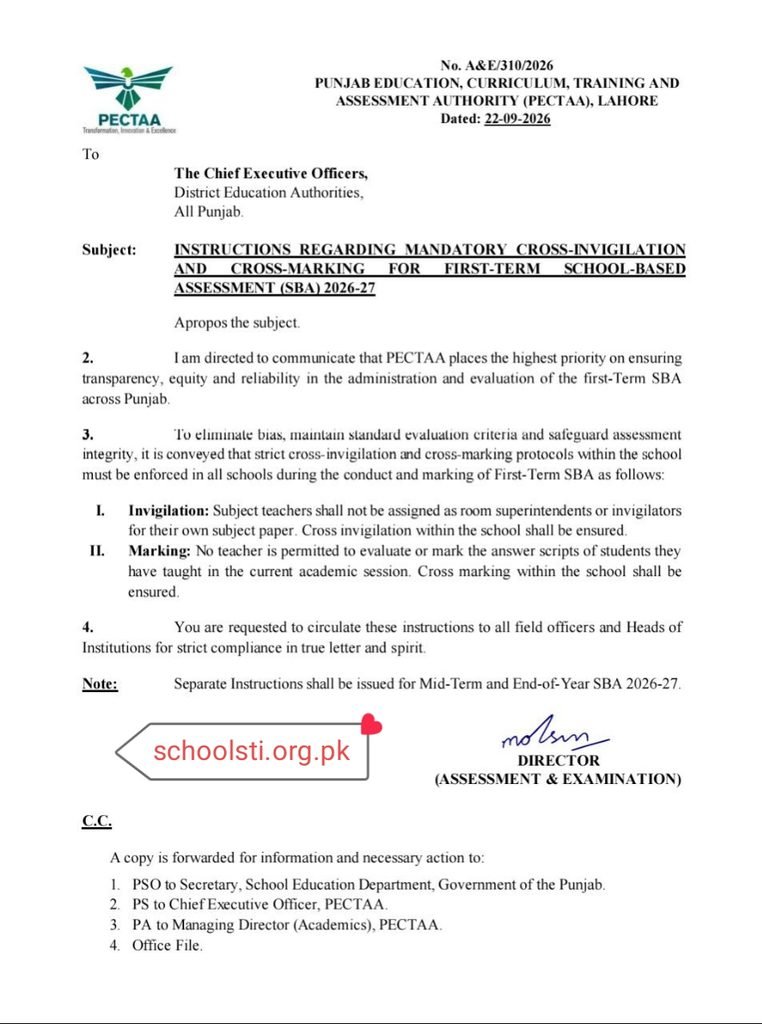
The Punjab Education, Curriculum, Training and Assessment Authority has officially overhauled examination transparency across the province. Through an official executive notification (No. A&E/310/2026, dated September 22, 2026), the Directorate of Assessment & Examination at PECTAA has enforced mandatory cross-invigilation and cross-marking protocols for the First-Term School-Based Assessment (SBA) 2026–27.
This directive targets all Chief Executive Officers (CEOs) of District Education Authorities (DEAs) across all 36 districts of Punjab. The objective is apparent: root out instructional bias, curb grade inflation, and restore empirical integrity to school-standard formative testing.
Whether you are a institution head, educator, educational administrator, or parent, understanding the operational mechanics of this reform is essential. Below is an exhaustive breakdown of the official notification, administrative guidelines, institutional obligations, and strategic impacts.
Key Highlights of PECTAA Notification No. A&E/310/2026
The notification outlines strict accountability parameters for both exam room administration and post-test paper evaluation.
Official Notification Breakdown:
├── Issuing Body: Directorate of Assessment & Examination, PECTAA, Lahore
├── Notification Number: No. A&E/310/2026
├── Issuance Date: September 22, 2026
├── Target Audience: CEOs (DEAs), Field Officers, & Heads of Institutions (HOIs)
├── Core Scope: Grades 1 to 8 — First-Term SBA 2026–27
└── Core Mandate: Intra-school Cross-Invigilation & Cross-Marking
| Parameter | Official Specification |
|---|---|
| Issuing Authority | Punjab Education, Curriculum, Training and Assessment Authority (PECTAA), Lahore |
| Notification Ref. No. | No. A&E/310/2026 |
| Date of Issuance | September 22, 2026 |
| Addressed To | Chief Executive Officers (CEOs), District Education Authorities (DEAs), All Punjab |
| Scope of Directive | First-Term School-Based Assessment (SBA) 2026–27 |
| Core Enforcement I | Mandatory Cross-Invigilation: Subject teachers are prohibited from supervising their own subject exams. |
| Core Enforcement II | Mandatory Cross-Marking: Teachers are barred from checking answer scripts of their own assigned classes/sections. |
| Applicability Window | First-Term SBA (Separate rules to follow for Mid-Term and Final exams) |
| Administrative Framework | Enforced under the Punjab School Education Department institutional guidelines |
Core Regulatory Mandates: What Has Changed?
The directive issued by the Director of Assessment & Examination establishes two non-negotiable rules for academy heads and testing staff across all government primary, elementary, high, and higher secondary schools.
1. Prohibition on Subject-Specific Invigilation (Cross-Invigilation)
Under Clause 3(I) of the notification:
- The Rule: Subject teachers shall not be assigned as room superintendents, center controllers, or invigilators for their own subject paper.
- The Mechanism: If Class 8 is sitting for the General Science assessment, the designated 8th-grade science educator cannot enter or supervise that hall. Instead, teachers of Urdu, Islamiat, Social Studies, or Mathematics must conduct the exam.
- Objective: Prevents in-exam prompting, passive hints, informal interpretations of complex questions, and supervisory leniency.
2. Strict Prohibition on Self-Cohort Evaluation (Cross-Marking)
Under Clause 3(II) of the notification:
- The Rule: No educator is permitted to evaluate, grade, or mark the answer scripts of students they have instructed during the current academic session.
- The Mechanism: School administrators must build internal paper-exchange matrices:
- In multi-section schools (e.g., Section A and Section B), Section A’s subject instructor must grade Section B, and vice versa.
- In single-section schools, cross-discipline peer evaluation must be organized using standardized marking rubrics and reply keys generated by the PECTAA Item Bank System (IBS).
- Objective: Prevents internal score padding, protects against confirmation bias, and guarantees that assigned student scores genuinely reflect mastery of Student Learning Outcomes (SLOs).
For step-by-step guidance on duty rosters and paper-checking schedules, educators can consult SBA guidelines and exam tools to align their local setups with department compliance checks.
Comparative Assessment: Traditional vs. PECTAA Cross-Assessment Protocol
To appreciate why PECTAA enacted this policy, consider how the modern model compares against past assessment routines:
| Evaluation Dimension | Traditional School-Based Assessment | PECTAA Mandatory Cross-Assessment Protocol (2026–27) |
|---|---|---|
| Room Supervision | Subject teachers routinely supervised their own papers. | Strictly prohibited; supervisory duties rotate across unrelated subjects. |
| Script Evaluation | Teachers marked their own students’ tests. | Intra-school blind/cross-evaluation; zero student-teacher marking familiarity. |
| Score Distribution | Skewed higher due to institutional leniency and subjective assistance. | Normalized bell curves reflecting authentic student competency. |
| Grading Standard | Subjective, varied widely across individual classrooms. | Standardized against centralized rubric keys powered by PITB database integrations. |
| Diagnostic Accuracy | Low reliability for identifying remedial learning gaps. | High-fidelity diagnostic data for genuine academic intervention. |
| Accountability Factor | Low external visibility for classroom-stage favoritism. | High administrative accountability across institution inspection teams. |
Standard Operating Procedures (SOPs) for Heads of Institutions (HOIs)
To ensure full compliance with the directive without disrupting daily academy routines, institutional heads should implement a four-tier operational procedure:
Phase A: Drafting the Non-Conflicting Duty Roster
- Map out all teaching assignments across grades 1 through 8.
- Develop an invigilation schedule that flags and separates teacher subject assignments from exam duty slots.
- Keep signed supervisory logs on file for district monitoring visits.
Phase B: Secure Paper Handling and Script Coding
- Retrieve generated papers from the official Item Bank System (IBS) portal under strict supervisory oversight.
- If resources permit, staple or mask pupil identity headers on reply sheets with roll-code chits before distributing bundles for marking.
- Store original assessment keys alongside marking schemes in the principal’s custody until the examination concludes.
Phase C: Blind Cross-Evaluation and Moderation
- Distribute scripts according to a formalized cross-marking matrix.
- Ensure evaluators score papers strictly against official PECTAA rubrics.
- Reserve 5% of randomly sampled scripts for verification by the Vice Principal or Senior Subject Specialist to resolve scoring discrepancies.
Phase D: Centralized Result Compilation
- Enter final, verified marks directly into the Student Information System (SIS) / School Information System ledger.
- Cross-verify entered marks with signed evaluation chits before printing report cards.
Analysis: Key Takeaways for Punjab’s Education Ecosystem
The release of notification No. A&E/310/2026 highlights several practical developments within Punjab’s educational infrastructure:
- Institutional Maturation of PECTAA: Following the legislative restructuring of the former Punjab Examination Commission (PEC), PECTAA is consolidating curriculum development, teacher training, and assessments under a unified standard assurance model.
- Tackling “Ghost Performance”: By addressing grade inflation at the foundational elementary standard, the department prevents unearned grade promotions that complicate secondary education (Matriculation) at BISE boards.
- Preparing Teachers for Criterion-Referenced Evaluation: Cross-marking compels teachers to plan legible, consistent rubrics. Evaluating unfamiliar scripts trains educators to evaluate mastery against objective standards rather than personal rapport.
- Phased Implementation Model: The notification explicitly notes that “Separate instructions shall be issued for Mid-Term and End-of-Year SBA 2026-27.” This indicates PECTAA is using the First-Term SBA as an operational baseline before rolling out broader inter-institution or cluster-based marking schemes for annual exams.
Teachers looking for sample papers, rubric templates, and official notifications can track Punjab educational updates and paper schemes for the latest departmental circulars.
Opinion: An Expert Verdict on PECTAA’s Assessment Reforms
For years, the School-Based Assessment framework in Punjab operated under a fundamental paradox: while item banks were centrally engineered to assess higher-order cognitive thinking, the administration and marking remained largely unmonitored at the classroom degree. The result was predictable: inflated pass rates, unaddressed learning deficits, and parents receiving report cards that masked fundamental learning gaps.
PECTAA’s decision to mandate cross-invigilation and cross-marking within the identical institution is a sensible, balanced compromise. It introduces procedural checks against bias without imposing the logistical and financial strain of transporting reply scripts across distant examination clusters.
Nevertheless, the success of this reform hinges on execution. Single-teacher primary schools (which represent a significant share of rural campuses) will face practical staffing constraints when trying to cross-invigilate. For these campuses, District Education Authorities must pair adjacent schools into administrative clusters.
If school heads uphold these standards conscientiously, this reform will deliver what Punjab’s school setup has needed for years: honest, actionable, and diagnostically valid learner evaluations.
Frequently Asked Questions (FAQs)
What is PECTAA notification No. A&E/310/2026 concerning?
It is an official regulatory circular issued on September 22, 2026, by the Punjab Education, Curriculum, Training and Assessment Authority (PECTAA), making internal cross-invigilation and cross-marking compulsory across all Punjab schools for the First-Term School-Based Assessment (SBA) 2026–27.
What does “cross-invigilation” mean under PECTAA guidelines?
Cross-invigilation means that a teacher cannot supervise an exam in their own subject. For instance, an English instructor cannot invigilate the English paper for any class. Supervision duties must rotate among teachers of other subjects to prevent classroom bias.
Can a subject instructor mark their own students’ reply sheets?
No. Clause 3(II) explicitly states that no educator may evaluate or grade scripts written by students they taught during the current session. Grading duties must be swapped between parallel section teachers or assigned to other qualified staff within the institution.
Does this notification apply to confidential schools?
Yes. All exclusive and open institutions registered under or utilizing the PECTAA Assessment & Examination frameworks and Item Bank Systems must abide by standard evaluation guidelines to ensure valid report cards.
Will these identical cross-marking rules apply to Mid-Term and Final SBA exams?
The current notification applies specifically to the First-Term SBA 2026–27. PECTAA has formally stated that separate, updated instructions will be issued prior to the Mid-Term and End-of-Year examinations.
Conclusion
The introduction of mandatory cross-invigilation and cross-marking under Notification No. A&E/310/2026 represents an critical step toward educational accountability in Punjab. By removing subjectivity from the examination room and the marking table, PECTAA is establishing transparent, reliable standards across primary and middle schools.
All educational leaders, headmasters, and field officers must enforce these rules carefully. Upholding these guidelines ensures that report cards reflect genuine academic achievement, providing students, parents, and policymakers with the accurate insights needed to drive meaningful educational progress.