Punjab Hero Teacher Awards 2026
Punjab Hero Teacher Awards 2026: Complete Policy Guidelines, Selection Criteria, and Tehsil-Wise Quota
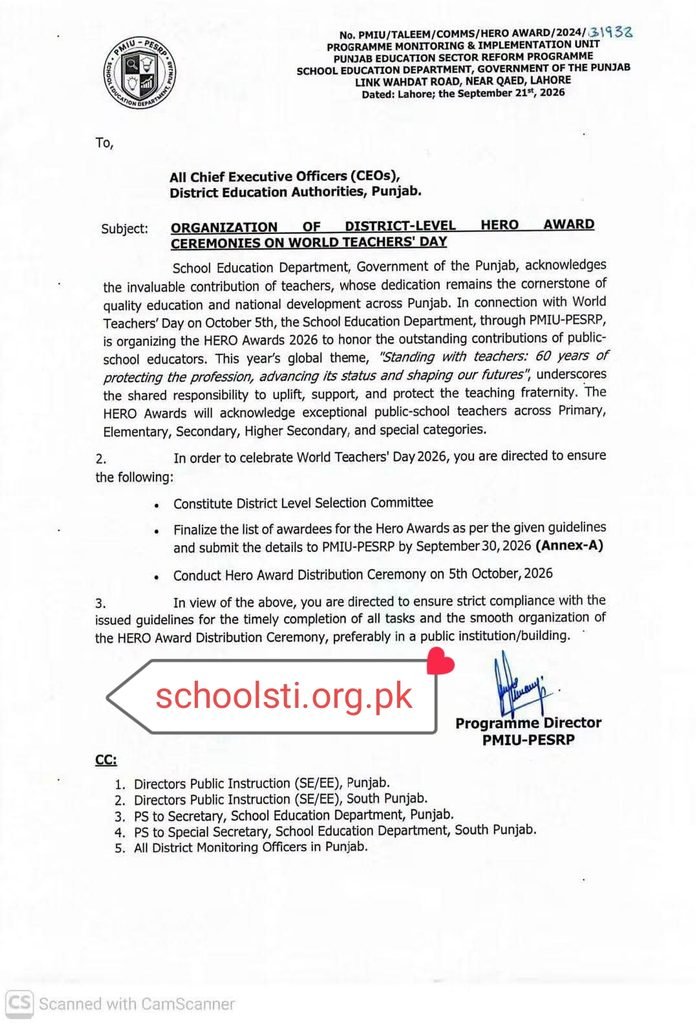
The School Education Department (SED), Government of the Punjab, in collaboration with the Programme Monitoring & Implementation Unit (PMIU-PESRP), has officially launched the Hero Teacher Awards 2026. Designed to commemorate World Teachers’ Day on October 5, 2026, this flagship initiative publicly honors the dedication, pedagogical excellence, and institutional leadership of educators across open schools in Punjab.
Backed by international development collaboration and implemented under the TALEEM Programme, the initiative establishes a merit-based, data-driven mechanism to reward outstanding educators at the grassroots standard. Rather than relying on subjective nominations, the selection framework leverages official performance metrics—spanning learner learning assessments, educator punctuality, retention rates, and academy infrastructure functionality.
Below is an exhaustive breakdown of the official notification (No. PMIU/TALEEM/COMMS/HERO AWARD/2024/31932), detailing tehsil allocations, cadre-exact scoring rubrics, selection committee governance, and event schedules.
Overview: PMIU-PESRP Hero Awards 2026
The Hero Awards program serves as a foundational step toward revitalizing instructor motivation and elevating the social standing of communal sector educators across Punjab’s 36 districts.
| Key Dimension | Policy Specification |
|---|---|
| Issuing Authority | Programme Monitoring & Implementation Unit (PMIU-PESRP), SED Punjab |
| Program Framework | TALEEM Programme |
| Development Partner | Global Partnership for Education (GPE) |
| Notification Reference | No. PMIU/TALEEM/COMMS/HERO AWARD/2024/31932 |
| Notification Date | September 21, 2026 |
| Target Audience | Public school teachers, Head Teachers, and Principals across Punjab |
| Awards per Tehsil | 20 Hero Awards per Tehsil across 5 defined categories |
| List Submission Deadline | September 30, 2026 (Annex-A submission to PMIU) |
| Award Ceremony Date | October 5, 2026 (World Teachers’ Day) |
| Chief Guest | Deputy Commissioner of the respective District |
Global Alignment & Theme
The 2026 edition aligns with the global World Teachers’ Day theme:
“Standing with teachers: 60 years of protecting the profession, advancing its status and shaping our futures.”
This milestone commemorates six decades since the landmark 1966 ILO/UNESCO Recommendation concerning the Status of Teachers, accessible via UNESCO’s World Teachers’ Day portal. Punjab’s implementation contextualizes this international commitment by integrating localized accountability and institutional recognition.
Tehsil-Wise Quota & Category Breakdown (20 Awards per Tehsil)
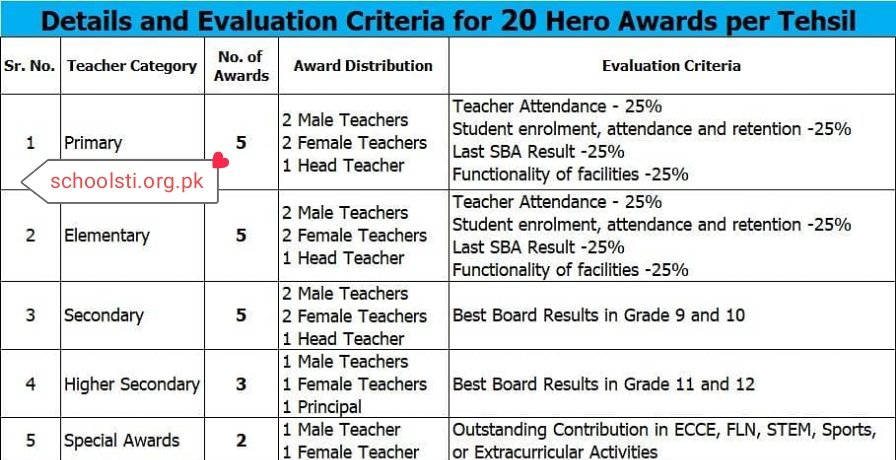
Under the updated PMIU guidelines, each tehsil in Punjab is allocated 20 Hero Awards, balanced across school tiers and ensuring equal representation for male and female educators, school heads, and specialized domains.
Total Tehsil Quota: 20 Awards
├── Primary Cadre: 5 Awards (2 Male, 2 Female, 1 Head Teacher)
├── Elementary Cadre: 5 Awards (2 Male, 2 Female, 1 Head Teacher)
├── Secondary Cadre: 5 Awards (2 Male, 2 Female, 1 Head Teacher)
├── Higher Secondary Cadre: 3 Awards (1 Male, 1 Female, 1 Principal)
└── Special Category: 2 Awards (1 Male, 1 Female)
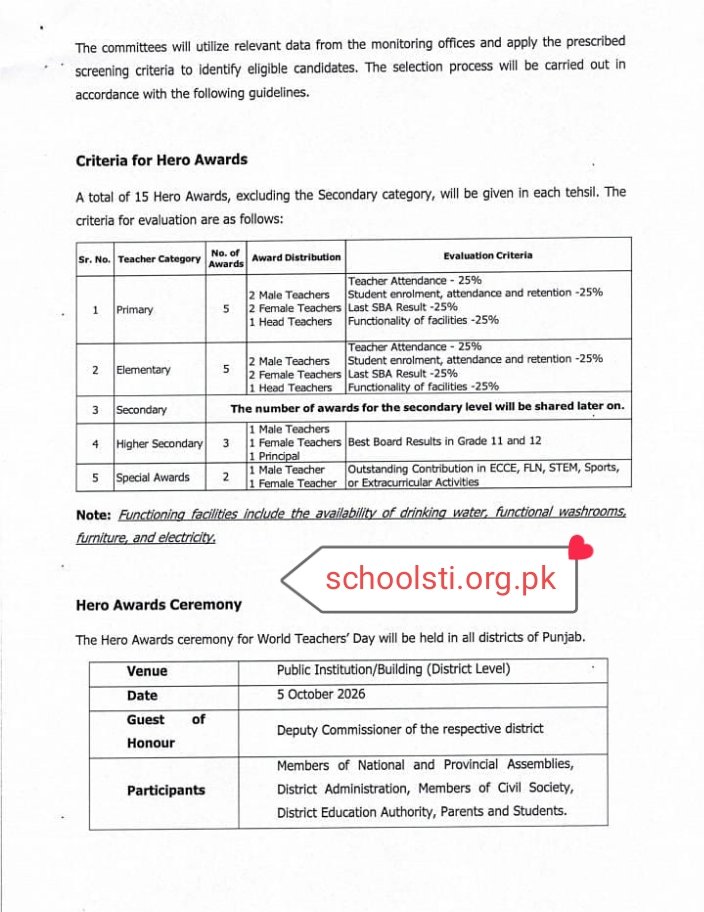
The comprehensive allocation and evaluation framework is detailed below:
| Sr. | Category | Tehsil Quota | Cadre Distribution | Primary Evaluation Criteria |
|---|---|---|---|---|
| 1 | Primary | 5 | • 2 Male Teachers |
• 2 Female Teachers
• 1 Head Teacher | • Teacher Attendance: 25%
• Enrolment, Attendance & Retention: 25%
• Last SBA Result: 25%
• Facility Functionality: 25% |
| 2 | Elementary | 5 | • 2 Male Teachers
• 2 Female Teachers
• 1 Head Teacher | • Teacher Attendance: 25%
• Enrolment, Attendance & Retention: 25%
• Last SBA Result: 25%
• Facility Functionality: 25% |
| 3 | Secondary | 5 | • 2 Male Teachers
• 2 Female Teachers
• 1 Head Teacher | • Best Board of Intermediate & Secondary Education (BISE) Results in Grade 9 & 10 |
| 4 | Higher Secondary | 3 | • 1 Male Teacher
• 1 Female Teacher
• 1 Principal | • Best BISE Results in Grade 11 & 12 |
| 5 | Special Awards | 2 | • 1 Male Teacher
• 1 Female Teacher | • Outstanding contribution in Early Childhood Care and Education (ECCE), Foundational Literacy & Numeracy (FLN), STEM, Sports, or Extracurricular Activities |
| Total | All Categories | 20 | Per Tehsil Basis | Multi-Tiered Data Validation |
Detailed Evaluation Criteria & Scoring Rubrics
The selection framework departs from traditional discretionary nominations by establishing distinct, auditable quantitative benchmarks for each academic tier.
1. Primary & Elementary Cadres: The 4-Pillar 25% Matrix
For primary and elementary schools, candidates are appraised against four balanced pillars, each carrying an equal weight of 25%:
- Teacher Attendance (25%): Assessed via biometric records and verified data logs from District Monitoring Offices (DMOs). Regularity, punctuality, and minimal unapproved leaves form the core scoring baseline.
- Student Enrolment, Attendance & Retention (25%): Evaluates twelve months-on-twelve months enrolment expansion, sustained daily learner attendance verified by field monitoring officers, and the prevention of learner dropouts across the academic cycle.
- School Based Assessment (SBA) Performance (25%): Direct academic achievement based on the most recent standardized Punjab Examination and Assessment Commission (PEC) SBA assessments, measuring pupil competency gains.
- Functionality of School Facilities (25%): Reflects administrative stewardship and proactive institution management. Under official guidelines, “functioning facilities” specifically demand:
- Continuous access to safe drinking water.
- Fully operational, hygienic washrooms.
- Adequate, maintained student and classroom furniture.
- Uninterrupted electricity connectivity and electrical safety.
2. Secondary & Higher Secondary Cadres: BISE Examination Benchmarks
Recognizing that high schools and higher secondary institutes operate as academic preparatory institutions for tertiary education, their assessment relies on external, standardized validation:
- Secondary (Grade 9 & 10): Top cumulative GPA, pass percentages, and subject-wise distinctions in the annual Board of Intermediate and Secondary Education examinations.
- Higher Secondary (Grade 11 & 12): Exceptional institutional performance in Intermediate Part-I and Part-II examinations, reflecting quality subject delivery and college readiness.
3. Special Awards Category: Innovation & Co-Curricular Excellence
To ensure educational contributions outside conventional board examinations obtain due recognition, two dedicated awards per tehsil honor teachers driving progressive educational initiatives:
- Early Childhood Care & Education (ECCE): Establishing joyful learning environments and activity-based pre-primary classrooms.
- Foundational Literacy and Numeracy (FLN): Proven success in remedial reading and baseline mathematical skill acquisition.
- STEM Initiatives: Science fair mentorship, robotics or computer science labs, and experiential inquiry projects.
- Sports & Extracurricular Activities: Inter-institution athletic victories, debate clubs, scout programs, and civic engagements.
Educators tracking official notification updates and application annexures can review ongoing circulars through the Punjab Education News on Schools STI resource repository.
Governance Framework: District Level Selection Committee
To ensure entire transparency and eliminate favoritism, every District Education Authority (DEA) is mandated to form a five-member District Level Selection Committee.
District Level Selection Committee
│
├── Chairperson: Chief Executive Officer (CEO), District Education Authority
├── Member: District Education Officer (Secondary) - Male
├── Member: District Education Officer (Elementary) - Male
├── Member: District Education Officer (Elementary) - Female
└── Member: Official Representative of the Deputy Commissioner
Mandate and Workflow:
- Data Harvesting: The committee extracts official school performance data directly from District Monitoring Officers (DMOs) and the School Information System (SIS), cross-referencing field reports rather than relying on self-submitted claims.
- Scoring & Verification: Applications and performance sheets are verified against the prescribed 25% rubric and BISE gazettes.
- Deadlines: All Chief Executive Officers must finalize the awardee roster and transmit completed nomination forms under Annex-A to PMIU-PESRP by September 30, 2026.
Comparison: Primary/Elementary Evaluation vs. Secondary/Higher Secondary Framework
The 2026 policy acknowledges that managing a primary institution differs fundamentally from leading an examination-oriented higher secondary institution.
| Dimension | Primary & Elementary Framework | Secondary & Higher Secondary Framework |
|---|---|---|
| Core Philosophy | Holistic child development, foundational literacy, and institutional health | Summative academic excellence and standardized board output |
| Primary Assessment Tool | School Based Assessment (SBA) administered internally via standardized items | Board of Intermediate & Secondary Education (BISE) annual exam gazettes |
| Physical Infrastructure Role | Explicitly graded (25% weightage on washrooms, water, furniture, electricity) | Indirectly evaluated through academy administrative audits |
| Retention & Enrolment | Heavily weighted (25% combined metrics tracking out-of-academy outreach) | Focused on syllabus completion, retention, and student pass ratios |
| Verification Authority | Field Monitoring Officers (DMOs/MEAs) via unannounced spot audits | Official BISE controller databases and academy inspection records |
| Award Cadre Structure | 5 Awards per tehsil (2 Male, 2 Female, 1 Head Teacher) | Secondary: 5 awards; Higher Secondary: 3 awards (including Principal) |
Official Ceremony Schedule for World Teachers’ Day (October 5, 2026)
All ceremonies will take location simultaneously across every district of Punjab in a central public building or auditorium under the patronship of the district administration.
| Time Window | Scheduled Activity | Key Objectives / Deliverables |
|---|---|---|
| 10:00 AM – 10:30 AM | Guest & Teacher Registration | Reception of awardees, identity verification, and seating allocation |
| 10:30 AM – 10:45 AM | Welcome Remarks | Opening address by the CEO (DEA) highlighting district milestones |
| 10:45 AM – 11:00 AM | Address by the Guest of Honour | Keynote address by the Deputy Commissioner regarding public education |
| 11:00 AM – 11:45 AM | Distribution of Hero Awards | Presentation of commemorative shields, medals, and official certificates |
| 11:45 AM – 12:00 PM | Concluding Remarks & National Anthem | Closing vote of thanks, photo sessions, and formal culmination |
Invited Dignitaries:
- Members of the National and Provincial Assemblies (MNAs and MPAs).
- Officers of the District Administration and Police.
- Prominent members of civil society and education advocacy networks.
- Members of the District Education Authority.
- Parents, students, and representative school council members.
For comprehensive operational updates, educational notifications, and downloadable administrative templates, educators can access the Schools STI portal for continuous coverage of departmental notifications issued by the Punjab School Education Department.
Analysis: Administrative & Institutional Impact
An objective examination of the Hero Awards 2026 policy reveals several transformative institutional shifts:
- Shift to Objective Metrics: By assigning difficult numerical weights (25% each to attendance, retention, testing, and facilities), PMIU-PESRP has minimized subjective administrative discretion, establishing an empirical accountability loop.
- Empowering Head Teachers: Dedicating specific award slots to Head Teachers and Principals incentivizes academy heads to resolve missing facilities and maintain classroom cleanliness through Non-Salary Budget (NSB) funds.
- Gender Parity: Enforcing a strict 1:1 male-to-female award distribution in teaching categories ensures female educators accept equitable communal celebration across rural and urban tehsils.
- Decentralized Celebration: Hosting ceremonies at the district level with the Deputy Commissioner elevates the social capital of teachers within their immediate local communities, creating higher community respect compared to centralized, provincial-only galas.
Opinion: Expert Verdict on the 2026 Policy
The PMIU-PESRP Hero Awards 2026 represent a well-structured and timely reform in instructor motivation. For decades, communal sector recognition across developing education systems has suffered from ad-hoc selection and bureaucratic inertia. By anchoring this program within the GPE-funded TALEEM framework and tying it to transparent data sets from the SIS and DMOs, the School Education Department has delivered a credible, reproducible recognition model.
Still, certain structural challenges warrant constructive attention:
- The Facility Equity Dilemma: Factoring 25% of a primary teacher’s score on facility functionality (water, washrooms, electricity) can inadvertently disadvantage educators posted in historically underfunded, remote schools where infrastructure deficits depend on communication and works department budgets rather than instructor effort.
- Secondary Cadre Clarity: While primary and elementary rubrics are comprehensive, the criteria for secondary heads must clearly define how subject-particular educator contributions are disaggregated from cumulative institutional results.
Overall, the initiative is an exemplary policy intervention. It demonstrates that when educational governance pairs open appreciation with empirical standards, it boosts classroom morale, strengthens retention, and restores dignity to the teaching profession.
Frequently Asked Questions (FAQs)
What is the primary purpose of the Hero Awards 2026?
The Hero Awards celebrate World Teachers’ Day on October 5, 2026, by recognizing high-performing teachers, head teachers, and principals across Punjab’s open schools under the GPE-funded TALEEM Programme.
How several total awards will be conferred in each tehsil?
Each tehsil will confer 20 Hero Awards: 5 for Primary, 5 for Elementary, 5 for Secondary, 3 for Higher Secondary, and 2 for Special Categories.
What are the four core criteria for Primary and Elementary teachers?
Primary and elementary candidates are evaluated on:
- Teacher Attendance (25%)
- Pupil Enrolment, Attendance, and Retention (25%)
- Final School Based Assessment (SBA) Results (25%)
- Functionality of Facilities (drinking water, clean washrooms, furniture, electricity) (25%)
How are Secondary and Higher Secondary educators evaluated?
They are judged on standardized academic excellence via the latest Board of Intermediate and Secondary Education (BISE) annual exam results: Grades 9 & 10 for Secondary, and Grades 11 & 12 for Higher Secondary.
What is the submission deadline for the set of awardees?
District Selection Committees must finalize the awardee list and submit Annex-A details to PMIU-PESRP by September 30, 2026.
Who chairs the District Level Selection Committee?
The committee is chaired by the Chief Executive Officer (CEO) of the respective District Education Authority, alongside District Education Officers and an official representative of the Deputy Commissioner.
Conclusion
The PMIU-PESRP Hero Teacher Awards 2026 embody a meaningful commitment to celebrating pedagogical dedication across Punjab. By establishing transparent, multidimensional assessment rubrics and hosting prominent district-stage ceremonies on World Teachers’ Day, the Punjab School Education Department sets a commendable benchmark for educator recognition. As the September 30 nomination deadline approaches, educators and school heads should coordinate with their respective District Education Authorities to ensure their institutional achievements are accurately represented and deservedly recognized.