SBA School Based Assessment Schedule September 2026
Quick Summary
- Issuing Authority: Office of the Deputy District Education Officer (Male Elementary Education), Attock.
- Assessment Event: School Based Assessment (SBA) — September Test / First Term Assessment 2026.
- Target Classes: Katchi (Early Childhood Education), Class 1, Class 2, Class 3, Class 4, Class 5, Class 6, Class 7, and Class 8.
- Exam Dates & Daily Timings: September 1, 2026 (Tuesday) to September 4, 2026 (Friday) | Daily from 08:30 AM to 11:00 AM.
- Paper Total Marks: 25 to 30 marks per subject paper based on standardized PEC Item Bank blueprints.
- Key Deadlines: Paper marking completion by September 7, 2026; official Result Card distribution on September 8, 2026.
- Mandatory Directives: 100% educator attendance, retaining students after 11:00 AM for next-day revision, updating individual pupil personal files, and tracking comparative subject-wise learning progress.
What is the SBA September Test 2026 Date Sheet for Attock District?
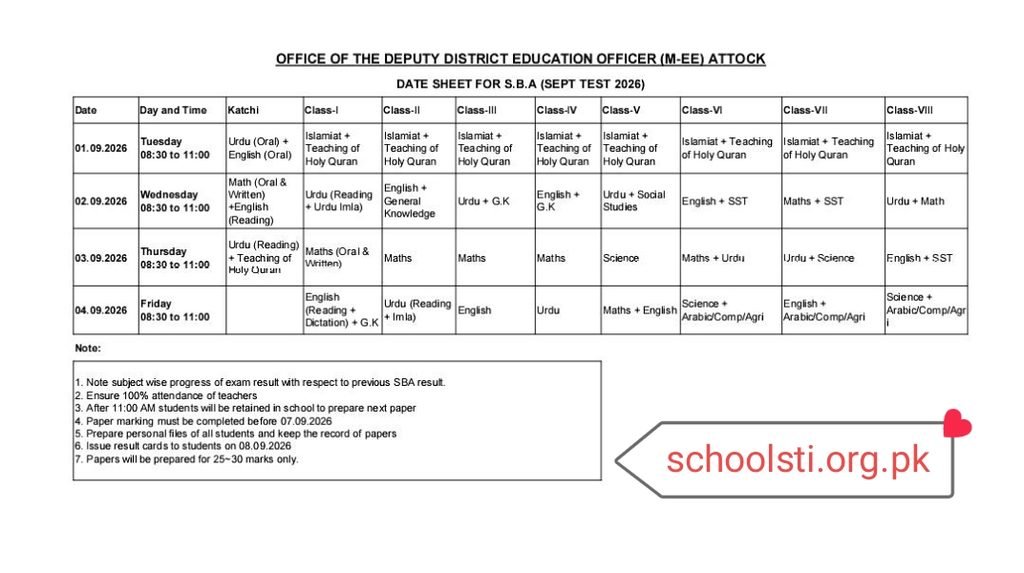
The Deputy District Education Officer (M-EE) Attock has officially notified the School Based Assessment (SBA) September Test 2026 date sheet for Katchi through Class 8 across all general elementary and primary schools. Examinations run from September 1 to September 4, 2026, daily between 08:30 AM and 11:00 AM, carrying 25 to 30 marks per subject.
Every academic twelve months, the arrival of September brings a distinct buzz across state schools in Punjab. For elementary school headmasters and classroom teachers, the primary term assessment is not just another administrative routine. It represents the initial concrete reality check on how well students have absorbed the curriculum after the summer vacation break.
If you have spent any period managing a primary or elementary school in Punjab, you realize the frantic scramble that happens when official notifications drop. Printers run hot, query papers are generated through district portals, duty rosters gain pinned to notice boards, and teachers frantically review lesson plans to make sure no learner gets left behind.
The official notification issued by the Office of the Deputy District Education Officer (Male Elementary Education), Attock, lays down a evident, four-day examination framework for all elementary schools in the district. Let us walk through the exact schedule, dissect the seven mandatory departmental guidelines, and discuss practical, field-tested classroom strategies to ensure smooth execution, fair paper marking, and meaningful record keeping.
What is the Complete Class-Wise Date Sheet for Katchi to Class 8?
The examination timetable runs simultaneously across nine grade levels—from Katchi (Early Childhood Education) to Class VIII. Each exam session begins promptly at 08:30 AM and concludes at 11:00 AM.
Below is the full, official subject-wise date sheet as notified by the education authority:
| Date & Day | Time | Katchi | Class-I | Class-II | Class-III | Class-IV | Class-V | Class-VI | Class-VII | Class-VIII |
|---|---|---|---|---|---|---|---|---|---|---|
| 01.09.2026 |
(Tuesday) | 08:30 AM – 11:00 AM | Urdu (Oral) + English (Oral) | Islamiat + Teaching of Holy Quran | Islamiat + Teaching of Holy Quran | Islamiat + Teaching of Holy Quran | Islamiat + Teaching of Holy Quran | Islamiat + Teaching of Holy Quran | Islamiat + Teaching of Holy Quran | Islamiat + Teaching of Holy Quran | Islamiat + Teaching of Holy Quran |
| 02.09.2026
(Wednesday) | 08:30 AM – 11:00 AM | Math (Oral & Written) + English (Reading) | Urdu (Reading + Urdu Imla) | English + General Knowledge | Urdu + General Knowledge | English + General Knowledge | Urdu + Social Studies | English + Social Studies | Maths + Social Studies | Urdu + Mathematics |
| 03.09.2026
(Thursday) | 08:30 AM – 11:00 AM | Urdu (Reading) + Teaching of Holy Quran | Maths (Oral & Written) | Mathematics | Mathematics | Mathematics | General Science | Maths + Urdu | Urdu + General Science | English + Social Studies |
| 04.09.2026
(Friday) | 08:30 AM – 11:00 AM | Activity Review / Spoken Practice | English (Reading + Dictation) + G.K | Urdu (Reading + Imla) | English | Urdu | Maths + English | Science + Arabic / Computer / Agri | English + Arabic / Computer / Agri | Science + Arabic / Computer / Agri |
What are the Key Departmental Guidelines Issued by Dy. DEO Attock?
The official notification contains seven binding operational directives printed directly beneath the timetable. These rules are designed to maintain academic integrity, ensure uniform assessment standards, and turn test data into actionable classroom interventions.
1. Tracking Subject-Wise Progress Against Baseline Data
The notification explicitly instructs teachers to record and analyze subject-wise progress with respect to previous SBA results. This means the September test cannot be treated as an isolated event. Teachers must pull out the diagnostic or previous term records, identify persistent learning deficits (particularly in foundation subjects like Mathematics and English literacy), and see whether student competencies have improved or stagnated.
2. Ensuring 100% Attendance of Teaching Staff
Supervisory staff and classroom teachers are prohibited from taking casual leave during the four-day test window without prior emergency approval from the competent authority. Full teacher presence is necessary to maintain proper invigilation ratios, conduct oral assessments for early graders, and back single-educator or low-staffed primary sections.
3. Pupil Retention After 11:00 AM for Next-Day Preparation
One of the most practical directives is that students must not be dismissed at 11:00 AM when the paper ends. Instead, children must stay in institution until the standard closing duration. This post-exam block is dedicated entirely to guided revision, issue-solving, and concept drilling for the subjects scheduled on the following morning.
4. Paper Marking Deadline: September 7, 2026
All response sheets must be evaluated within 72 hours of the final paper. Marking must adhere strictly to standard response keys and rubrics. Setting the marking deadline for September 7 ensures that teachers do not carry backlogs into regular teaching days.
5. Compulsory Maintenance of Student Personal Files
Every pupil enrolled in administration primary and elementary schools must have an individual portfolio or personal assessment file. Evaluated solution sheets, oral assessment rubrics, and diagnostic sheets from this September test must be placed inside these physical folders. Monitoring officers (MEAs) and AEOs frequently inspect these files during routine institution visits.
6. Official Result Card Distribution on September 8, 2026
Schools are required to prepare official consequence cards and hand them over to students and parents on September 8, 2026. This creates immediate parental engagement and transparency regarding learner academic performance.
7. Total Paper Weightage: 25 to 30 Marks Only
Unlike annual exams that carry 100 marks or terminal exams with 50 marks, the September SBA test is a focused periodic check carrying 25 to 30 marks per subject. This allows teachers to test high-priority Student Learning Outcomes (SLOs) without overburdening young learners with lengthy query papers.
How are SBA September 2026 Papers Generated on the PEC Item Bank Portal?
Assessment papers for authority schools in Punjab are standardized through the Punjab Examination Commission (PEC) via the centralized Item Bank System (IBS). The IBS portal allows school heads to generate customized, secure, and curriculum-aligned inquiry papers using unique academy login credentials.
If you are logging into the portal to download inquiry sheets, follow this sequence:
- Access the Official IBS Portal: Navigate to the verified PEC Item Bank System Portal using your school’s unique EMIS code and designated password.
- Select Grade and Subject: Choose the target class (Class 1 through Class 8) and the corresponding subject from the dropdown menu.
- Configure the 25–30 Marks Blueprint: Ensure the paper configuration matches the notified short-assessment weightage. For most subjects, this consists of a balanced mix:
- Multiple Choice Questions (MCQs): Typically 10 to 12 items assessing knowledge and basic comprehension.
- Constructed Response Questions (CRQs): 2 to 3 short structured questions testing application and problem-solving.
- Download Question Papers and Answer Keys: Generate the unique paper version (Version A, B, or C) along with the corresponding scoring rubrics and marking keys.
- Secure Printing and Photostat: Keep printed bundles sealed in the Head Teacher’s office until the morning of the exam.
For up-to-date policy notifications, staff tracking guides, and educational circulars, institution administrators regularly consult the Schools STI Portal alongside official directives from the Punjab School Education Department.
[ACCESS PEC ITEM BANK SETUP (IBS) PORTAL]
Link: https://www.pecassessment.com/
(Use Registered School EMIS Code & Password to Generate Papers)
How Should Teachers Structure Oral and Written Exams for Early Graders?
Conducting assessments for Katchi, Class 1, and Class 2 requires patience and a completely distinct pedagogical touch compared to senior classes. Young children get easily anxious when handed printed assessment sheets.
Assessing Katchi (ECE)
- Urdu & English Oral (Day 1): Focus on phonetic recognition, letter naming, identifying familiar everyday objects (e.g., animals, fruits, classroom objects), and reciting short nursery rhymes. Keep interactions conversational and stress-no-cost.
- Math & English Reading (Day 2): Use physical objects like counters, blocks, or flashcards for counting from 1 to 10. Check whether the child can recognize simple shapes and spot sight words.
- Teaching of Holy Quran (Day 3): Listen to basic recitation of Noorani Qaida letters, right pronunciation of Arabic alphabets (Makharij), and short daily supplications (Duas).
Assessing Class 1 and Class 2
- Reading & Imla (Dictation): Grade 1 and 2 students frequently struggle with speed. Review out dictation words clearly, repeating each word twice with natural pronunciation rather than rushing through.
- General Knowledge & Science: Encourage students to express understanding in their own plain sentences rather than penalizing minor spelling slips on factual questions.
How Can Head Teachers Manage the Post-11:00 AM Revision Sessions?
The third guideline from the Dy. DEO notification—retaining students after 11:00 AM to prepare for the next day’s paper—is arguably the most impactful part of the day if managed strategically. However, if left unstructured, students quickly lose focus, gain restless, and end up simply waiting for the final bell.
Here is a tested three-phase timetable to build the post-exam hours genuinely productive:
+-------------------+---------------------------------------------------------+
| Time Slot         | Academic Activity & Focus Area                          |
+-------------------+---------------------------------------------------------+
| 11:00 AM - 11:30 AM| Break, Hydration, and Light Snack Time                  |
| 11:30 AM - 12:30 PM| Board Work & Core Concept Review (Next Day Subject 1)   |
| 12:30 PM - 01:15 PM| Peer Practice & Quick Quiz Drills (Next Day Subject 2)  |
| 01:15 PM - Closing | Targeted Assistance for Struggling Learners             |
+-------------------+---------------------------------------------------------+
Practical Tips for Effective Retention Classes:
- Avoid Monotonous Lectures: After sitting through a 2.5-hour exam, children cannot absorb dry, hour-long lectures. Use interactive quizzes, pair labor, and white-board exercises.
- Target the 25–30 Marks Framework: Review the precise SLOs that commonly appear in PEC item banks. Highlight key definitions, recurring formulas, and standard short-solution formats.
- Focus on At-Risk Students: Group students who struggled during the morning paper and pair them with stronger peers or offer direct 1-on-1 teacher guidance.
What is the Correct Protocol for Paper Marking and Rubric Verification?
With the paper marking deadline fixed for September 7, 2026, teachers must handle evaluation systematically to eliminate subjective grading errors.
[Paper Conducted] ---> [Collect & Count Scripts] ---> [Apply PEC Rubric / Marking Key]
                            |
                            v
[Calculate Total (25-30 Marks)] ---> [Enter Scores into Award Lists] ---> [Place in Student Files]
Step-by-Step Marking Workflow:
- Count and Reconcile Scripts: Immediately after 11:00 AM, the invigilator must tally the total answer scripts against the learner attendance register.
- Follow the Standard PEC Scoring Key: Use the official rubric provided with the downloaded IBS paper. For CRQs (Constructed Response Questions), award partial credit based on step-wise performance rather than an all-or-nothing approach.
- Double-Check Mark Additions: Calculation errors on award lists are one of the most typical oversights identified during departmental audits. Invariably recount sub-totals before finalizing the front-page score.
- Draft the Master Award List: Enter marks clearly into the school’s central assessment register, categorizing scores by subject, roll number, and gender.
How to Maintain Student Assessment Personal Files According to Departmental Standards?
Creating and updating learner personal files is a non-negotiable compliance requirement across Punjab’s education framework. These portfolios provide tangible proof of continuous learning and diagnostic tracking.
An ideal student portfolio folder should contain:
- Student Profile Sheet: Name, Father’s Name, B-Form number, SIS enrollment ID, blood group, and emergency contact.
- Baseline / Diagnostic Assessment Data: Previous term results or entrance assessment records showing initial competency levels.
- Marked SBA September Test Papers: The original, teacher-evaluated reply scripts from the September 1–4 test series.
- Progress Tracking Tracker: A plain single-page chart showing subject-wise percentage gains or drops.
- Duplicate Copy of Issued Result Card: A signed copy of the final report card issued on September 8, 2026.
Keep these physical folders organized alphabetically by class in a secure, accessible cabinet in the staff room or head instructor’s office for immediate presentation during supervisory inspections.
How to Prepare and Distribute Official SBA Result Cards on September 8, 2026?
The culmination of the assessment cycle takes site on September 8, 2026, when schools distribute progress reports. A well-organized result distribution day builds robust trust between the institution and the local community.
Best Practices for Result Day:
- Host a Focused Parent-Teacher Meeting (PTM): Invite parents to visit the school between 09:00 AM and 12:00 PM. Hand over the outcome card in person rather than merely sending it home with the pupil.
- Discuss Concrete Strengths and Weaknesses: Show parents the actual marked solution sheets from the learner’s personal file. Point out specific areas where the child needs home support, whether in Urdu handwriting, English spelling, or basic arithmetic operations.
- Collect Parent Signatures: Ensure the parent signs the counter-foil or attendance sheet confirming receipt of the result card.
What are the Most Common Administrative Mistakes to Avoid During SBA 2026?
Over years of managing institution exams, certain recurring operational mistakes tend to disrupt the evaluation process. Being mindful of these pitfalls saves valuable time:
- Printing Mismatched Paper Versions: Distributing question papers without checking whether the corresponding marking key matches that exact version.
- Neglecting Oral Assessments for Katchi to Class 2: Treating early-grade exams like conventional written tests instead of conducting structured oral interviews.
- Failing to Reconcile Attendance Registers: Missing absentees on day one, leading to confused roll-call numbers and inaccurate award lists later.
- Delaying Paper Marking: Postponing evaluation until the weekend, resulting in rushed marking right before the September 7 deadline.
- Treating Retention Time as Idle Time: Allowing students to sit without guided revision after 11:00 AM, which defeats the core purpose of Directive 3.
Frequently Asked Questions (FAQs) About SBA September Test 2026
What is the total marks breakdown for the September SBA Test 2026?
The September SBA test papers are prepared for a total weightage of 25 to 30 marks per subject, combining Multiple Choice Questions (MCQs) and short Constructed Response Questions (CRQs) based on PEC item bank guidelines.
When will the SBA September 2026 results be announced?
As per the official notification issued by the Deputy DEO (M-EE) Attock, official effect cards must be prepared, verified, and issued to students on September 8, 2026.
Can teachers take casual leave during the SBA examination days?
No. The notification mandates 100% attendance of teaching staff from September 1 to September 4, 2026. Leaves are strictly restricted to unavoidable medical emergencies subject to formal departmental permission.
Why are students retained in academy after 11:00 AM during exams?
Students are retained after 11:00 AM to participate in structured, instructor-led revision sessions for the next day’s scheduled papers, ensuring focused academic preparation and minimizing exam anxiety.
Are confidential schools required to follow this exact date sheet?
While this exact date sheet is issued for open elementary schools under the jurisdiction of the Deputy DEO (M-EE) Attock, registered confidential institutions in Punjab generally align their internal assessments with PEC curriculum frameworks and SED academic calendars obtainable on Punjab SED Official Notifications.
Summary Checklist for School Heads and Teachers
Before commencing the examination cycle on September 1, verify that your institution has completed the following checklist:
- Question papers generated, printed, and securely stored for all classes (Katchi to Class 8).
- Daily invigilation duty roster finalized and signed by all staff members.
- Seating arrangements and room allocations clearly numbered.
- Bell schedule configured for 08:30 AM begin, 11:00 AM paper conclusion, and subsequent revision periods.
- Blank master award lists and pupil personal file folders pre-arranged.
- Stationery, extra writing sheets, and marking rubrics distributed to evaluators.
- Parent communication sent out regarding the Result Card distribution scheduled for September 8, 2026.
Author Bio:
Majid Farooq is a seasoned educator, educational technologist, and digital platform administrator working with the Government School Education Department in Punjab, Pakistan. With over a decade of hands-on experience in public academy administration, curriculum implementation, and exam management, he writes comprehensive, practical guides for teachers, headmasters, and students navigating Punjab’s academic systems.
Last updated: August 30, 2026